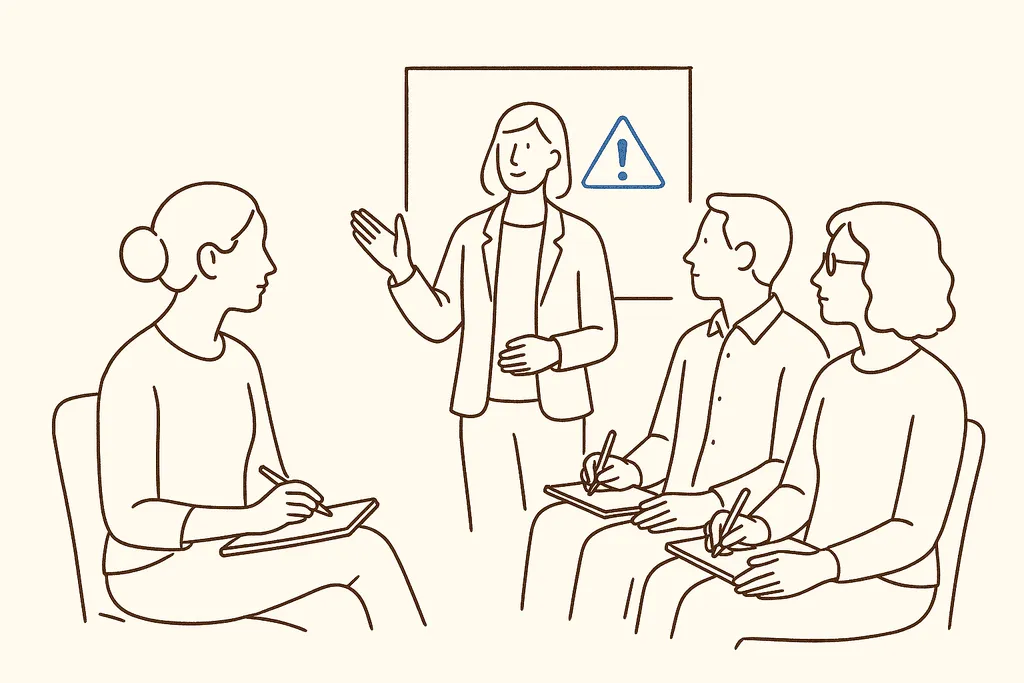
Teaching the adults around a teen to recognize warning signs and respond builds a wider, earlier safety net.
- Training equips the adults already in a teen's life to notice trouble sooner.
- Knowing a simple action plan lets you respond calmly instead of freezing.
- The clearest evidence is for changes in the adults — more knowledge, more confidence, less stigma.
- Sharing the training across parents, coaches, and school staff widens the net around a teen.
The situation, the move, the outcome.
Youth Mental Health First Aid (YMHFA) trains the adults who interact with teens — parents, school staff, coaches — to recognize the signs of a mental-health challenge or crisis and to follow a clear five-step action plan that connects a young person to help. Systematic reviews find consistent results: trained adults gain mental-health knowledge, feel more confident stepping in, and hold less stigma, with gains that hold at follow-up.
In practice the training gives ordinary adults two things they often lack in the moment: the ability to recognize that something may be wrong, and a clear, ordered plan for what to do next so they connect a teen to help instead of hesitating. Because the people being trained — parents, teachers, coaches — are already woven into teens' daily lives, the recognition can happen early, before a struggle escalates. The documented gains are in those adults: they come away knowing more, feeling more confident about stepping in, and carrying less stigma, and those shifts tend to stick. The honest framing is that this builds a more capable circle of grown-ups, which is the foundation a young person leans on.
Why it matters beyond one family.
The honest limit: the strong evidence is for changes in the adults — knowledge, confidence, stigma. Whether that ultimately improves outcomes for teens themselves needs more study. Still, more capable, willing adults is a sturdy foundation.
This generalizes because mental-health challenges in teens are most often first noticed by the non-specialists around them, not by clinicians, so equipping those everyday adults extends the reach of help. The same training logic applies whether the trained adult is a parent at home, a teacher in a hallway, or a coach at practice — more prepared adults means more places a teen might be caught before they fall far. It's also additive rather than competing: capable adults sit naturally alongside crisis lines and professional care, filling the space between 'seems fine' and 'clear emergency.' The measured takeaway is that the strong evidence so far is about better-prepared adults, and a wider, earlier-acting safety net is a sturdy thing to build even as research on teen outcomes continues.
- Courses are often offered free locally, so the training is realistically within reach.
- Trained adults consistently gain knowledge and confidence and carry less stigma, which holds over time.
- It builds capability before a crisis rather than scrambling during one.
- It complements crisis lines, giving everyday adults a role between 'fine' and 'emergency.'
How to apply it.
- Consider taking a YMHFA course — many are offered free locally.
- Encourage your teen's school to train staff in recognizing warning signs.
- Learn the basic action plan so you can respond calmly and route to help.
There's a free Youth Mental Health First Aid class at the library Saturday — I'm thinking of going.
Why? I'm not falling apart or anything.
I know. It's not about you specifically — I just want to know what to do if any kid around me is struggling.
Isn't that kind of the school counselor's job?
Partly. But the more adults who can spot it early, the less anyone has to handle it alone.
I guess that makes sense. Coach Ramirez would probably be good at that too.
Good point — I'll mention it to him. Honestly I'd rather learn this and never need it.
Fair. Just don't start diagnosing all my friends, okay?
Promise. Listening, not diagnosing — that's actually the whole idea.
Concrete next steps.
- Find a course via MentalHealthFirstAid.org or local providers.
- Share the training with other parents and coaches in your circle.
- Pair adult training with crisis numbers (988, 741741) everyone knows.
Read it for yourself.
If your teen is in crisis: call or text 988 (Suicide & Crisis Lifeline, 24/7) or text HOME to 741741. For immediate danger, call 911.