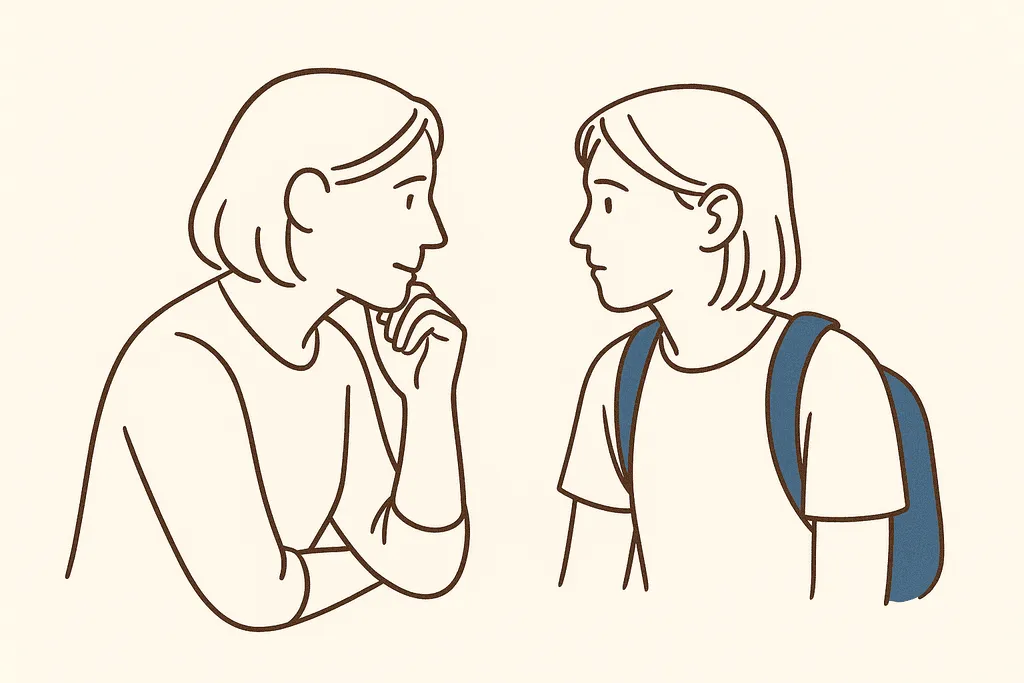
You don't need a program — being the one adult who helps, pays attention, and believes in your teen is itself a powerful protective factor.
- What makes the bond protective is concrete — helping, paying attention, and showing belief out loud.
- Small, frequent check-ins do more than rare, heavy conversations.
- If you can't be that steady adult right now, connecting your teen to one who can still helps.
- Saying you believe in their future, not just thinking it, is part of the protective effect.
The situation, the move, the outcome.
Decades of research point to a strikingly simple protective factor: a young person who has at least one caring, trusted adult — at home, at school, or in the community — is significantly less likely to attempt suicide. What makes the relationship protective is concrete and learnable: helping (with homework or problems), concern (knowing where they are and who they're with), and visible belief that they will succeed. CDC's 2023 youth data echoes that adult connectedness lowers a whole range of risk indicators.
In practice the protective bond isn't an abstraction; it's built from ordinary, repeatable acts — pitching in with a problem or assignment, knowing where a teen is and who they're with, and saying plainly that you believe they'll be okay. A teen who experiences that steadiness has someone to turn to before a hard moment hardens into a crisis. The everyday version usually looks like brief, reliable check-ins woven into drives, meals, and bedtimes rather than one dramatic talk. What carries the weight is that the warmth and belief are dependable, so the teen learns the door is always open.
Why it matters beyond one family.
It's the most empowering finding in the field for parents: you don't need a program or a budget. Reliable warmth, attention and belief from one adult is itself a powerful intervention.
This generalizes because the protective effect lives in the relationship itself, not in any credential or setting — which is why a parent, a relative, a coach, or a teacher can all fill the role. The ingredients are deliberately ordinary and learnable, so an adult who isn't sure they're 'doing it right' can still grow into being that person. It also scales: surrounding a teen with several caring adults means the net doesn't depend on one relationship being perfect on any given day. The empowering bottom line is that reliable attention and belief from at least one trusted adult is itself a serious intervention, with crisis lines standing by as the backstop rather than the first line of defense.
- The most powerful protective factor here is something a parent can simply be — no program or budget required.
- The protective ingredients are learnable, so any committed adult can grow into the role.
- It can be shared across a circle of trusted adults, widening the safety net beyond one person.
- It pairs naturally with crisis resources, so connection and a clear backstop reinforce each other.
How to apply it.
- Be consistently available — small, regular check-ins beat big talks.
- Show interest in their world and confidence in their future, out loud.
- If you can't be that adult right now, help connect them to one who can.
I noticed you've been pretty quiet this week. I'm not prying — just here if you want me.
I'm okay. It's just been a lot.
A lot how? I've got time, and nothing you say is going to scare me off.
Everything feels kind of pointless lately. I don't really know why.
Thank you for telling me that — it takes guts. I'm really glad you did.
You're not going to freak out?
No. I'm staying right here with you on this. We can figure out the next step together.
Okay. I don't want it to be a big thing.
It doesn't have to be. For tonight, you're not carrying it alone — that's the only thing I need you to know.
Concrete next steps.
- Protect daily low-pressure moments to talk (drives, meals, bedtime).
- Strengthen ties to other caring adults — relatives, coaches, teachers, mentors.
- Keep 988 visible as the backstop, but know connection is the prevention.
Read it for yourself.
If your teen is in crisis: call or text 988 (Suicide & Crisis Lifeline, 24/7) or text HOME to 741741. For immediate danger, call 911.