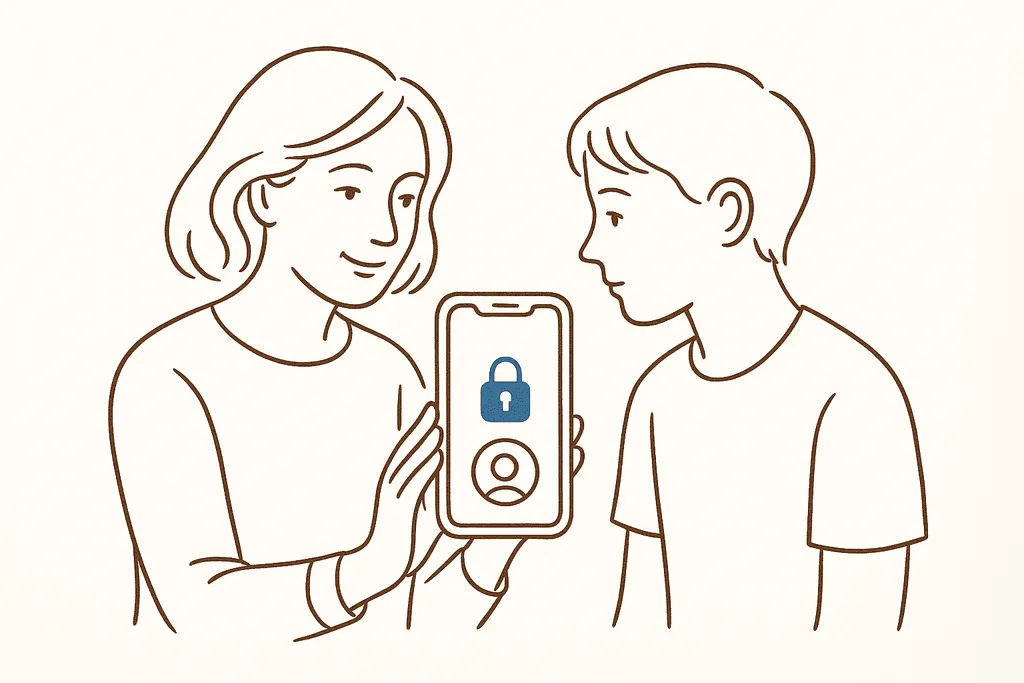
Safer-by-default beats hoping teens find the settings — Instagram now starts under-18s in private, restricted accounts.
- Defaults do the heavy lifting, because most teens never open the settings menu.
- Use the change as a conversation starter, not a fix you can set and forget.
- Keep the under-16 locks in place and loosen them gradually as your teen matures.
- Pair platform settings with family norms — the tools work best with talk, not instead of it.
The situation, the move, the outcome.
In September 2024, under intense scrutiny, Meta launched Instagram Teen Accounts. Under-18s are placed by default into private accounts (they must approve every follower), put into the strictest messaging settings so only people they follow can message them, and limited to the most restrictive sensitive-content filter. Teens under 16 need a parent's permission to loosen any of these. Meta rolled it out first across the US, UK, Canada and Australia, then globally.
The reason a default change is so powerful in practice is behavioral: the overwhelming majority of teens use whatever setting they're handed, so moving the safe choice to the starting point quietly protects everyone who never digs into a menu. Layering the strictest messaging, privacy, and content filters together closes several common entry points for harm at the same time. Requiring a parent's permission for younger teens to loosen anything keeps an adult in the conversation at exactly the ages where it matters most. Families get the most from it by confirming the account is set up correctly and treating it as the floor, not the ceiling.
Why it matters beyond one family.
Critics argue it doesn't go far enough and that enforcement leans on imperfect age detection. But the direction matters: moving the safe option to the default, rather than burying it in settings, protects the many teens who never change defaults.
This generalizes into a broader principle of online safety: design beats willpower. When the protective option is buried in settings, only the most diligent families ever find it; when it's the default, it reaches the many who don't. That's why the direction matters even though enforcement leans on imperfect age detection and critics say it could go further. The lesson for parents extends past Instagram — wherever a platform offers a safer default, accepting it costs little, and wherever it doesn't, the same protections are usually worth setting up by hand. Defaults are powerful precisely because most people never change them.
- The safe option is now the starting point, which protects teens who'd never adjust it themselves.
- Private accounts and strict messaging limits address the most common risks at once.
- Younger teens need a parent's sign-off to loosen protections, keeping a parent in the loop.
- It rolled out broadly, so the protection isn't limited to a small pilot group.
How to apply it.
- Confirm your teen is in a Teen Account and set up parental supervision.
- Use the moment to discuss why private and restricted settings help.
- Don't rely on defaults alone — pair them with conversation and family norms.
Your Instagram should be set up as a Teen Account now — private, and only people you follow can message you. Can we look at it together?
It's already private, I don't need you in my settings.
I'm not trying to read your messages. I just want to make sure the protections are actually on and understand what they do.
Why does it even matter if randos can't message me?
Because the strangers who cause real trouble usually start with a message to someone who doesn't follow them. This just closes that door.
Okay, that's actually kind of reasonable.
And the under-16 stuff stays locked for now — not to control you, but we can revisit it as you get older.
Fine, as long as you're not lurking on my posts.
Deal. Supervision tools, not spying. If anything ever feels off in there, you come to me first.
Concrete next steps.
- Set up Instagram's parental supervision tools and review settings together.
- Keep under-16 settings locked and revisit as your teen matures.
- Combine with screen-time limits and a family media plan.
Read it for yourself.
Call or text 988 (Suicide & Crisis Lifeline, 24/7) · Text HOME to 741741 (Crisis Text Line) · Find a child psychiatrist at aacap.org · For immediate danger, call 911.