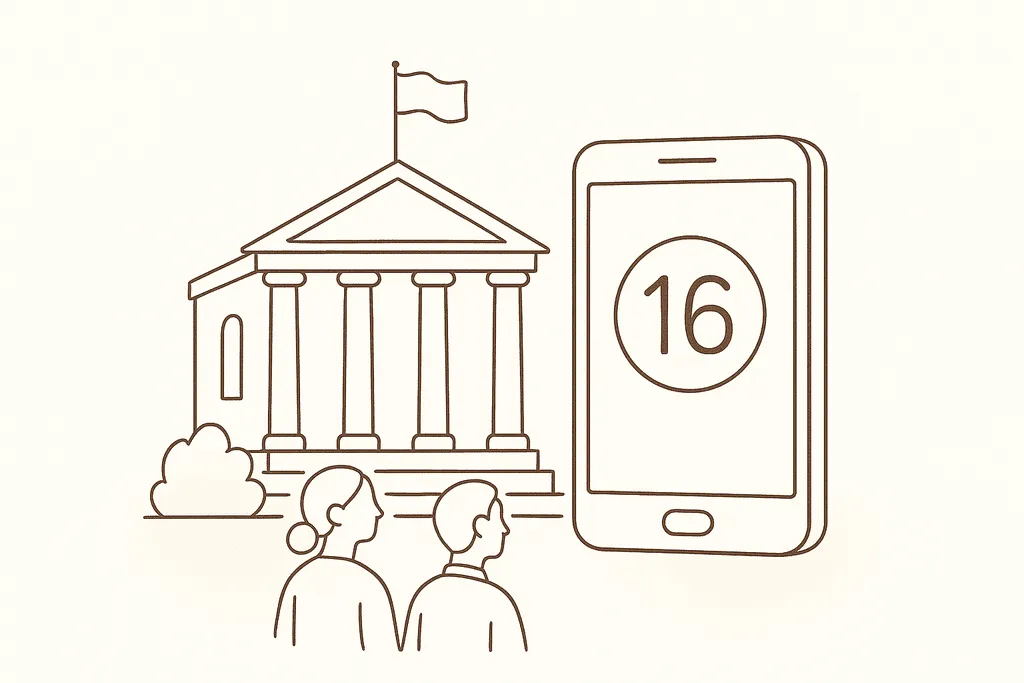
The first national age-16 rule puts responsibility on platforms, not kids — a precedent the world is now watching.
- Putting responsibility on platforms spares families and teens from carrying the whole burden alone.
- Even a strong law has gaps, so it works best layered with norms at home.
- A national debate about age limits is a natural opening to talk with your own teen.
- Watch how a real-world policy unfolds before assuming it will or won't work.
The situation, the move, the outcome.
On 29 November 2024, Australia passed the Online Safety Amendment (Social Media Minimum Age) Act — the first national law of its kind — and it took effect on 10 December 2025. The law requires platforms including Facebook, Instagram, TikTok, Snapchat, YouTube and others to take 'reasonable steps' to stop under-16s from holding accounts, with penalties up to A$49.5 million for failures. Critically, the penalties fall on the companies, not on young people or their families. Public support was strong, with a YouGov poll finding 77% of Australians backed the age limit.
In practice the law's most important move is where it places the obligation: companies must take reasonable steps to keep under-16s off their platforms, and the consequences for failing land on the companies. That flips the usual setup, in which keeping kids off a service depends on a family's vigilance or a teen's restraint. Early reporting makes clear the approach isn't airtight — determined teens find workarounds — so it functions as a strong design pressure rather than a perfect wall. The long-term outcome is still emerging, which is precisely why it's worth watching rather than declaring settled.
Why it matters beyond one family.
It's a bold, closely watched experiment. Early reporting shows enforcement is imperfect — some teens still find workarounds — so the long-term outcome is still emerging. But it shifts the design burden onto platforms and sets a precedent other governments are studying.
The reason this matters beyond one country is the principle underneath it: responsibility for online safety can be assigned to design and defaults instead of to individual willpower. Families can borrow that same logic at home by leaning on settings, defaults and shared rules rather than expecting a teen to resist a feed built to be hard to resist. Because the law is the first of its kind and closely watched, its successes and stumbles will shape how other governments think about age limits. The honest framing is that it's a bold experiment whose verdict is still being written.
- It's the first national law of its kind, shifting the design burden onto companies rather than children.
- Penalties for failure fall on the platforms, not on young people or their parents.
- Public backing for the age limit was strong, signaling broad agreement that something needed to change.
- Other governments are now studying it, so one country's experiment can inform many.
How to apply it.
- Watch how Australia's rollout unfolds; it's a real-world test of platform-side age limits.
- Don't outsource the whole job to law — pair any policy with family norms.
- Use the public debate as a conversation starter with your own teen.
Did you see Australia's banning social media for anyone under 16? That's so unfair to kids.
I did see that. What stood out to me is that the penalties land on the companies, not the kids. What do you think about that?
I guess that's better than punishing teens. But people will just get around it.
You're probably right that some will — the early reporting says enforcement isn't perfect. So it's not a magic fix on its own.
So what's the point then?
The point is it makes the platforms responsible for their design instead of leaving it all on families' willpower. We still set our own house rules on top of that.
Would you ever want a rule like that here?
I'm honestly still watching how it goes. Let's keep an eye on it together — I'd rather learn from a real test than guess.
Concrete next steps.
- Follow neutral explainers (e.g., UNICEF Australia) as evidence on the ban accumulates.
- Apply the principle at home: put responsibility on design and defaults, not willpower.
- Combine with delay pledges and family media plans for layered protection.
Read it for yourself.
Call or text 988 (Suicide & Crisis Lifeline, 24/7) · Text HOME to 741741 (Crisis Text Line) · Find a child psychiatrist at aacap.org · For immediate danger, call 911.