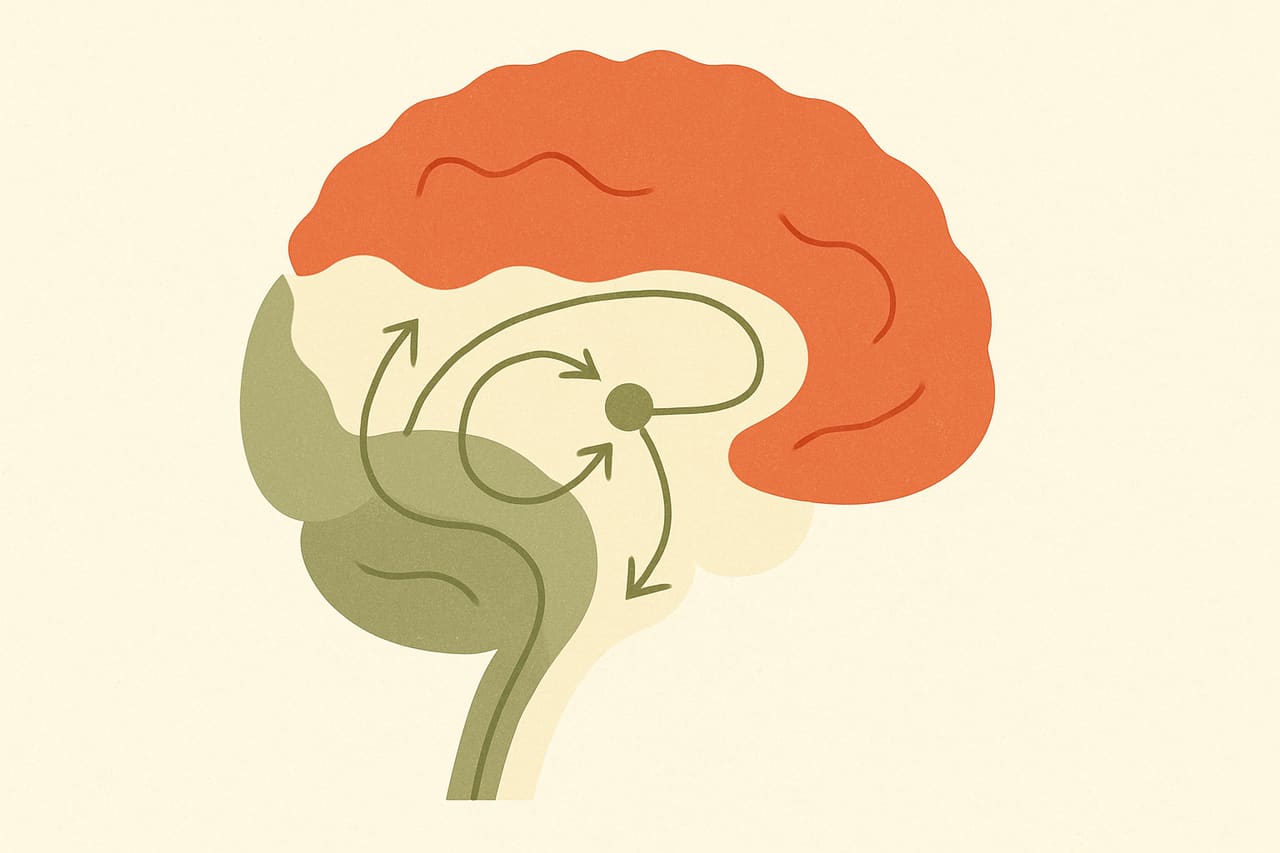
A flooded brain can't be reasoned with until it settles.
The short version.
'Flooding' is when stress hormones overwhelm the system and the thinking brain goes offline. In that state, a teen can't access logic, perspective, or your good advice. Pushing harder — 'just calm down and explain' — only adds threat and deepens the flood. The instinct to push harder in the moment is natural, but it only adds threat to a brain that's already overwhelmed.
What researchers actually find.
- Under high stress, blood flow and control shift away from the prefrontal cortex.
- Reasoning, memory, and language all degrade while flooded.
- Recovery takes time — often 20+ minutes after the trigger ends.
- During flooding, the body prioritizes survival over speech and logic — which is why words often fail entirely.
When a teen floods, their body has shifted into a survival mode that physically reprioritizes resources away from the slow, deliberate parts of the brain that handle reasoning, perspective, and language. In that state the request to 'calm down and explain' is asking for the exact functions that are temporarily offline — it's like asking someone to read fine print in the dark. Worse, a demand or a raised voice registers as more threat, which deepens the flood rather than ending it. The system can only stand down once it gets enough signals of safety and enough time; stress chemistry doesn't clear on command, and recovery commonly takes twenty minutes or more after the trigger stops. This is why the reasonable, regretful kid reappears an hour later — nothing about their character changed, only their physiology came back online. Knowing this reframes the moment from 'defiance to be overpowered' to 'a brain to wait out and steady.'
You might recognize this.
- Questions met with 'I don't know!' and more upset.
- Logic bouncing off until later.
- A totally different, reasonable kid an hour after the storm.
- A reasonable kid reappearing an hour later, sometimes embarrassed by what they said while flooded.
How to help.
- Pause the conversation; safety and calm first, problem-solving later.
- Drop the demands and the questions while they're flooded.
- Return to it once they've genuinely settled — then they can think.
- Agree on a 'we'll talk when we're both calm' signal ahead of time, so pausing doesn't feel like dismissal.
How this changes by age
Flooding often looks like a younger meltdown — tears, 'I don't know!', or shutting down completely. Keep it simple: fewer words, a safe space, and your calm presence until the wave passes.
Floods can get loud and door-slamming, and pushing for an explanation mid-storm reliably makes it worse. Drop the questions in the moment and circle back later, when the thinking brain is actually available.
Older teens may flood more quietly — going cold, leaving, or refusing to engage rather than exploding. Respect the pause and resist chasing them for a conversation until they've genuinely reset.
During a calm moment, agree together on a simple signal — a word or gesture — that either of you can use to mean 'we'll finish this when we're both calm.' Setting it up in advance keeps a mid-storm pause from feeling like you're dismissing or shutting them out.
Pausing a flooded conversation is not the same as dropping the issue or skipping consequences — you return to it once everyone can think, you just don't litigate it mid-flood. And while occasional flooding is normal, a teen who floods constantly, can't recover, or becomes unsafe to themselves or others needs more than time and patience; that's a signal to involve a professional.
This is a plain-words summary of well-established psychology — a map, not a diagnosis. If your teen is struggling in a way that worries you, a pediatrician or licensed mental-health professional is the right next step. In crisis: call or text 988 (Suicide & Crisis Lifeline, 24/7) · text HOME to 741741 · call 911 for immediate danger.