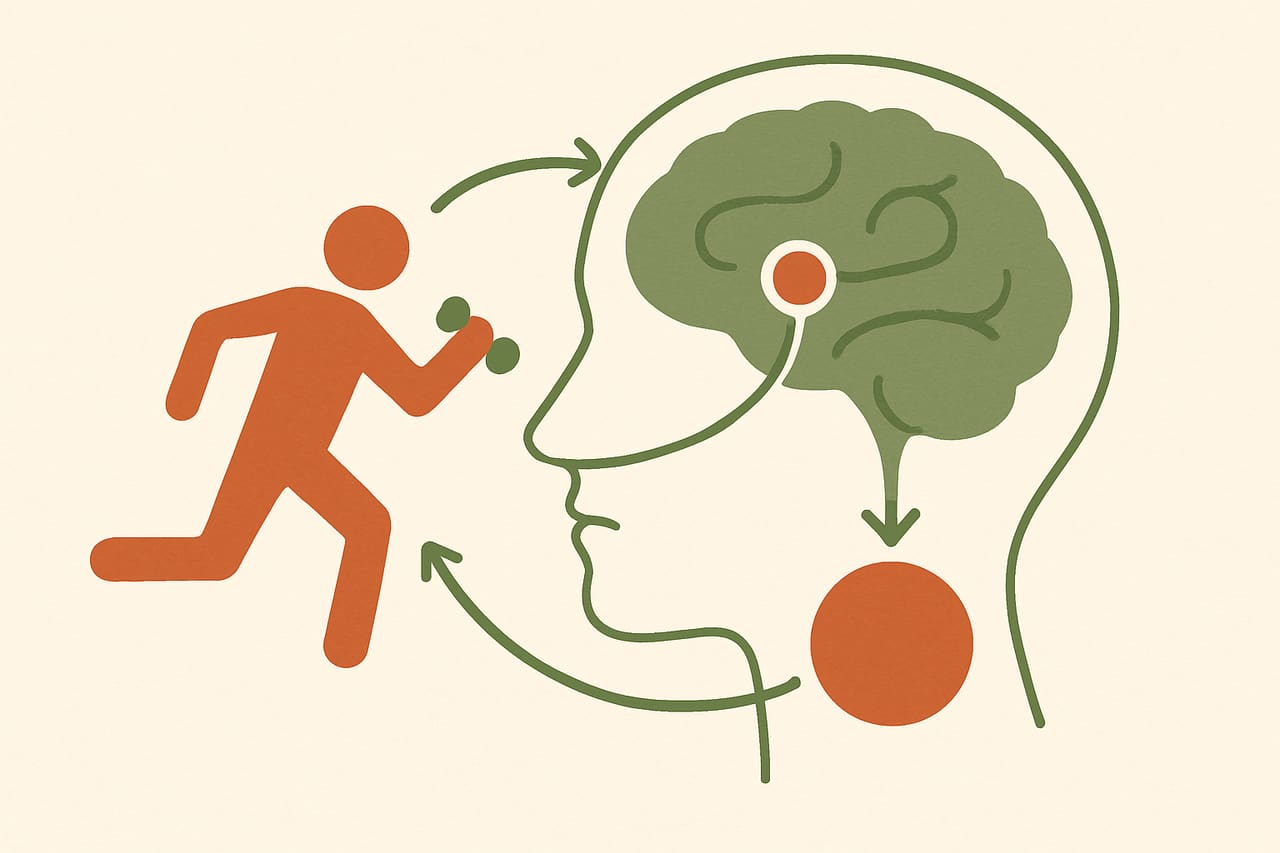
Self-regulation is learned, like a sport, through reps.
The short version.
Emotional regulation — noticing, naming, and managing feelings — is a learnable skill set, not a fixed personality trait. The teen years are prime practice time, because the brain regions involved are actively developing. Setbacks are part of the learning curve. Like any skill it improves with reps and good coaching — and stalls when every mistake is treated as a character flaw.
What researchers actually find.
- Regulation skills improve with deliberate practice and coaching.
- The brain circuitry for self-control is under active construction in adolescence.
- Teens who practice (and watch adults model) regulation get measurably better at it.
- Teens who watch the adults around them regulate calmly tend to pick up the same strategies.
Regulation isn't one ability but a chain of small steps — noticing a feeling is rising, naming it, pausing before acting, and choosing a response — and each link runs through brain circuitry that is still physically maturing in adolescence. The thinking, braking part of the brain comes online more slowly than the part that generates big feelings, so for years teens are essentially driving a powerful emotional engine with brakes that are still being installed. This is why the same teen can be remarkably composed one day and fall apart over something trivial the next: the skill exists but isn't yet automatic, so fatigue, hunger, or a full emotional load can knock it offline. Practice physically strengthens these pathways, which is why reps matter more than lectures — a teen gets better at pausing by actually pausing, many times, often badly at first. And because so much of this is learned by watching, the regulation they see modeled at home becomes part of the toolkit they reach for under pressure.
You might recognize this.
- Handling a setback gracefully one week, falling apart the next.
- Slowly getting better at catching themselves before exploding.
- Copying the coping styles they see at home — for better or worse.
- Slowly catching themselves earlier in a spiral than they used to.
How to help.
- Treat blow-ups as practice reps, not proof of character.
- Model the skills out loud: 'I'm frustrated, so I'm going to take a minute.'
- Coach specific tools — pausing, breathing, naming — and expect a learning curve.
- Debrief calmly after a blow-up: 'what could we try next time?' turns a bad moment into practice.
How this changes by age
Feelings can still arrive faster than words, so meltdowns may look 'young' for their size. The biggest help is a calm adult who narrates the process — 'you're really frustrated, let's take a breath' — giving them language and a model before expecting them to do it alone.
Emotions run especially hot here while the braking system lags furthest behind, so expect more frequent, more intense blow-ups even in a capable kid. Keep your own voice level during the storm and save the coaching for after — a calm debrief lands when a lecture mid-meltdown never will.
The skills are coming together and they can increasingly catch themselves, though stress and exhaustion still cause backslides. Treat them more like a partner — ask what strategies actually work for them and let them lead, since they'll soon be regulating entirely on their own.
The next time you feel your own frustration rising in front of your teen, narrate it out loud — 'I'm getting irritated, so I'm going to step away for a minute and come back.' You're showing them the exact skill you want them to learn, in real time.
A teen who melts down isn't failing or 'immature,' and good regulation doesn't mean never having big feelings — it means the feelings don't run the show every time. Progress is bumpy and non-linear by nature, so a bad week after a good month isn't a sign the skill is slipping away.
This is a plain-words summary of well-established psychology — a map, not a diagnosis. If your teen is struggling in a way that worries you, a pediatrician or licensed mental-health professional is the right next step. In crisis: call or text 988 (Suicide & Crisis Lifeline, 24/7) · text HOME to 741741 · call 911 for immediate danger.