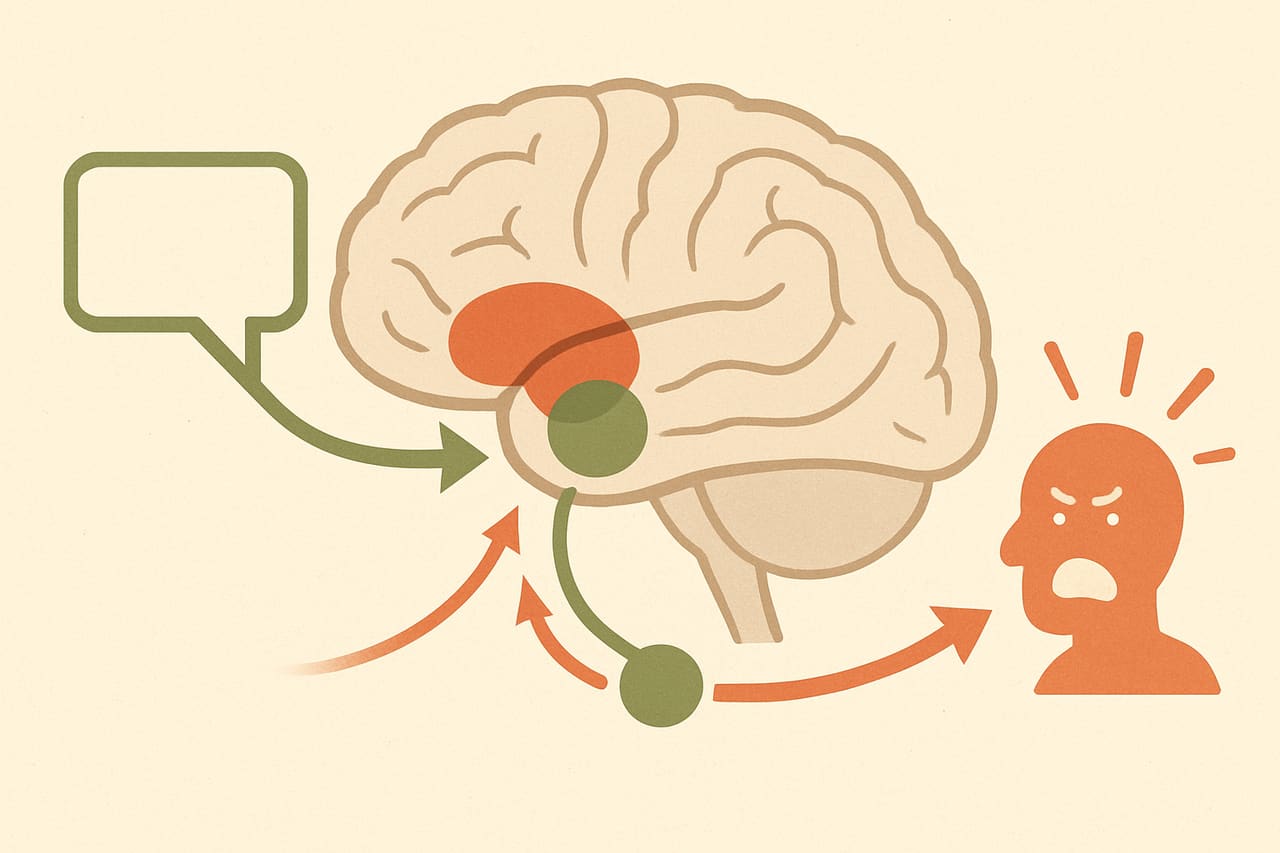
Words turn down the volume on big emotions.
The short version.
'Affect labeling' is the finding that naming an emotion ('I'm anxious about the test') reduces activity in the brain's alarm center and engages the thinking brain. For teens whose feelings run hot, vocabulary is a regulation tool. It's a skill that compounds: the more precise their emotional vocabulary, the faster they can settle themselves.
What researchers actually find.
- Labeling an emotion dampens amygdala activity and recruits prefrontal regions.
- Teens with richer emotional vocabularies regulate better.
- It works even when the labeling is simple and brief.
- Brain scans show that simply labeling a feeling shifts activity from the alarm center toward the thinking brain.
Naming a feeling works because language and raw emotion are handled by partly different brain systems, and engaging the verbal, thinking system seems to take some of the charge out of the emotional alarm system. When a feeling stays wordless, it floods the body as pure sensation — a racing chest, a clenched jaw — with nothing to contain or direct it. Translating that into 'I'm nervous about the game and a little angry I got benched' converts an overwhelming blob into something with edges, a cause, and therefore a handle. The act of labeling shifts a teen from being inside the emotion to observing it, and that small step back is itself regulating. This is a trainable skill, not a fixed trait: the more specific words a teen has for inner states, the faster and finer their self-soothing becomes over time. That's why building emotional vocabulary in calm moments pays off most in the hard ones.
You might recognize this.
- A meltdown that eases once they can say what's actually wrong.
- Difficulty explaining feelings beyond 'fine' or 'whatever.'
- Calmer after talking, even when nothing got solved.
- A storm that loses its force the moment they manage to say 'I'm just really overwhelmed.'
How to help.
- Offer words: 'Sounds like you're frustrated and a little embarrassed?'
- Don't rush to fix — labeling itself is the help.
- Build the vocabulary over time; more precise words mean better control.
- Model it yourself — narrate your own feelings in plain words so they hear it done.
How this changes by age
At this age feelings often come out as behavior — a slammed door, tears, 'I'm fine' — because the words aren't there yet. Offer simple labels ('looks like that felt unfair?') and a small feelings vocabulary, treating it like teaching any other skill.
Emotions run hot and fast, and teens may resist a parent putting words in their mouth. Offer a tentative guess and leave room to be corrected ('frustrated, or more embarrassed?'), since being slightly wrong still invites them to find the right word themselves.
Many can name feelings well but skip the step when overwhelmed or guarding privacy. Model it in your own life out loud and trust them to do their own labeling, sometimes in a journal or to a friend rather than to you.
Next time your teen is upset, resist fixing the problem and instead offer one gentle, specific guess at what they're feeling — 'sounds like you're frustrated and maybe a little let down?' — then let them correct you. The goal is to help them land on the right word, not to be right yourself.
Labeling lowers the intensity of a feeling; it doesn't erase the feeling or solve what caused it, and a calmer teen may still need the underlying problem addressed. It also won't reach a teen who is fully flooded — wait until the storm has passed before reaching for words.
This is a plain-words summary of well-established psychology — a map, not a diagnosis. If your teen is struggling in a way that worries you, a pediatrician or licensed mental-health professional is the right next step. In crisis: call or text 988 (Suicide & Crisis Lifeline, 24/7) · text HOME to 741741 · call 911 for immediate danger.