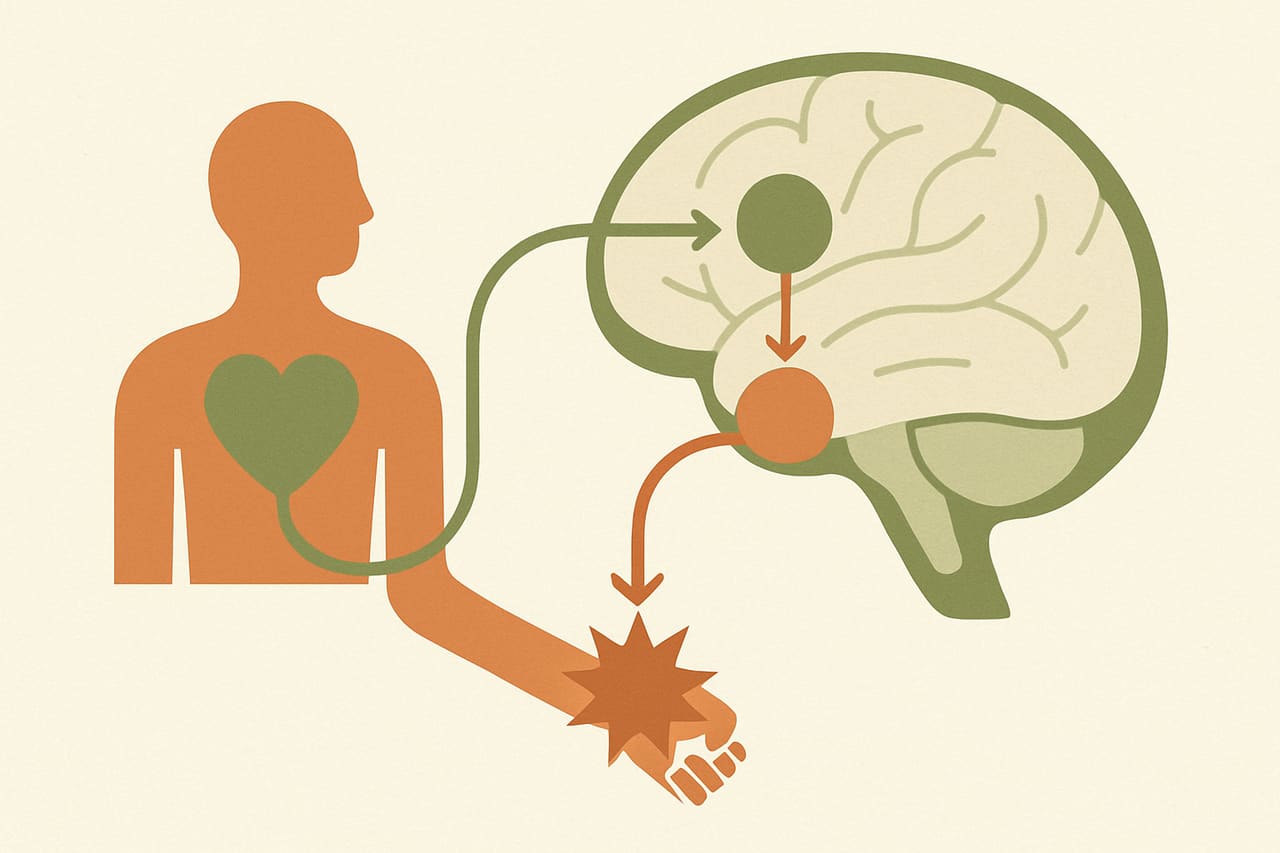
The brain processes social rejection in pain circuitry.
The short version.
Studies of social exclusion show that being rejected activates brain regions also involved in physical pain. For teens — wired to care intensely about belonging — exclusion genuinely hurts. 'Why are you so upset, it's just a group chat?' misses the biology. Knowing this changes the response: you wouldn't tell a kid with a broken arm to 'just get over it,' and the same logic applies here.
What researchers actually find.
- Social rejection activates the same neural alarm system as physical pain.
- Adolescents are especially sensitive to exclusion; the social brain is in overdrive.
- The pain of being left out can disrupt sleep, appetite, and concentration.
- In experiments, a dose of plain pain reliever even slightly dulled the sting of social rejection — a hint at how literally the brain treats it.
The overlap between social and physical pain isn't a metaphor — it reflects the brain's deep history. For social animals, being cut off from the group was once a genuine survival threat, so evolution wired the alarm of exclusion into circuitry that overlaps with the system that flags bodily injury. That's why rejection can feel like a punch to the gut: the brain is using some of the same machinery to say 'something is wrong, fix this now.' In adolescence this system runs especially hot, because the teen brain is tuned to prize belonging and read social standing intensely, making every slight or silence feel amplified. The same circuitry that drives the hurt also drives the urge to monitor and repair the bond, which is why an excluded teen can't simply look away from the group chat. Understanding this reframes the response: their distress is a real alarm doing its job, not drama to be argued out of.
You might recognize this.
- Devastation over being left off an invite or a group chat.
- Obsessive checking to see what they missed.
- Physical complaints — stomachaches, headaches — around social stress.
- A single unanswered message ruining an entire evening.
How to help.
- Validate first: 'That really hurts' before any problem-solving.
- Don't minimize ('it's not a big deal') — to their brain, it is.
- Help them widen their social base so no single group holds all the power.
- Treat exclusion as a real injury that needs comfort first and problem-solving later.
How this changes by age
Friendships are concrete and shifting, and a single 'you're not my friend anymore' can feel like the end of the world. Take the hurt seriously and help them see that friendships at this age change often, so one rupture isn't the whole picture.
Belonging peaks in importance and group chats make exclusion visible and constant, so being left off an invite can dominate a whole night. Validate the sting first, then quietly help them build more than one social circle so no single group holds all the power.
Rejection now includes dating, shifting friend groups, and online reputation, and they're better able to talk it through. Be the steady sounding board — comfort first, then help them think about who deserves their energy — rather than rushing to fix it.
Next time they're crushed by being left out, lead with 'That really hurts — I'd be upset too,' and just sit with it for a few minutes before offering any advice; naming the pain as real does more than any reassurance that it doesn't matter.
That rejection registers like physical pain explains why it hurts so much; it doesn't mean a teen should be shielded from every social sting, which is part of how they build resilience. Comfort the genuine wound, but the goal is to help them recover and widen their world — not to treat all discomfort as an injury to be prevented.
This is a plain-words summary of well-established psychology — a map, not a diagnosis. If your teen is struggling in a way that worries you, a pediatrician or licensed mental-health professional is the right next step. In crisis: call or text 988 (Suicide & Crisis Lifeline, 24/7) · text HOME to 741741 · call 911 for immediate danger.