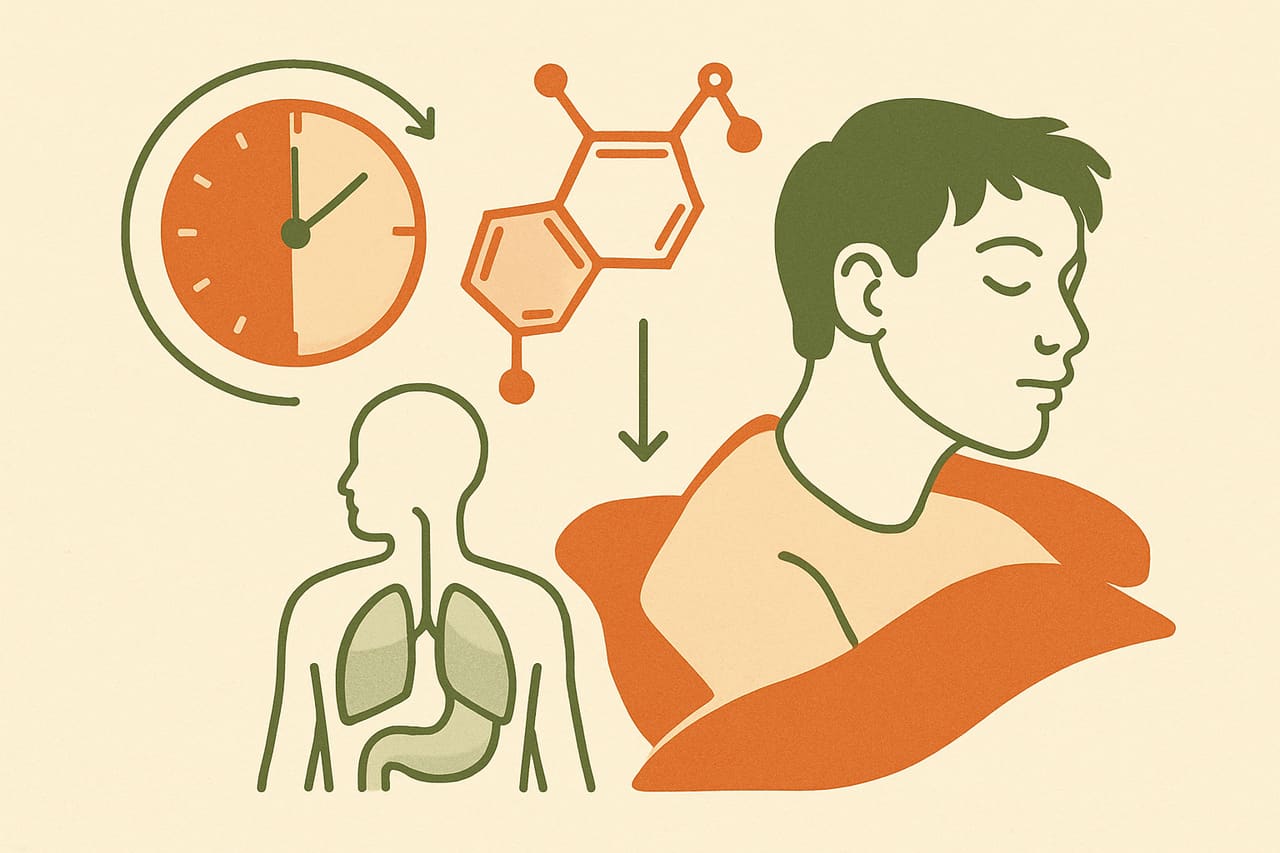
Adolescence pushes the body clock later — biology, not attitude.
The short version.
During puberty the brain starts releasing melatonin (the sleep hormone) about two hours later than in childhood. The natural window for sleep slides to roughly 11pm–8am. Early school start times then collide with this biology, leaving most teens chronically short on sleep. Left alone on weekends, most teens drift to a late-night, late-morning schedule — the clearest sign their clock has shifted, not their willpower.
What researchers actually find.
- Melatonin onset shifts later in adolescence and doesn't shift back until the early 20s.
- Teens need 8–10 hours; most U.S. teens get closer to 7.
- Sleep loss hits the teen brain hard — mood, focus, impulse control, and immune function all suffer.
- Research on later school start times consistently finds teens sleep more, attend more, and crash their cars less.
The shift is driven by two clocks that drift apart in puberty. One is the circadian clock in the brain, which delays its melatonin release so the body simply isn't sending a 'sleepy' signal until later at night. The other is the sleep-pressure system: the chemical drive to sleep builds more slowly in adolescents, so an evening teen feels alert at an hour that would have flattened them as a child. On top of this, the teen brain is exquisitely sensitive to light, so a bright phone screen at night doesn't just keep them entertained — it actively tells the clock 'it's still daytime' and pushes the whole schedule even later. Add an early alarm for school, and you get a body trying to wake during what is biologically its deep-night, which is why mornings feel so brutal. The clock isn't broken; it's just running on a later timezone than the school bell.
You might recognize this.
- Wide awake at 11pm, impossible to wake at 7am.
- Weekend 'catch-up' sleep into the afternoon.
- Irritability and fog that look like attitude but are really sleep debt.
- Most alert and chatty late in the evening, foggy and short-tempered first thing in the morning.
How to help.
- Protect the back end of sleep: consistent wake times matter more than a forced early bedtime.
- Get phones out of the bedroom — light and notifications push the clock even later.
- Morning daylight helps reset the clock; advocate for later start times where you can.
- Dim the lights and dim the stimulation in the last hour before bed so melatonin can do its job.
How this changes by age
The shift is just beginning, so bedtimes that worked at 8 still mostly work — this is the easiest window to lock in habits. Set a consistent wake time and get phones charging outside the bedroom now, before the later clock arrives in full force.
This is usually the steepest part of the delay, so 'I'm not tired' at 10pm is often literally true, even as the alarm stays early. Defend morning daylight and a steady wake time over weekends rather than fighting for an early lights-out that their biology won't honor.
The clock is at its latest here while school still starts early, producing the deepest sleep debt and the riskiest drowsy driving. Focus on protecting total sleep — guard against all-nighters, watch late caffeine, and treat a consistent wake time as a safety issue, not just a school one.
An hour before their usual bedtime, turn the overhead lights down and move phone-charging to the kitchen, framing it as 'the house is winding down' rather than a punishment — dimmer light is the single fastest cue that helps melatonin start on time.
A teen who can't sleep early and won't wake early is just undisciplined.
Their internal clock genuinely runs later. Fighting biology with willpower mostly produces exhausted, demoralized teens.
A later clock explains why falling asleep early is hard; it does not mean every late night is biological or that bedtimes don't matter. Plenty of late nights are just gaming, group chats, or stress, and those still need limits — the shift is a reason for compassion and steady structure, not a reason to stop having a sleep schedule at all.
This is a plain-words summary of well-established psychology — a map, not a diagnosis. If your teen is struggling in a way that worries you, a pediatrician or licensed mental-health professional is the right next step. In crisis: call or text 988 (Suicide & Crisis Lifeline, 24/7) · text HOME to 741741 · call 911 for immediate danger.