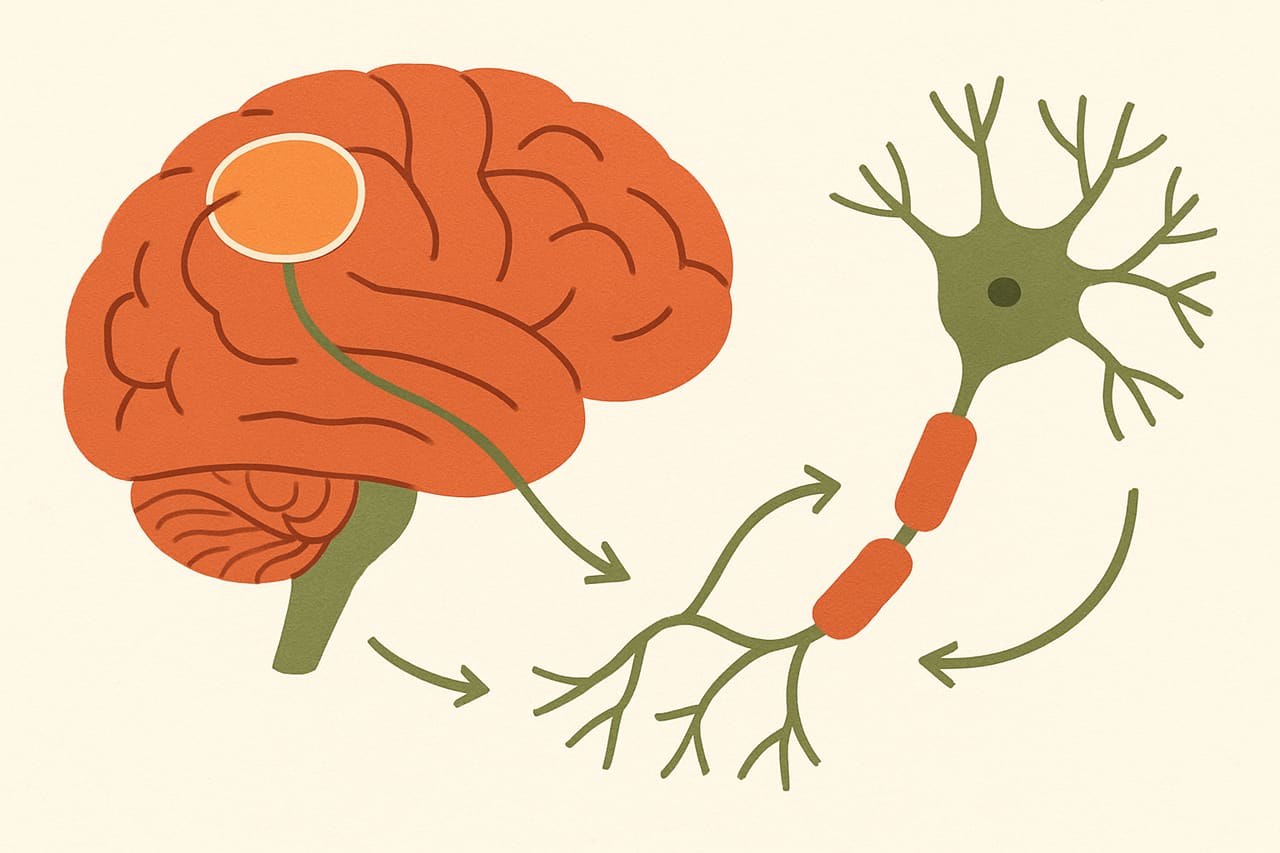
The brain is insulating its wiring — thinking speeds up.
The short version.
While the teen brain prunes unused connections, it also myelinates the ones it keeps — wrapping them in a fatty insulation that makes signals travel far faster. The result is quicker, more efficient, more abstract thinking. It's why teens can suddenly debate, reason hypothetically, and see nuance. It's why a teen can suddenly out-argue you — the wiring for fast, abstract reasoning races ahead of the wiring for judgment.
What researchers actually find.
- Myelination continues through adolescence into the mid-20s, speeding neural signals.
- It powers new abilities: abstract reasoning, hypotheticals, and seeing multiple perspectives.
- Faster thinking arrives before mature judgment — capability outpaces wisdom for a while.
- Faster, sharper thinking arrives years before mature judgment; capability outpaces wisdom for a while.
Two things are happening in the teen brain at once, on different timelines. The connections that get used are wrapped in a fatty insulation called myelin, which makes signals travel dramatically faster and more reliably — that's why thinking gets quicker, more efficient, and more abstract, and why a teen can suddenly reason hypothetically, debate, and see several sides at once. But this upgrade doesn't reach the whole brain evenly or simultaneously: the regions handling fast reasoning mature ahead of the prefrontal circuits that govern judgment, impulse control, and weighing long-term consequences, and that wiring keeps maturing into the mid-twenties. So a teen can genuinely out-argue you and still make a baffling decision an hour later — not because they're being difficult, but because raw processing power is running ahead of the slower-maturing judgment system. Capability is real; it just arrives before the wisdom to steer it.
You might recognize this.
- Suddenly able to argue circles around you.
- New interest in big abstract questions — justice, meaning, identity.
- Sharper reasoning paired with still-shaky judgment.
- A new appetite for big abstract questions — justice, meaning, fairness, identity.
How to help.
- Engage the new reasoning — debate ideas with them as near-equals.
- Channel the abstract thinking toward real problems and causes.
- Remember sharp thinking doesn't yet mean mature judgment; keep guardrails.
- Engage the new reasoning as near-equals while keeping guardrails for the judgment still catching up.
How this changes by age
Thinking is getting noticeably faster and more logical, and they start spotting inconsistencies in your rules. Reward the sharper reasoning by explaining your 'why' and letting them ask real questions, while keeping decisions clearly yours.
Abstract reasoning blooms — big questions about fairness, justice, and identity — alongside still-shaky impulse control. Engage the debates seriously, but don't mistake a great argument for mature judgment; keep guardrails on high-stakes choices.
Reasoning is close to adult-level, which makes it tempting to assume the judgment has caught up — it usually hasn't, especially under stress, fatigue, or peer pressure. Treat them as near-equals in discussion while keeping structure around driving, money, and late-night decisions where judgment lags most.
Pick a real topic your teen has opinions about and genuinely debate it as near-equals tonight — ask them to make their case and steelman the other side. You're feeding the fast new reasoning without pretending the judgment has fully caught up.
Faster, sharper thinking is real, but it doesn't mean a teen has adult judgment — the 'capability outpaces wisdom' gap is exactly why a brilliant argument can sit next to a risky choice. And the brain-maturity timeline is a population average, not a verdict on any one teen; it explains tendencies, it doesn't excuse everything or predict an individual's behavior.
This is a plain-words summary of well-established psychology — a map, not a diagnosis. If your teen is struggling in a way that worries you, a pediatrician or licensed mental-health professional is the right next step. In crisis: call or text 988 (Suicide & Crisis Lifeline, 24/7) · text HOME to 741741 · call 911 for immediate danger.