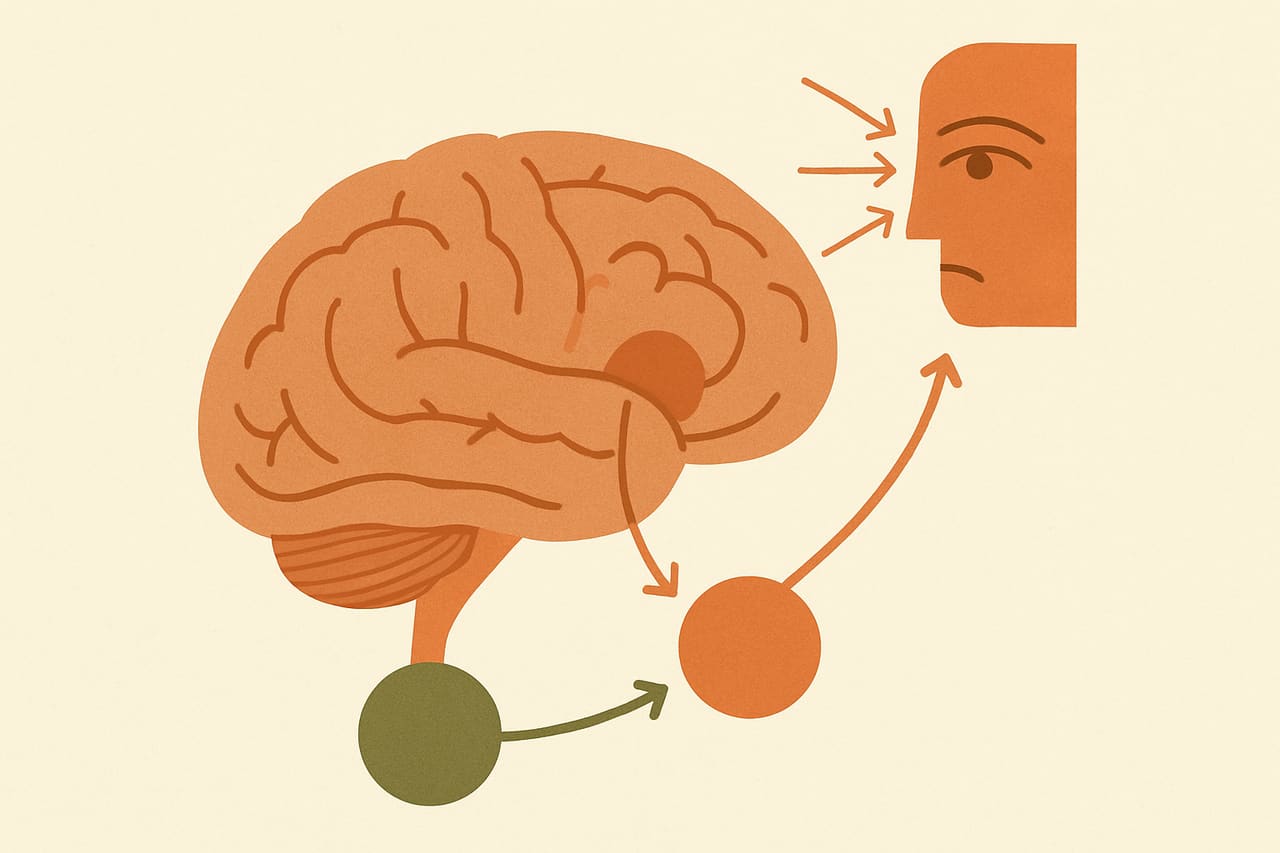
They feel constantly watched — even when no one is.
The short version.
The 'imaginary audience' is a classic feature of adolescent thinking: the conviction that others are as focused on you as you are on yourself. A bad haircut feels like a public catastrophe because the teen believes the whole school is watching. It eases naturally as teens get better at imagining other people's actual (mostly self-absorbed) inner lives.
What researchers actually find.
- It stems from a new, still-miscalibrated ability to imagine what others think.
- It peaks in early adolescence and fades as perspective-taking matures.
- Social media intensifies it by making the 'audience' literal and quantified.
- The feeling is strongest right when self-awareness is new and the skill of reading others is least calibrated.
The spotlight feeling comes from a brand-new mental ability that hasn't been fine-tuned yet: the capacity to imagine what's going on inside other people's heads. A younger child barely models other minds at all; a teen suddenly can, but the skill is still crude, so they over-apply it and assume everyone's attention is aimed at them the way their own attention is aimed at themselves. Because their own self-consciousness is running so high, they project that intensity outward and conclude the whole room must be scrutinizing the same flaw they're fixated on. What actually dissolves it isn't reassurance but practice — thousands of real social moments that quietly teach them most people are absorbed in their own worries, not cataloging someone else's. That's why the feeling fades on its own through the mid-to-late teens as perspective-taking gets more accurate. Knowing the mechanism helps you stay patient: you're watching a normal skill come online, not a personality you need to correct.
You might recognize this.
- Refusing to leave the house over a tiny perceived flaw.
- Intense self-consciousness about clothes, skin, body, voice.
- Assuming a single embarrassing moment defines them forever.
- Hours spent on appearance before leaving the house, sure everyone will notice the smallest flaw.
How to help.
- Reassure without dismissing — gently note that others are mostly worried about themselves.
- Share your own teenage spotlight moments; it normalizes the feeling.
- Avoid public corrections; embarrassment lands ten times harder right now.
- Resist the urge to fix their looks for them; small criticisms confirm the fear that everyone is judging.
How this changes by age
The spotlight often shows up around appearance and being singled out — hating to be called on in class or wear something 'wrong.' Small, private heads-ups ('there's spinach in your teeth') and avoiding any public teasing keep their new self-awareness from hardening into dread.
This is usually the loudest stretch: one awkward moment can feel like permanent social ruin, and they may refuse outings over a tiny flaw. Naming the feeling out loud ('it feels like everyone saw, but they're mostly thinking about themselves') and not arguing them out of it helps more than logic.
The sense of being watched typically softens as they read others more accurately, though it can spike again in high-stakes settings like a new job or college visit. Treat them as the increasingly capable observer they're becoming, and let real experience do the rest.
Tell them a specific story of a moment you were sure everyone was judging you as a teen — the outfit, the stumble, the thing you said — and how you later realized no one even remembered it. Hearing that the feeling is universal and temporary lands far better than 'no one's looking at you.'
This is a normal developmental stage, not a sign of vanity or weakness, and feeling self-conscious is not the same as having an anxiety disorder. But if self-consciousness becomes so intense that a teen consistently avoids school, friends, or food, that's worth a conversation with a professional rather than something to simply wait out.
This is a plain-words summary of well-established psychology — a map, not a diagnosis. If your teen is struggling in a way that worries you, a pediatrician or licensed mental-health professional is the right next step. In crisis: call or text 988 (Suicide & Crisis Lifeline, 24/7) · text HOME to 741741 · call 911 for immediate danger.