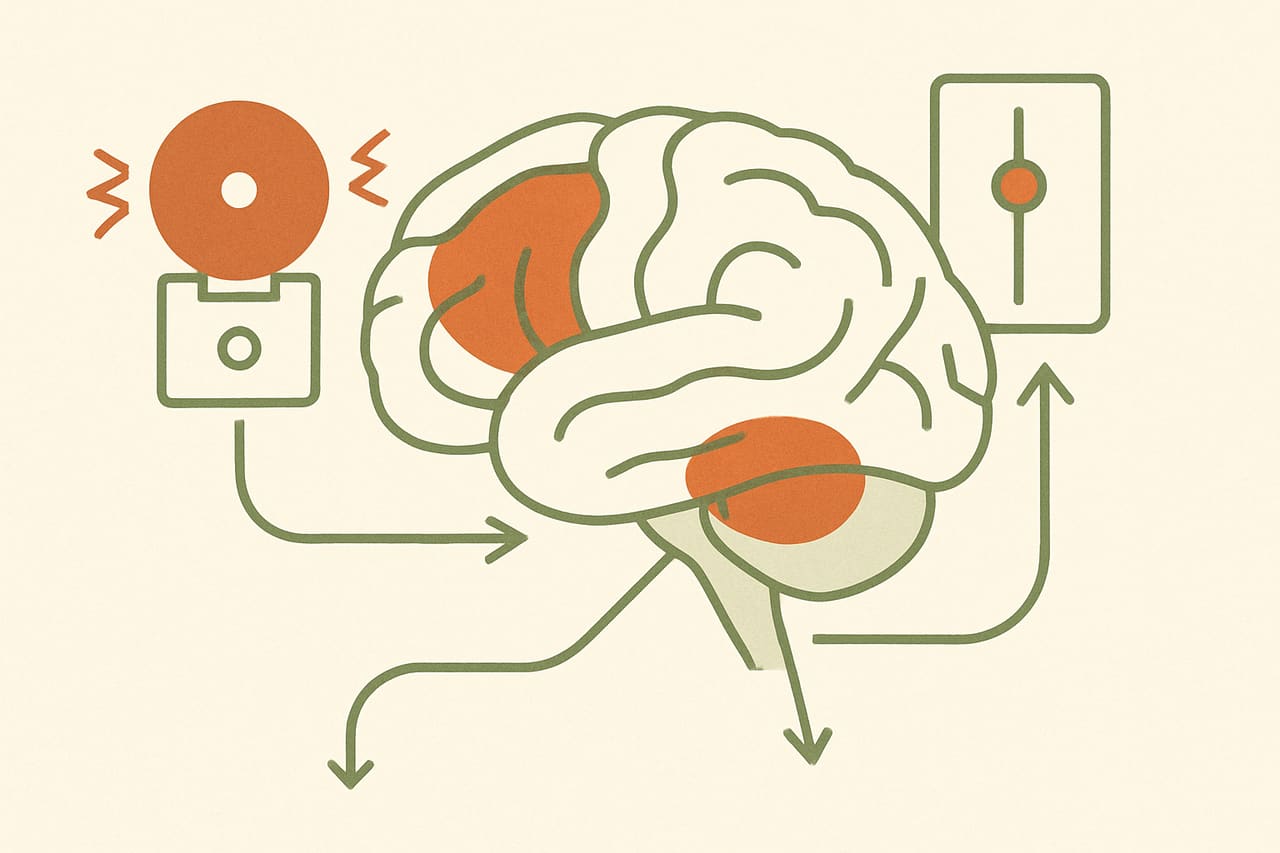
The alarm bell is loud while the dimmer switch is still being installed.
The short version.
The amygdala — the brain's threat-and-emotion alarm — is highly active in adolescence, while the prefrontal regions that would interpret and regulate it are still maturing. Teens lean on the alarm system, so emotions arrive fast, big, and sometimes misread. It also means a teen's emotional read can be sincere and completely off at once — they truly feel the threat they've misperceived.
What researchers actually find.
- In experiments, teens are more likely than adults to read a neutral face as hostile or threatening.
- Emotional reactions are quicker and larger; the 'top-down' calming signal arrives more slowly.
- This settles with age as the regulating circuitry matures.
- As the prefrontal cortex matures, it gradually takes over interpreting emotion, and the misreads grow less frequent.
When a teen reacts hard and fast, it's often because the amygdala — the brain's quick threat-and-emotion alarm — is firing before the slower, calming prefrontal regions can weigh in. In adults those top-down signals arrive fast enough to interpret a situation and dial the alarm down; in teens that braking signal is still maturing, so the raw alarm gets a head start and a louder voice. That timing gap is why emotions land big and immediate, and why a neutral face or a curt text can read as hostility — the alarm fills in a threatening interpretation before reason can check it. Crucially, the misread feels completely real to them; they're not being dramatic, they're genuinely responding to a threat their brain perceived. As the regulating circuitry comes online over the years, the calming signal speeds up and the misfires grow rarer — which is why the same teen handles things far better at eighteen than at thirteen.
You might recognize this.
- Zero to furious (or devastated) in seconds.
- Misreading your tone as anger when you meant nothing by it.
- Calm returns surprisingly fast once the wave passes.
- Reading a short text reply or a brief 'fine' as proof that someone is angry at them.
How to help.
- Lower your own volume first — you're the calm their brain borrows.
- Wait for the wave to pass before reasoning; logic can't reach a flooded brain.
- Name what you see ('that really stung') instead of arguing the facts in the moment.
- Say what you actually feel out loud ('I'm not upset, just tired') so they don't have to guess from your face.
How this changes by age
Big feelings arrive fast but the triggers are often concrete — fairness, embarrassment, friendship spats. Name the emotion out loud ("that really stung") to help them build the vocabulary their calming brain will lean on later.
This is the peak of misreads, where a short text or a neutral look easily reads as rejection or anger. Lower your own volume first and wait for the wave to pass before reasoning — logic can't reach a flooded brain.
Regulation is noticeably improving, but social stakes and stress can still trigger fast, outsized reactions. Treat them more as a partner — "I can see this hit hard; want to talk it through now or later?" — which respects their growing control.
Tonight, when you're not in a conflict, say plainly what your neutral face means: "By the way, when I'm quiet or my texts are short, I'm usually just tired or busy — it's not that I'm mad at you." Giving them that baseline now means their alarm has less blank space to fill with the worst interpretation later.
Intense reactions don't mean a teen is fragile, manipulative, or has a disorder — fast, big feelings are typical in these years and usually settle with age. This also doesn't mean every strong emotion should be smoothed over; the aim is to wait out the wave and then talk, not to walk on eggshells or avoid all hard conversations.
This is a plain-words summary of well-established psychology — a map, not a diagnosis. If your teen is struggling in a way that worries you, a pediatrician or licensed mental-health professional is the right next step. In crisis: call or text 988 (Suicide & Crisis Lifeline, 24/7) · text HOME to 741741 · call 911 for immediate danger.