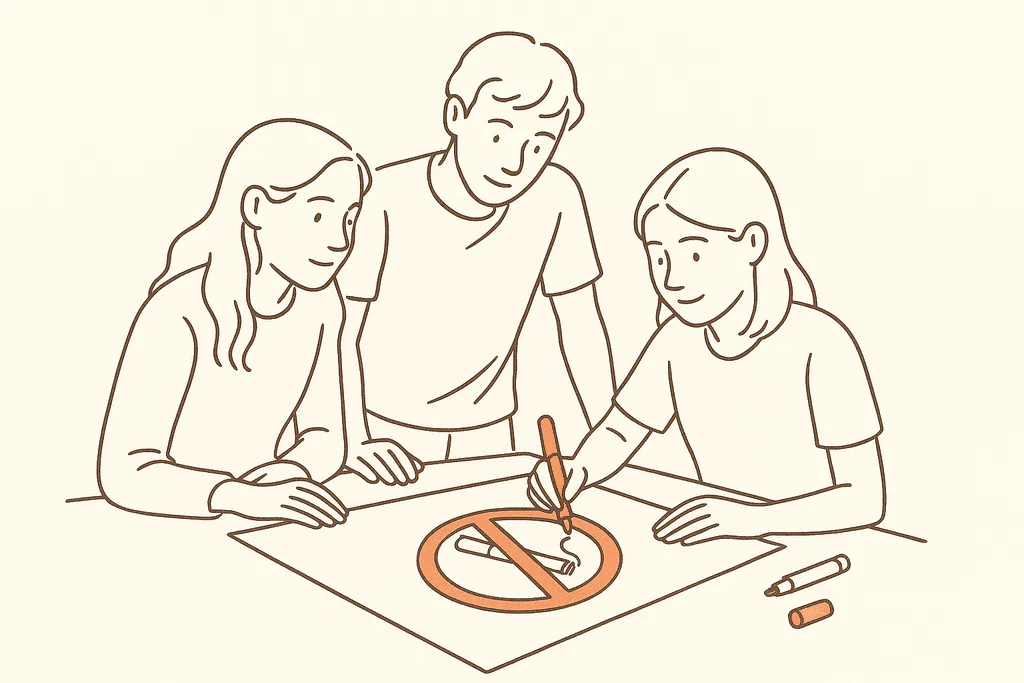
Honest, manipulation-exposing messaging — not scare tactics — drove youth smoking to record lows and is now bending the vaping curve.
- Teens respond to being respected, so explaining how a product is engineered beats telling them what to feel about it.
- Anger at being manipulated is a stronger motivator than fear of a distant health risk.
- Tie a risk to what your teen already cares about — mood, sleep, money — and the message lands.
- Treating your teen as smart enough to handle the real story tends to open the conversation rather than close it.
The situation, the move, the outcome.
The 'truth' campaign showed that the right messaging — not finger-wagging, but exposing industry manipulation and speaking in teens' own voice — can shift a generation's behavior. Mass-media campaigns like truth helped push youth cigarette smoking from nearly 30% in 1997 to about 2% in 2022, preventing an estimated 2.5 million young people from becoming smokers between 2015 and 2018 alone. Now the same playbook is working on vaping: a truth campaign linking nicotine to mental health helped prevent about 1.3 million young people from starting to vape in roughly a year, with weeks of high campaign awareness showing 14-18% lower odds of current e-cigarette use.
In practice the approach works by changing who the teen is angry at. Instead of positioning the parent or campaign as the scold, it points the spotlight at companies that profit from addiction, which lets a teen keep their pride and their sense of autonomy. Concrete, near-term consequences a teen can verify in their own life — feeling tired, anxious or broke — carry more weight than statistics about decades away. Pair that with respect for the teen's intelligence and you get a conversation they're willing to stay in, which is where any real influence happens.
Why it matters beyond one family.
The lesson for parents is about tone: scare tactics and lectures tend to fail, while honest framing that respects teens' intelligence and exposes who profits from their addiction actually changes behavior. It's a model for how to talk about risk in general.
The reason this generalizes is that the tone, not the topic, is doing the work. Lectures and scare tactics tend to trigger pushback because they imply the teen can't think for themselves, while honest framing that exposes manipulation invites them to think harder. That pattern holds across many risks teens face, from gambling-style apps to engineered-for-engagement feeds. For parents, the transferable move is to swap warnings for the question of who benefits, and to anchor the discussion in outcomes the teen can feel rather than ones they have to take on faith.
- A generation-scale problem was moved by honesty and respect rather than fear, which is a hopeful model for any hard conversation.
- The same approach proved adaptable, carrying over from cigarettes to vaping instead of starting from scratch.
- It put real, usable tools — including free quit support — into teens' hands, not just warnings.
- The strategy worked by recruiting teens' own intelligence and skepticism, treating them as allies rather than targets.
How to apply it.
- Skip the lecture — explain how products are engineered to hook them and who profits.
- Use facts and respect rather than fear; that's what moved the needle at scale.
- Connect nicotine and vaping to things teens care about, like mood, sleep and money.
Can I show you something? The way these vape flavors and ads are designed is kind of wild.
Here we go. Is this the 'don't vape' talk?
Nope. I'm not going to tell you what to do — I just think it's worth knowing who's making money off you.
What do you mean?
The nicotine's tuned so the first few are smooth and then your brain wants more. That's the business model, not an accident.
I mean, everyone knows it's addictive.
Sure — but they also know it can mess with your sleep and mood, the stuff you actually feel day to day. That's the part they don't put on the package.
Huh. Yeah, that's kind of shady.
That's all I wanted to say. You're smart enough to do what you want with it.
Concrete next steps.
- Use truth's free resources and quit tools (including text-to-quit programs) with teens.
- Borrow the 'expose the manipulation' framing for other risks too.
- Support school and community campaigns built on the same evidence-based approach.
Read it for yourself.
Call or text 988 (Suicide & Crisis Lifeline, 24/7) · Text HOME to 741741 (Crisis Text Line) · Find a child psychiatrist at aacap.org · For immediate danger, call 911.