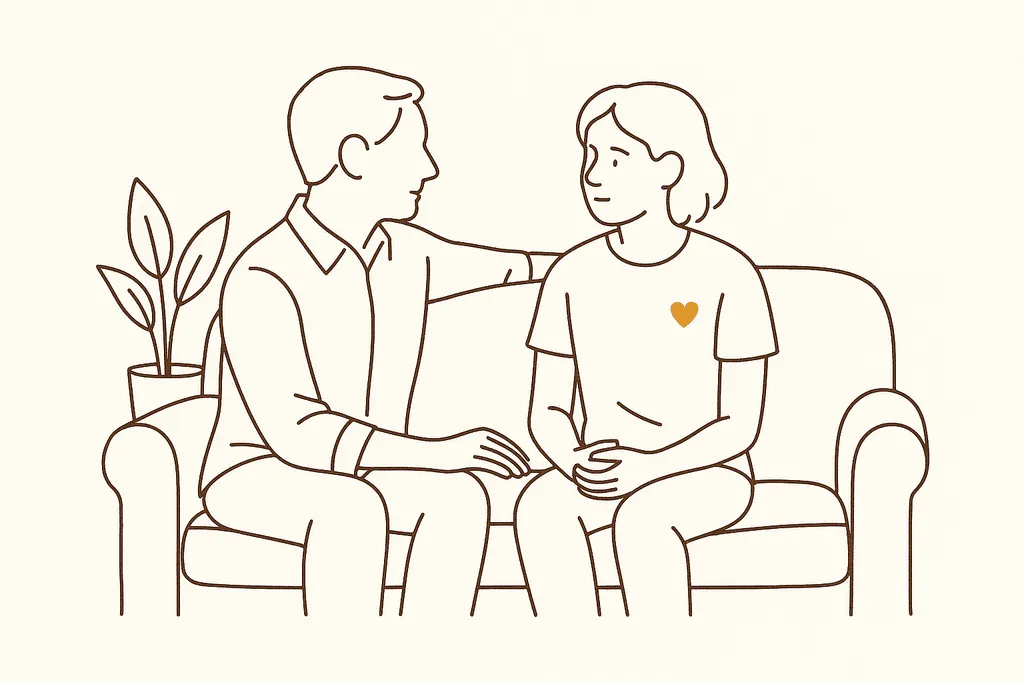
Specialized crisis support helps in the moment — and an affirming, supportive home is one of the strongest protective factors a parent controls.
- Acceptance is most protective when it's said out loud and early, not just assumed.
- A disclosure is a sign of trust; meeting it calmly keeps the door open for the next hard moment.
- Knowing where to turn in a crisis — and having those numbers saved before you need them — is part of being prepared, not a sign you expect the worst.
- The single biggest protective factor here is something a parent directly controls: a supportive home.
The situation, the move, the outcome.
LGBTQ+ youth face sharply higher suicide risk, and generic services don't always reach them. The Trevor Project built free, 24/7 crisis support — phone, text and chat — specifically for them, and it reaches those most in need: three-quarters of LGBTQ+ young people who used a crisis line had seriously considered suicide in the past year. The organization's research also pinpoints what protects them at home: living in an LGBTQ+-affirming household was linked to 37% lower odds of suicidal thoughts, and high family support to 62% lower odds. In its SPARK cohort, past-year suicide attempts fell from 11% to 7%.
In practice the protective effect comes from a teen feeling safe enough to bring you the hard things instead of hiding them. When acceptance is signaled clearly and consistently, the home stops being one more place to manage and becomes a place to exhale, which lowers the daily load a struggling teen carries. Specialized crisis support layers on top of that, giving a teen a trained, judgment-free voice to reach in an acute moment. The two work in tandem: steady warmth at home reduces how often crises arrive, and the right number saved in a phone catches the moments that still do.
Why it matters beyond one family.
The finding cuts two ways for parents: specialized crisis lines save lives in the acute moment, and family acceptance — something a parent directly controls — is among the most powerful protective factors there is.
This cuts two ways for any parent. The crisis-line piece reflects a broader truth that support works best when it's built for the specific person who needs it, not assumed to be one-size-fits-all. The home piece reflects something even more general: across many of a teen's struggles, feeling accepted by the people they live with is among the strongest buffers there is. A parent can't control everything their teen faces, but the felt sense of being loved without conditions is squarely within their reach, and it is exactly the factor the research keeps pointing to.
- Free, around-the-clock support exists that is built specifically for these teens and genuinely reaches those at highest risk.
- The research identifies a protective factor that's fully within a parent's power — family acceptance — which is empowering rather than discouraging.
- It shows that warmth at home isn't just kind, it measurably lowers risk, giving parents a clear and worthwhile target.
- Acute help in the moment and steady support over time work together, so families aren't choosing between them.
How to apply it.
- Signal acceptance early and explicitly; it measurably lowers suicide risk.
- Save the Trevor Project's contacts in your teen's phone alongside 988.
- Meet any disclosure with support and curiosity, not alarm or correction.
There's something I've been wanting to tell you, but I'm kind of scared to.
Thank you for trusting me with it. Take your time — I'm here and I'm not going anywhere.
Okay. I think I'm... I'm into someone, and it's not who you'd expect.
That's okay. I love you exactly the same right now as I did a minute ago. Tell me as much or as little as you want.
You're not mad?
Not at all. I'm glad you felt you could say it. Is there anything you need from me right now?
Just... that. That you're okay with it.
I'm more than okay. And whatever comes up, we figure it out together — you don't have to carry it alone.
Concrete next steps.
- TrevorText: text START to 678678, call 1-866-488-7386, or chat at TheTrevorProject.org.
- Use 988 (call or text) as the parallel national lifeline.
- Read Trevor's research on affirming homes to ground a supportive conversation.
Read it for yourself.
Call or text 988 (Suicide & Crisis Lifeline, 24/7) · Text HOME to 741741 (Crisis Text Line) · Find a child psychiatrist at aacap.org · For immediate danger, call 911.