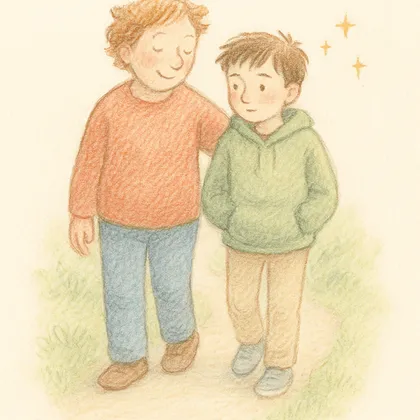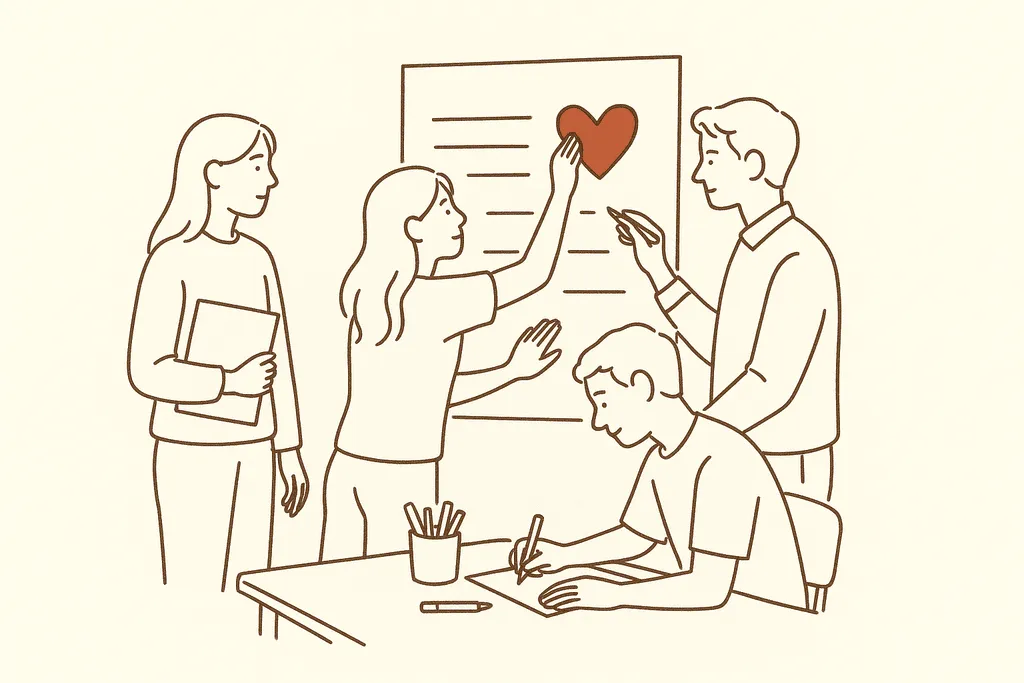
Equipping respected students to model help-seeking shifts the whole school's norms upstream — the protective culture that makes crises less likely.
- Teens take cues from respected peers more readily than from adult lectures, so who delivers a message matters as much as the message.
- Framing help-seeking as a strength at home reinforces the same culture the program builds at school.
- Upstream culture change won't show up as a single dramatic save; it shows up as a school where asking for help feels normal.
- A strong everyday culture and a clear crisis backstop like 988 are complementary, not competing, layers of safety.
The situation, the move, the outcome.
Sources of Strength flips suicide prevention from top-down lectures to peer culture. It recruits student 'peer leaders' from every social clique and coaches them to spread messages of hope, help and connection. In a randomized trial across 18 high schools, the program improved students' norms about suicide and help-seeking, strengthened connectedness to adults, and made peer leaders far more likely to refer a suicidal friend to an adult. It's one of the most rigorously studied prevention programs in the country.
In practice the program works by seeding ordinary social networks with students who quietly model hope, connection and help-seeking. Because those peer leaders are drawn from every clique, the messages travel along the relationships teens already trust rather than being announced from the front of an assembly. Over time the unspoken norms shift — reaching out for a struggling friend starts to look responsible instead of risky — and connections to caring adults grow stronger. The effect is cultural and gradual, which is its strength as an upstream layer even as the harder question of directly preventing attempts remains a separate, more stubborn challenge.
Why it matters beyond one family.
The honest picture: Sources of Strength reliably strengthens the protective, help-seeking culture, while recent large trials show mixed results on directly reducing attempts. It's rated 'promising' — strongest as an upstream, norm-shifting layer.
This generalizes because norms are contagious and teens are exquisitely tuned to what their peers consider acceptable. Change the visible behavior of respected students and you change the water everyone is swimming in, which is why peer-led efforts often outperform adult-delivered ones with this age group. For families, the same principle works in miniature: when help-seeking is treated at home as a sign of strength rather than failure, it reinforces the culture a teen is absorbing at school. The honest framing is that this builds a protective floor — it makes a healthier environment more likely without being a guarantee, which is why a clear crisis backstop still belongs alongside it.
- The program reaches teens through trusted peers from every social circle, not just the usual joiners.
- It strengthens connections between students and adults, building bridges rather than just rules.
- It's one of the most rigorously studied programs of its kind, so families can lean on real evidence.
- By focusing upstream on norms, it aims to make crises less likely rather than only reacting after they occur.
How to apply it.
- Ask whether your teen's school runs an evidence-based peer prevention program.
- Reinforce help-seeking at home as a strength, mirroring the program's message.
- Support student-led wellbeing efforts, which carry more weight with teens than adult lectures.
My friend's been posting some really dark stuff lately. I don't know if I should say anything.
I'm really glad you noticed and told me. That instinct to take it seriously is exactly right.
But what if I make it weird, or they get mad at me?
That's a fair worry. But reaching out for a friend isn't snitching — it's looking out for them, and a trusted adult can help carry it.
Like who?
A school counselor's a good start, or me. You don't have to be the one who fixes it — you just have to pass it to someone who can.
Okay. I think I'd feel better telling the counselor with someone there.
Then let's do that together. Asking for help for a friend is one of the strongest things you can do.
Concrete next steps.
- Point your school to Sources of Strength's training and the CrimeSolutions rating.
- Pair peer programs with a school screening tool for a fuller safety net.
- Keep 988 visible at home as the backstop for any acute crisis.
Read it for yourself.
Call or text 988 (Suicide & Crisis Lifeline, 24/7) · Text HOME to 741741 (Crisis Text Line) · Find a child psychiatrist at aacap.org · For immediate danger, call 911.