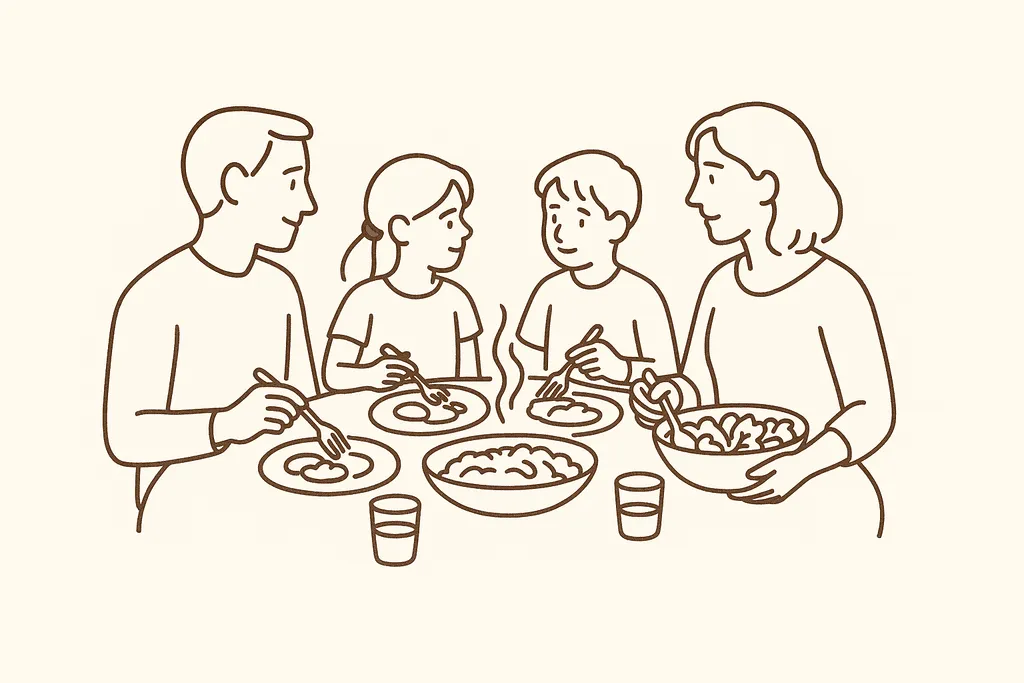
Regular family dinners are a low-cost protective ritual — their power is the everyday communication they create, when the relationship is warm.
- Consistency matters more than the menu — a simple, repeated meal beats an elaborate one you can't sustain.
- Phones off for everyone, parents included, is what makes the table feel safe to talk at.
- Let small, ordinary updates surface naturally instead of saving everything for a big sit-down talk.
- If dinner truly can't happen, any protected shared time carries much of the same benefit.
The situation, the move, the outcome.
Across national studies, the frequency of family dinners shows a dose-response link to teen wellbeing: more dinners, fewer emotional and behavioral problems, less depression, less substance use and delinquency, and higher life satisfaction. The mechanism researchers point to isn't the food — it's the open, regular communication mealtimes create, which lets teens feel heard and lets parents notice and coach.
In practice the ritual works less because of any single conversation and more because the table keeps coming back, night after night, as a predictable place to be heard. A teen who knows there's a low-stakes window every day rarely needs to schedule a serious talk — the important things tend to slip out between ordinary updates about school and friends. Parents, in turn, get a steady read on their teen's mood and world without having to interrogate, which means they notice small shifts early. The repetition is the point: it is the standing invitation, not the food, that does the protective work.
Why it matters beyond one family.
There's an honest caveat: dinners help most when the parent-child relationship is warm. Forced, tense meals don't carry the same benefit — so the win is really about protected, low-pressure time to connect.
The reason this generalizes is that the active ingredient is warm, regular attention, and a shared meal is simply the most common container for it in family life. Any household that protects unhurried time where a teen feels genuinely listened to is tapping the same mechanism, which is why breakfasts, drives, or evening walks can substitute when dinner won't fit. The caveat about warmth matters here too: the time has to feel safe, not like a summons, or teens learn to stay guarded. Seen this way, the dinner finding is really a finding about relationship — easy to start, but only as powerful as the tone you bring to it.
- The strategy costs nothing and uses time families already spend, so almost any household can start.
- It works through everyday communication rather than a special program, which makes it durable.
- The benefits show up across many areas of wellbeing at once — mood, behavior, and substance use.
- It gives parents a natural, low-pressure window to notice changes early and offer support.
How to apply it.
- Protect a few shared meals a week as device-free, low-pressure time.
- Keep the tone warm and curious — connection is the active ingredient.
- Use the time to listen more than to interrogate or lecture.
Phones in the basket — mine too. How was the bus this morning?
Fine. Kind of weird, actually. Mia's been off with me all week.
Off how? You don't have to get into it if you don't want to.
I dunno, she just stopped answering. It's annoying.
That sounds like it stings more than annoying. I'd be thrown by that too.
Yeah. I keep wondering if I did something.
Makes sense to wonder. Want to just think out loud about it, or would you rather I drop it for now?
We can talk about it. Pass the rice?
Concrete next steps.
- Pick realistic nights and make them phone-free for everyone, parents included.
- If dinners don't fit, protect any regular shared time (breakfast, drives, walks).
- Pair the ritual with genuine interest in your teen's world.
Read it for yourself.
Call or text 988 (Suicide & Crisis Lifeline, 24/7) · Text HOME to 741741 (Crisis Text Line) · Find a child psychiatrist at aacap.org · For immediate danger, call 911.