Teaching teens to recognize warning signs and screen themselves measurably cut suicide attempts — rare, hard evidence that prevention works.
- Ask your school directly whether its prevention program has been tested in a randomized trial, not just adopted.
- Teach the ACT steps at home so your teen knows exactly what to do when a friend worries them.
- Make self-screening sound as ordinary as a vision check, so a struggling teen never feels singled out.
- Awareness plus a screening step reaches kids who would otherwise stay invisible to adults.
The situation, the move, the outcome.
Signs of Suicide (SOS) does two things in a single short program: it teaches students to ACT — Acknowledge, Care, Tell — on warning signs in themselves or friends, and it adds a brief, confidential depression self-screen. In randomized trials, SOS cut self-reported suicide attempts by roughly 40-64%. It was the first school-based suicide prevention program to demonstrate a reduction in attempts in a randomized design.
In practice the program works by doing two complementary jobs at once: it gives every student a simple script for responding to warning signs, and it quietly offers a confidential way to check on themselves. The ACT framework matters because most teens freeze not from indifference but from not knowing what to do; naming the steps removes that paralysis. The self-screen catches the students who would never raise a hand, turning a passive assembly into an active door for help. At home, a parent reinforces both halves by treating help-seeking as routine and by being a clear, named person a teen can 'Tell.'
Why it matters beyond one family.
Hard evidence that any prevention program reduces actual attempts is rare, which makes SOS notable. It pairs awareness with a screening step that catches kids who might otherwise stay invisible.
The approach generalizes because its logic isn't specific to one curriculum: pair awareness with a low-stakes screening step, and you both teach response and surface hidden need. That combination addresses a stubborn reality — that struggling teens are often invisible precisely because they don't volunteer their pain. Schools and families anywhere can borrow the principle even where this exact program isn't offered, by normalizing self-checks and making sure every teen knows who to tell. What makes the case worth holding onto is that it moved a real outcome, which is the bar prevention efforts should aim for.
- This is one of the rare prevention efforts shown to reduce actual attempts, not just change attitudes.
- It proved that effect under a randomized design, the most demanding kind of evidence.
- The whole approach fits into a single short program, so schools can realistically run it.
- It catches quietly struggling students by pairing peer awareness with a confidential self-check.
How to apply it.
- Ask whether your school runs an evidence-based program like SOS.
- Teach the ACT steps at home so your teen knows what to do for a friend.
- Normalize self-screening and help-seeking as routine, not shameful.
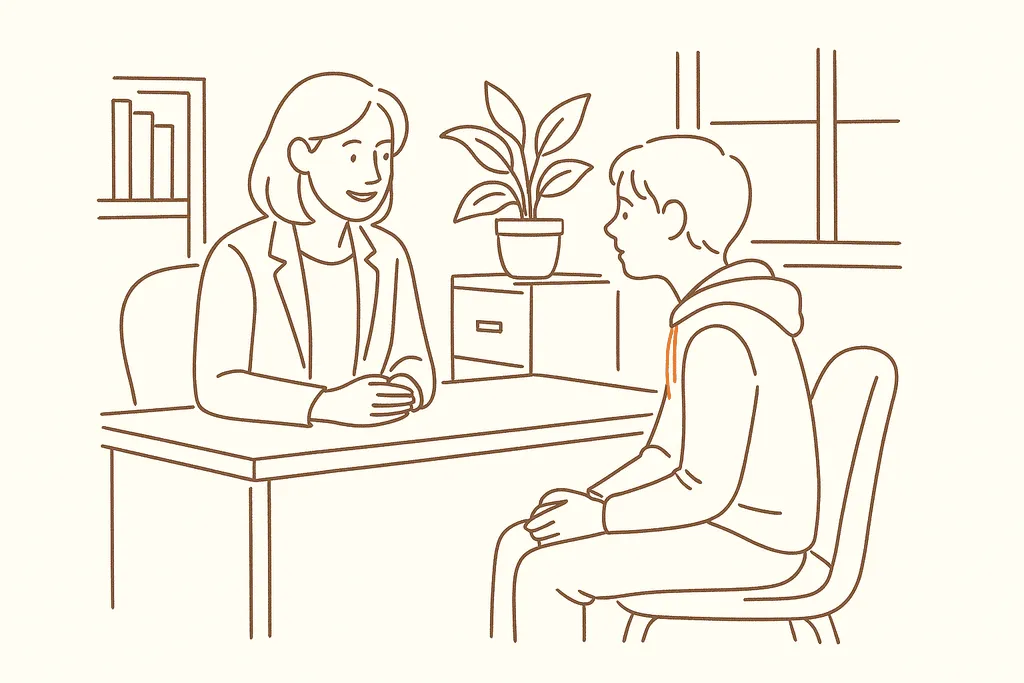
We did this thing at school today about warning signs. It made me think about my friend, honestly.
I'm glad you're telling me. What did you notice about them?
They've been saying stuff like everyone would be better off without them. I figured they were just venting.
That's exactly the kind of thing worth taking seriously. You learned the steps today — what were they?
Acknowledge it's real, show you care, and tell a trusted adult. But I don't want to betray them.
Telling someone who can help isn't betrayal — it's how you keep a friend safe. You don't have to carry this alone.
Can you help me figure out who to tell?
Absolutely. Let's loop in the school counselor tomorrow, and 988 is always there too. You did the brave thing already.
Concrete next steps.
- Point your school to SOS and its randomized-trial evidence.
- Keep 988 and 741741 visible and known at home.
- Pair school screening with open family conversation about mental health.
Read it for yourself.
If your teen is in crisis: call or text 988 (Suicide & Crisis Lifeline, 24/7) or text HOME to 741741. For immediate danger, call 911.