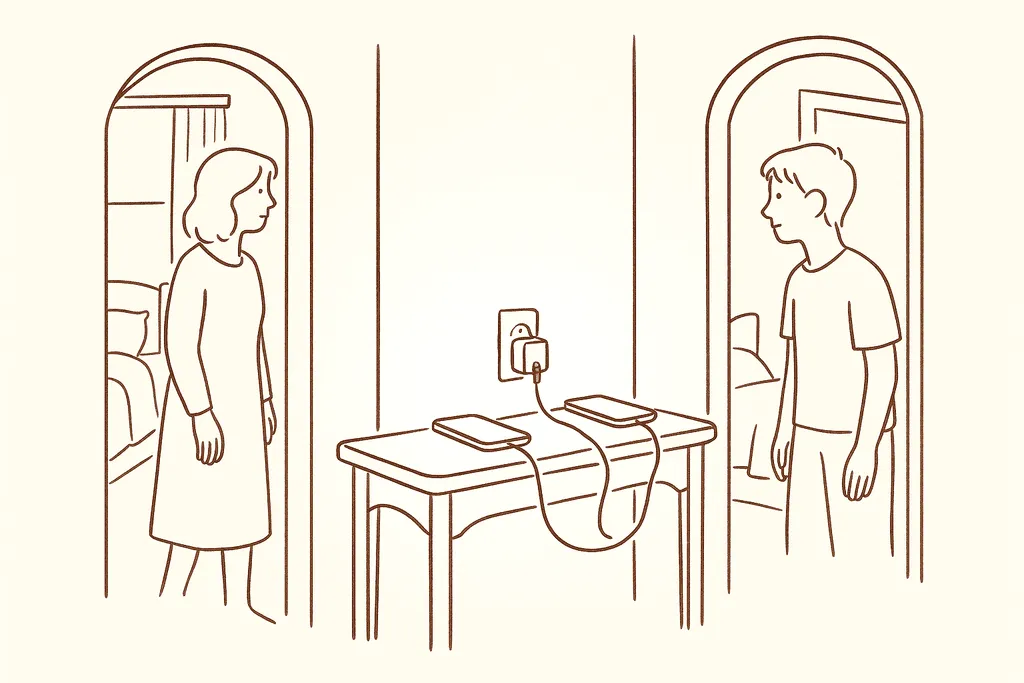
A charging station outside the bedroom is a tiny rule with measured gains in sleep, mood and memory.
- Deciding in advance where the phone charges settles the nightly debate before it starts.
- A cheap standalone alarm clock quietly removes the most common excuse for keeping the phone in bed.
- Pairing a fixed 'phones down' time with a wind-down routine gives the body a clear signal to settle.
- Making it a whole-family norm, with parents included, is what keeps it from feeling like a kid-only punishment.
The situation, the move, the outcome.
Sleep is one of the clearest casualties of the bedroom phone — and one of the easiest to fix. In a randomized pilot trial, participants who restricted phone use before bed for four weeks fell asleep faster (sleep latency dropped about 12 minutes), slept roughly 18 minutes longer, and reported less pre-sleep arousal plus better mood and working memory. Sleep experts' practical translation is blunt: decide where the phone charges, and make that spot outside the bedroom.
In practice the move works less through willpower and more through logistics: once the charging spot is outside the bedroom, the choice is made in advance and there's nothing to relitigate at lights-out. Swapping in a cheap clock closes the single most common loophole, since 'I need it for the alarm' is usually the reason the phone ends up on the nightstand. Pairing a consistent phones-down time with a short wind-down gives the body a predictable cue, which is part of why falling asleep gets easier. The effect compounds quietly — a little less time tossing, a bit more sleep overall — which is exactly why such a small rule shows up in mood and memory.
Why it matters beyond one family.
More than half of teens use phones in bed after lights-out, pushing sleep onset back by half an hour or more. Because chronic short sleep feeds anxiety, low mood and poor focus, protecting sleep is one of the highest-leverage moves a family can make.
What makes this generalize is that it targets a single, fixable habit rather than asking a teen to overhaul their whole relationship with the phone. For ordinary families, the practical lesson is to make it a norm everyone follows, because a rule parents also keep reads as a household value rather than a punishment aimed at the teen. Protecting sleep is high-leverage precisely because short sleep feeds anxiety, low mood, and poor focus, so one good habit pays off in several directions. And the fix is refreshingly cheap and concrete — a shared caddy and a basic clock — which lowers the bar to actually starting tonight.
- It's a tiny change with measured results, so families get real gains without a major fight.
- Protecting sleep is high-leverage because better sleep supports mood, focus, and memory all at once.
- The fix is concrete and cheap — a charging spot and a $10 clock — rather than abstract or expensive.
- Because parents can model it, the rule becomes a shared household habit that's far more likely to stick.
How to apply it.
- Set a household charging station outside bedrooms — and put your own phone there too.
- Pick a consistent 'phones down' time and pair it with a wind-down routine.
- Swap the phone alarm for a cheap standalone clock so 'I need it for the alarm' isn't a reason.
I want to set up a charging spot out in the hallway where all our phones land at night — mine included.
Why mine? I use it as my alarm.
Fair — that's why I picked up a little clock for your room. So the alarm's covered without the phone being right there.
But I like scrolling a bit before I fall asleep. It helps me relax.
I get that it feels relaxing, but there's pretty clear evidence it actually pushes sleep later and makes it lighter. Want to just see if you sleep better for a week?
I guess. What time would phones go down?
Let's pick a time together and do a short wind-down after — music, reading, whatever works for you.
Okay. But you actually have to put yours there too.
Deal. It only works if I do it too — that's kind of the whole point.
Concrete next steps.
- Use Do Not Disturb / sleep schedules to silence overnight notifications.
- Buy a $10 alarm clock and a shared charging caddy for the kitchen or hallway.
- Make it a family norm, not a kid-only rule — it sticks far better when parents model it.
Read it for yourself.
Call or text 988 (Suicide & Crisis Lifeline, 24/7) · Text HOME to 741741 (Crisis Text Line) · Find a child psychiatrist at aacap.org · For immediate danger, call 911.