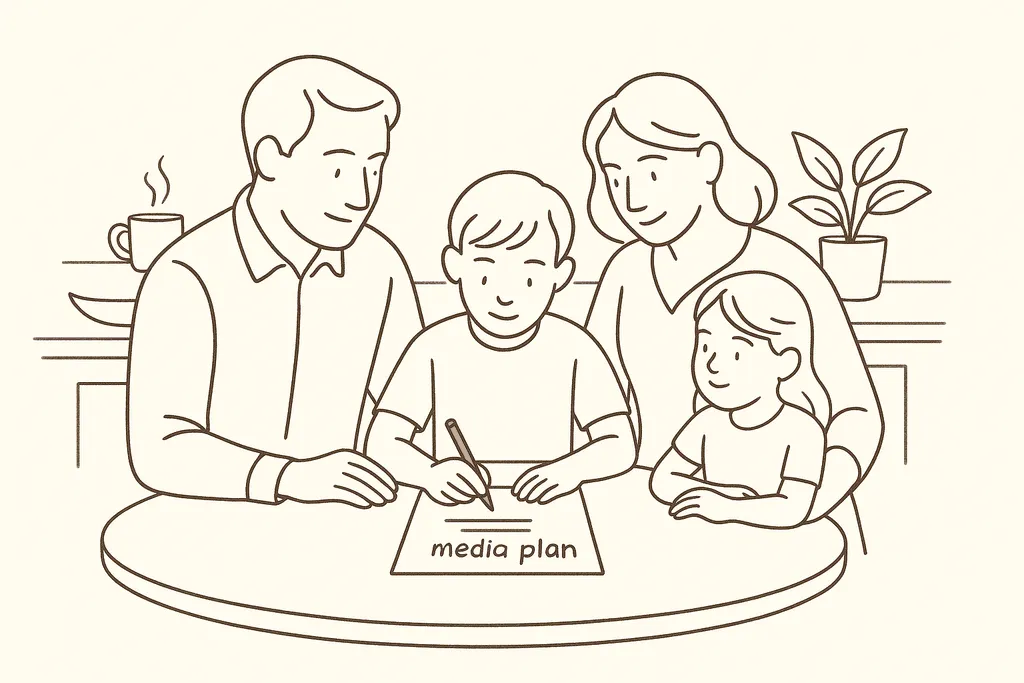
A written family media plan — the Surgeon General's top recommendation — turns vague rules into expectations everyone agreed to.
- Write the plan together with your teen so they have a stake in keeping it.
- Agree on device-free zones and times in advance to avoid nightly negotiations.
- Revisit the plan a few times a year as apps and your teen's needs shift.
- A shared written agreement carries more weight than rules invented on the spot.
The situation, the move, the outcome.
In May 2023 the U.S. Surgeon General issued a formal advisory on social media and youth mental health — the kind of statement reserved for urgent public-health issues. Crucially, it didn't stop at sounding an alarm; it handed parents a concrete tool. Its lead recommendation: create a written Family Media Plan using the AAP's free HealthyChildren.org resources, model healthy use yourself, and follow the AAP's media guidance. The plan lets a family set priorities and boundaries — device-free times, charging locations, content rules — that everyone has agreed to in advance.
In practice the family sits down and decides together what matters most — when devices go away, where they charge, what content is and isn't okay — and writes it down so it isn't reinvented every evening. Because the expectations were agreed to in advance, a phone at the dinner table becomes a reminder of a shared decision rather than the opening of a fresh argument. Building it with the teen, rather than for them, is what turns it from an imposed rule into something they helped author. The written plan does the negotiating once, so the family doesn't have to do it nightly.
Why it matters beyond one family.
With up to 95% of teens on social media, blanket bans are often unrealistic. A written, shared plan works better than ad-hoc rules because it replaces nightly negotiations with expectations the whole family signed off on.
This generalizes because clear, agreed-upon expectations reduce friction in almost any household, and tech is simply where that friction tends to flare. A blanket ban is often unrealistic when nearly all teens are online, so a flexible plan that the family shaped together holds up better than rigid prohibition. The same approach — decide the principles in advance, write them down, revisit periodically — can structure conversations about money, driving, or curfews just as well. The core insight is that shared ownership, not parental authority alone, is what makes a boundary stick.
- The advisory didn't just raise alarm — it pointed families to a concrete, free tool.
- A written plan replaces repeated arguments with expectations everyone signed off on.
- It's customizable, so families set priorities that fit their own values and routines.
- Building it with the teen earns the buy-in that makes the boundaries actually hold.
How to apply it.
- Build the plan with your teen, not for them — buy-in is what makes it hold.
- Set device-free zones and times (meals, bedrooms, the hour before sleep).
- Revisit it a few times a year as apps and your teen's needs change.
I'd rather not keep having the same screen argument every night. Can we just write down a plan together?
A plan sounds like you making rules and calling it a plan.
Fair. That's why I want you helping decide it, not just me handing it down.
So I actually get a say in the times and stuff?
Yes. Let's pick the spots that matter — maybe meals and the hour before bed — and you tell me what feels reasonable.
Phones out of bedrooms at night is going to be the hard one.
I'll do it too — we can charge them in the kitchen together. Same rules for me.
Okay. And we can change it if something's not working?
Definitely. We'll look at it again in a few months and adjust.
Concrete next steps.
- Make a free plan at HealthyChildren.org's Family Media Plan tool.
- Read the Surgeon General's advisory for the evidence and talking points.
- Anchor it with the AAP's age-based media recommendations.
Read it for yourself.
Call or text 988 (Suicide & Crisis Lifeline, 24/7) · Text HOME to 741741 (Crisis Text Line) · Find a child psychiatrist at aacap.org · For immediate danger, call 911.