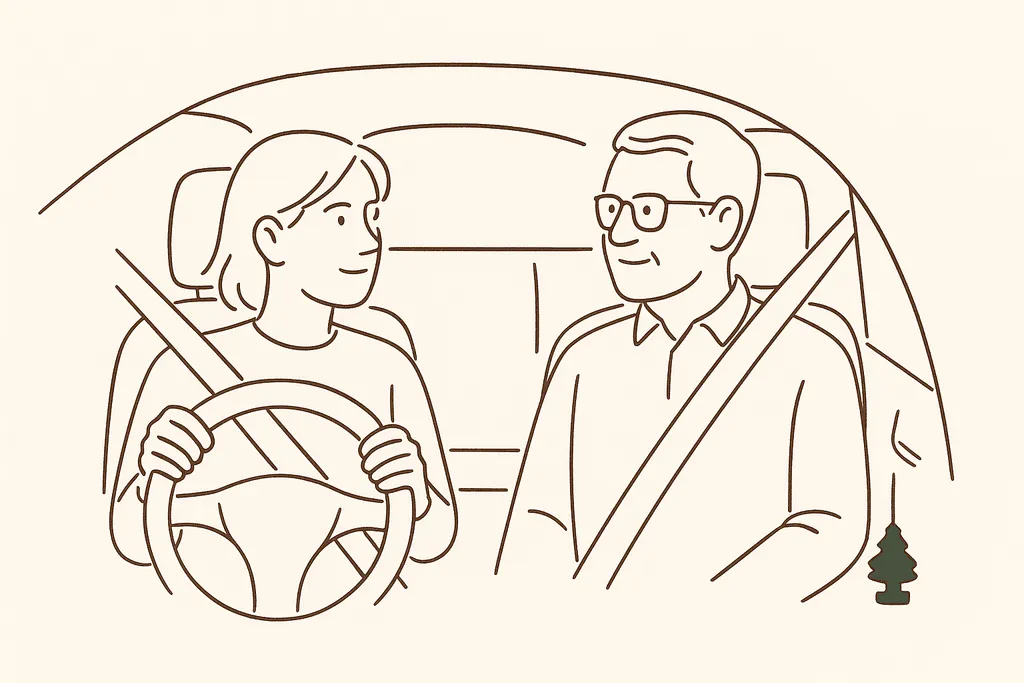
Phasing in driving privileges — limiting night driving and teen passengers at first — measurably cut teen crash deaths.
- Follow the night-driving and passenger limits even where local law is loose — that's where the risk concentrates.
- A written family driving agreement turns vague expectations into clear, staged privileges.
- Supervised practice across many conditions builds the skill that independence later relies on.
- Phasing in freedom beats banning it — the goal is staged risk, not a locked garage.
The situation, the move, the outcome.
Graduated Driver Licensing (GDL) replaced the all-at-once license with stages: a supervised learner period, then an intermediate phase with limits on late-night driving and teen passengers before full licensure. The results are well-documented — GDL cut fatal crashes among 16-17-year-olds by 8-14%, and the strongest laws are associated with about 30% lower fatal-crash rates than the weakest. The IIHS estimates that if every state adopted the toughest provisions, 500+ lives could be saved each year.
In practice the approach works by separating the act of learning to drive from the conditions most likely to overwhelm a beginner — driving late at night and ferrying a carful of peers — until enough skill is in place. A family using the same logic stages privileges deliberately: lots of supervised practice first, then limited independence, then more passengers and later hours as experience accumulates. A simple written agreement makes those stages concrete, so a Friday-night request becomes a known rule rather than a negotiation in the moment. The point isn't to keep a teen off the road but to let them build competence in the safer conditions before facing the harder ones.
Why it matters beyond one family.
GDL works because it limits the highest-risk conditions for inexperienced drivers — night driving and peer passengers — while they build skill. It's a model of staging risk rather than banning it outright.
This generalizes because the principle underneath it — match how much risk you allow to how much skill someone actually has — applies well beyond the specific provisions written into any one state's law. Inexperience is the core hazard for new drivers, and staging exposure gives that experience time to grow before the stakes rise. That's why families can extend the same model with their own rules on phones, curfews, and passengers even where the statute is permissive. The broader lesson is a calm one: risk for teenagers is often best managed by phasing it in under supervision rather than either banning it outright or handing over everything at once.
- The benefit is well-documented, so families are following an approach with a real track record.
- It targets the specific high-risk conditions for new drivers rather than restricting everything.
- Parents can apply the same staging at home regardless of how strict their state's law is.
- It treats new drivers as capable learners, expanding freedom as experience grows.
How to apply it.
- Follow GDL limits even where the law is lax — night and passenger rules save lives.
- Add your own family driving agreement on phones, curfews and passengers.
- Build supervised practice across varied conditions before full independence.
Everyone's going to the lake Friday night — can I drive a couple of them?
I love that you asked. Here's my hesitation: night plus a full car is the riskiest combo for a new driver.
It's like a fifteen-minute drive, I'll be fine.
I believe you'd try to be careful. It's not about trust — it's that the odds are just stacked on that one.
So what, I can never drive anyone?
Not never. Let's say one passenger for now, daytime, and we add more as you build hours.
And the lake?
I'll drop you and grab you at eleven, or you go with someone who's had their license a while. Your call.
Fine. Daytime and one person. I can live with that.
Concrete next steps.
- Use a written parent-teen driving contract with clear, staged privileges.
- Enable Do Not Disturb While Driving so phones aren't a temptation.
- Support strong GDL provisions in your state.
Read it for yourself.
Call or text 988 (Suicide & Crisis Lifeline, 24/7) · Text HOME to 741741 (Crisis Text Line) · Find a child psychiatrist at aacap.org · For immediate danger, call 911.