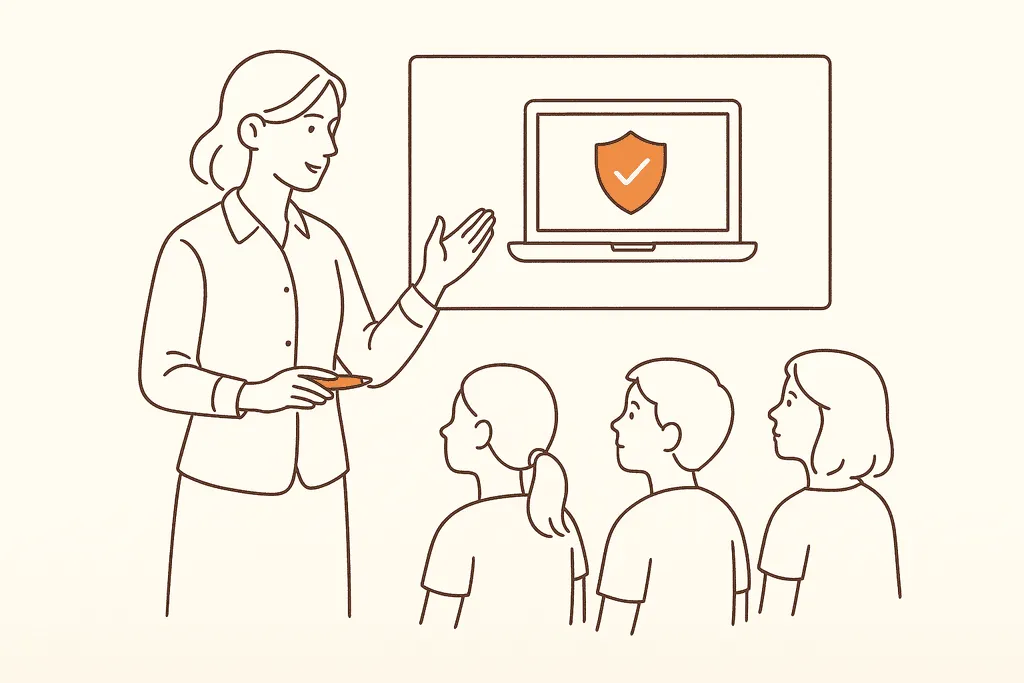
Teaching kids shared frameworks for online dilemmas — free, in tens of thousands of schools — is a scalable way to build safer habits.
- Ask which digital-citizenship curriculum your child's school uses, if any.
- Echoing the same frameworks at home lets school and family speak one language.
- Free family resources turn a classroom lesson into an ongoing conversation.
- If your school lacks a structured program, a ready-made free one is easy to suggest.
The situation, the move, the outcome.
Common Sense Media built a free, K-12 digital-citizenship curriculum covering privacy, cyberbullying, sexting, online safety and responsible behavior — and it scaled. It's now used in classrooms in all 50 states, across more than 50,000 schools, by over half a million educators. The lessons give kids concrete frameworks (like routines for responding to cruelty online and for being an 'upstander' rather than a bystander), and the program's impact reporting tracks how schools implement it and engage parents. It's the closest thing the US has to a widely-adopted media-literacy backbone.
In the classroom, the curriculum's strength is that it replaces vague warnings with concrete routines a kid can actually run when things go sideways online. Rather than telling students to 'be safe,' it gives them rehearsed moves — how to respond to cruelty, how to be the one who steps in rather than the one who watches — so the right action is already loaded before a hard moment hits. Because it's free and built for K-12, schools across very different settings can adopt the same backbone. The depth of any one classroom's experience still varies with the teacher, but the shared frameworks travel even when implementation doesn't.
Why it matters beyond one family.
Hard before-and-after numbers on cyberbullying reduction are still emerging, and the curriculum's reach varies by classroom. But equipping a generation with a shared vocabulary for online dilemmas — at no cost to schools — is a meaningful, scalable intervention.
This matters beyond any single school because a common vocabulary is what lets kids, teachers and parents coordinate at all. When a teen, their classmates and their family all understand terms like 'upstander' the same way, a tough online situation has a shared script instead of improvisation. Firm before-and-after numbers on outcomes are still emerging, which the program acknowledges, but equipping a whole generation with the same frameworks is a scalable bet rather than a one-off fix. The home advantage is simple: reinforce the school's language and the lesson stops being a one-day class and becomes a habit.
- A genuinely free curriculum scaled to classrooms in all fifty states and tens of thousands of schools.
- It hands kids concrete frameworks — like being an 'upstander' instead of a bystander — for hard online moments.
- It reaches a generation with a shared vocabulary for online dilemmas at no cost to schools.
- Its impact reporting tracks how schools put it into practice and bring parents in.
How to apply it.
- Ask whether your child's school uses a digital-citizenship curriculum, and which one.
- Reinforce the same frameworks at home so school and family speak the same language.
- Use the free family resources to keep conversations going outside class.
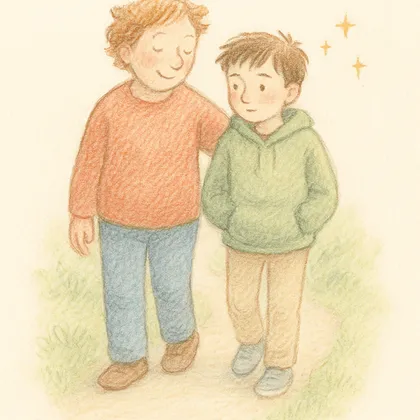
Did you cover anything about being online in class this week?
Yeah, we did this thing about being an 'upstander' if someone gets piled on in a group chat.
I like that. What does being an upstander actually look like to you?
Like, not joining in, and maybe messaging the person privately to check on them.
That's a really solid move. Has that ever come up for real?
Kind of. I didn't really know what to do at the time.
Totally normal. Now you've got a plan — and you can always loop me in if it gets heavy. Same words we use here, same idea.
Yeah, that actually helps.
Concrete next steps.
- Explore Common Sense's digital-citizenship curriculum and family materials.
- Bring it to teachers or your PTA if your school lacks a structured program.
- Read the impact report to see how schools are implementing it.
Read it for yourself.
Call or text 988 (Suicide & Crisis Lifeline, 24/7) · Text HOME to 741741 (Crisis Text Line) · Find a child psychiatrist at aacap.org · For immediate danger, call 911.