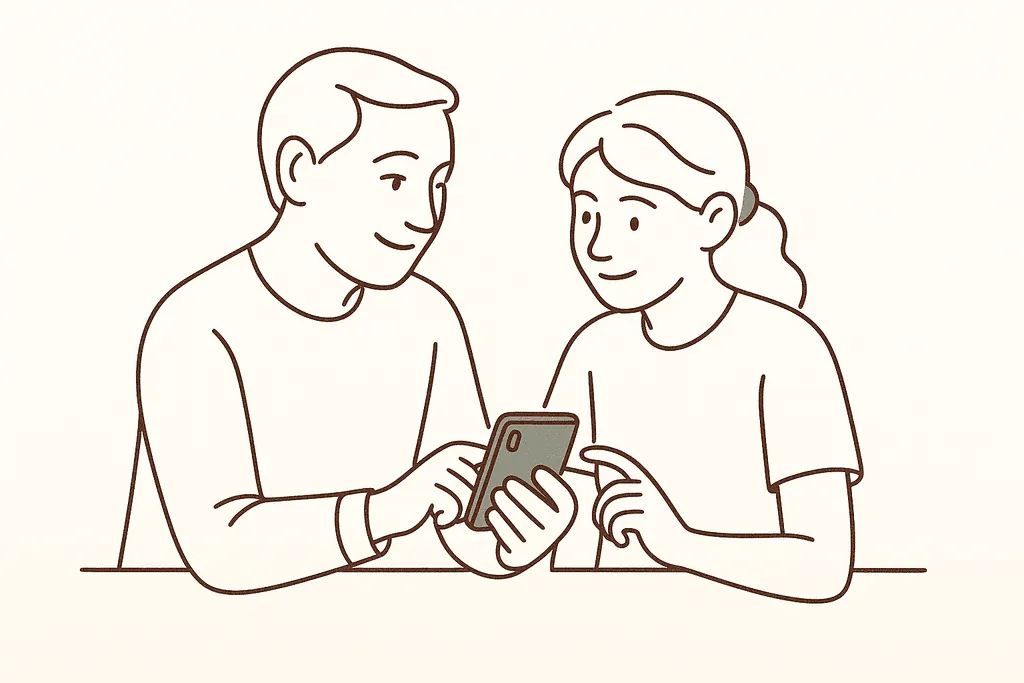
Ongoing, two-way conversation about online life — not just rules or spying — is what most reliably lowers online risk.
- Ongoing dialogue does protective work that monitoring software simply can't.
- Pair conversation with reasonable, openly agreed limits rather than secret surveillance.
- Building rules together helps a teen understand the 'why,' which makes the rules stick.
- Protecting trust is what keeps a teen talking honestly when something actually goes wrong.
The situation, the move, the outcome.
Researchers distinguish 'active mediation' — discussing and guiding a teen's online life — from purely restrictive rules or covert surveillance. Across studies, active mediation is linked to lower exposure to online risks and lower problematic internet use, and it works through stronger parent-child relationships and less hidden online behavior. In other words, the conversation itself does protective work that a spy app can't.
In practice active mediation looks like a running, two-way conversation — asking what a teen sees and shares, talking through what's tricky, and guiding rather than lecturing — instead of a fixed list of rules or a quiet monitoring app. That ongoing dialogue strengthens the parent-child relationship and cuts down on hidden online behavior, which is how it lowers risk: a teen who isn't hiding is a teen you can actually help. The most effective version doesn't drop limits entirely; it pairs warmth and conversation with a few well-judged, openly explained boundaries. The shift is from policing a teen's online life to staying genuinely involved in it.
Why it matters beyond one family.
The evidence is nuanced: active mediation especially supports mental health and relationship quality, while some well-judged restriction reduces risk exposure. The most effective approach blends warmth and dialogue with sensible limits — tuned to the individual teen.
This generalizes because the active ingredient is the relationship and the openness it creates, and those carry over to whatever platform or device a teen picks up next — unlike a specific rule or surveillance tool that's outdated the moment the apps change. Talking through online life also builds judgment a teen can use when a parent isn't watching, which is most of the time. The nuanced evidence supports a blend: dialogue does the heavy lifting for mental health and relationship quality, while some sensible, transparent restriction still helps limit exposure. The balanced takeaway is to lead with conversation and trust, tune the limits to the individual teen, and reserve monitoring for genuine safety concerns you're upfront about.
- The protective effect runs through a stronger relationship, so the approach builds something lasting.
- It reduces hidden online behavior, meaning parents hear about problems earlier.
- It blends warmth and dialogue with sensible limits, taking the best of both styles.
- It can be tuned to the individual teen rather than applied as one rigid rule for everyone.
How to apply it.
- Make online life an ongoing conversation, not a one-time set of rules.
- Pair dialogue with reasonable limits rather than relying on secret monitoring.
- Protect the relationship — trust is what keeps teens talking honestly.
What's actually fun on your feed these days? I'm genuinely curious, not checking up.
Mostly dumb videos. Some of it's people arguing about stuff, which is kind of a lot.
A lot how — like it gets heated, or it gets to you?
Sometimes it gets to me. People can be really harsh in the comments.
Yeah, that stuff can sit with you. What do you do when a comment thread gets ugly?
Usually just keep scrolling. I don't really say anything.
That sounds wise. Can we agree on one thing — if something ever crosses a line, you can show me, no punishment?
You won't take my phone the second I tell you something?
No. The point is you feel safe telling me, not that I confiscate stuff. That's the deal I want.
Okay. That's actually fair.
Concrete next steps.
- Ask open questions about what your teen sees and shares online.
- Co-create rules together so they understand the 'why.'
- Reserve monitoring for genuine safety concerns and be transparent about it.
Read it for yourself.
Call or text 988 (Suicide & Crisis Lifeline, 24/7) · Text HOME to 741741 (Crisis Text Line) · Find a child psychiatrist at aacap.org · For immediate danger, call 911.