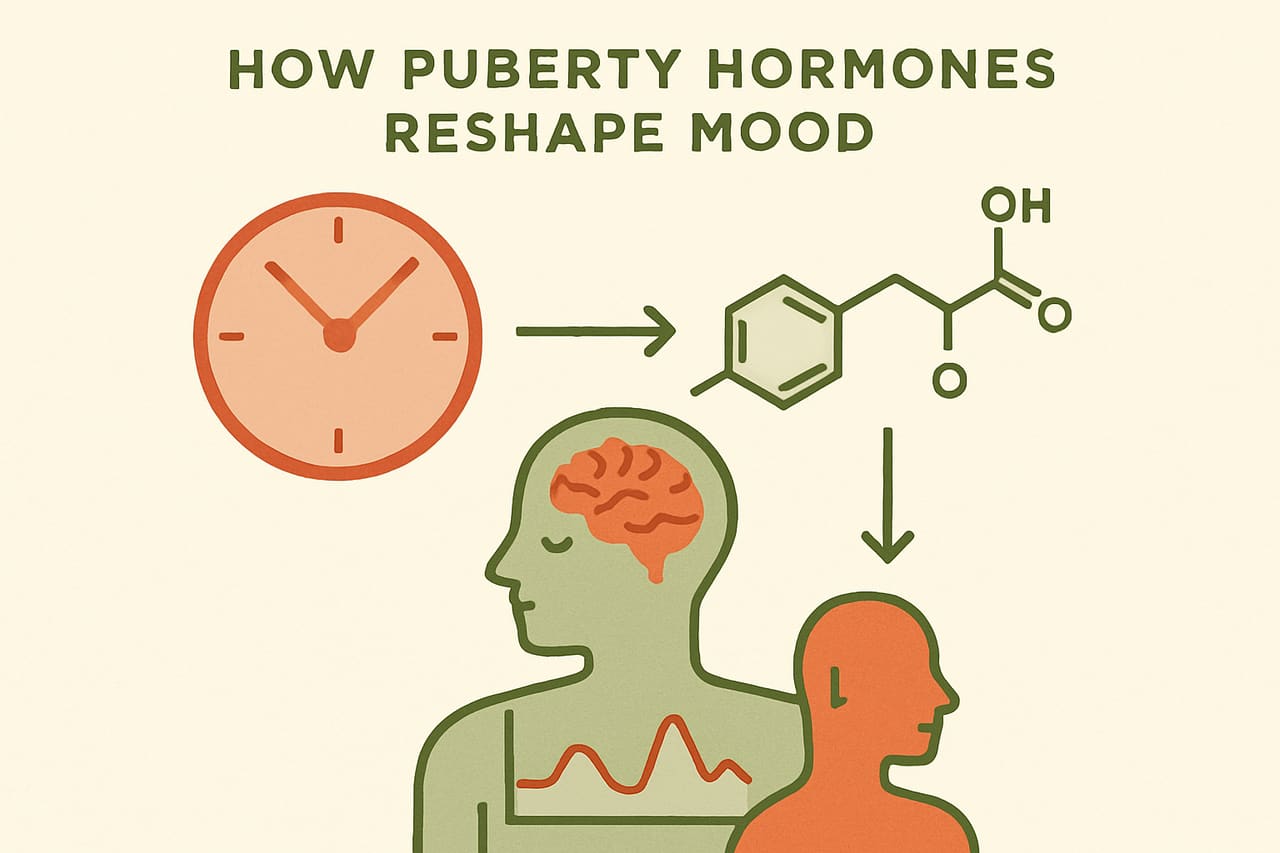
Puberty turns up the emotional gain, not just the growth spurt.
The short version.
The hormonal surges of puberty (testosterone, estrogen, and others) act directly on the brain's emotional and social circuits. They heighten sensitivity to status, attraction, and threat — which is part of why early adolescence can feel like an emotional storm. The intensity is real but usually temporary — as the hormonal system steadies, the emotional swings tend to even out.
What researchers actually find.
- Pubertal hormones change how the brain responds to social and emotional cues, not just the body.
- The timing of puberty matters: earlier-developing teens face social pressures before they're ready for them.
- Mood swings track hormonal change and tend to settle as puberty completes.
- Hormones don't just raise or lower mood; they change how strongly the brain reacts to social wins and losses.
Puberty's hormones don't simply 'cause moods' — they retune the volume on the brain's emotional and social circuits while the parts that regulate those feelings are still under construction. The same surges that reshape the body act on regions that track status, attraction, and threat, making social rewards feel more thrilling and social slights feel more wounding than they did a year earlier. Crucially, the brain's emotional accelerator matures earlier than its prefrontal 'brakes,' so for a stretch teens feel things at full intensity without the mature wiring to dial them back down quickly. Hormones also fluctuate hour to hour and, in girls, across the menstrual cycle, which is part of why mood can swing within a single afternoon. As the hormonal system finds a steadier rhythm and the regulating circuits catch up, the swings usually soften — the storm is a phase of mismatched timing, not a verdict on character.
You might recognize this.
- Tears, slammed doors, and euphoria within the same hour.
- New self-consciousness about appearance and status.
- Early bloomers drawn into older social scenes.
- Sudden sensitivity to teasing or criticism that wouldn't have landed a year ago.
How to help.
- Normalize the storm — say out loud that big feelings are part of a changing body.
- Watch early developers especially; their bodies outpace their experience.
- Don't take the mood swings personally; ride them out with steadiness.
- Name the pattern gently ('bodies in this much change make feelings bigger') so they don't think something's wrong with them.
How this changes by age
For early developers especially, big feelings can arrive before a child has words for them, showing up as stomachaches, clinginess, or sudden tears. Naming the body-feeling link in simple terms ('your body's changing, so feelings get bigger') helps them not feel broken.
This is often the peak of the swings, with euphoria and despair trading places fast and new self-consciousness about appearance and standing. Stay steady and unshocked; your calm is the regulation their own brain can't fully supply yet.
For most, the intensity is starting to settle and they can reflect on their own moods more than before. Treat them as a partner in noticing patterns ('rough week — anything pulling at you?') rather than as a storm to be managed.
Next time a mood blows up out of proportion, resist matching their intensity — say something like 'Your body's doing a lot right now, and that makes everything feel louder; I'm not going anywhere,' then give it room rather than debating the trigger.
Normalizing the storm doesn't mean every dark mood is 'just hormones.' Persistent sadness, withdrawal, or hopelessness that lasts for weeks isn't the ordinary puberty swing and deserves a closer look — the goal is to ride out the normal turbulence without waving off the signs that something more is going on.
This is a plain-words summary of well-established psychology — a map, not a diagnosis. If your teen is struggling in a way that worries you, a pediatrician or licensed mental-health professional is the right next step. In crisis: call or text 988 (Suicide & Crisis Lifeline, 24/7) · text HOME to 741741 · call 911 for immediate danger.