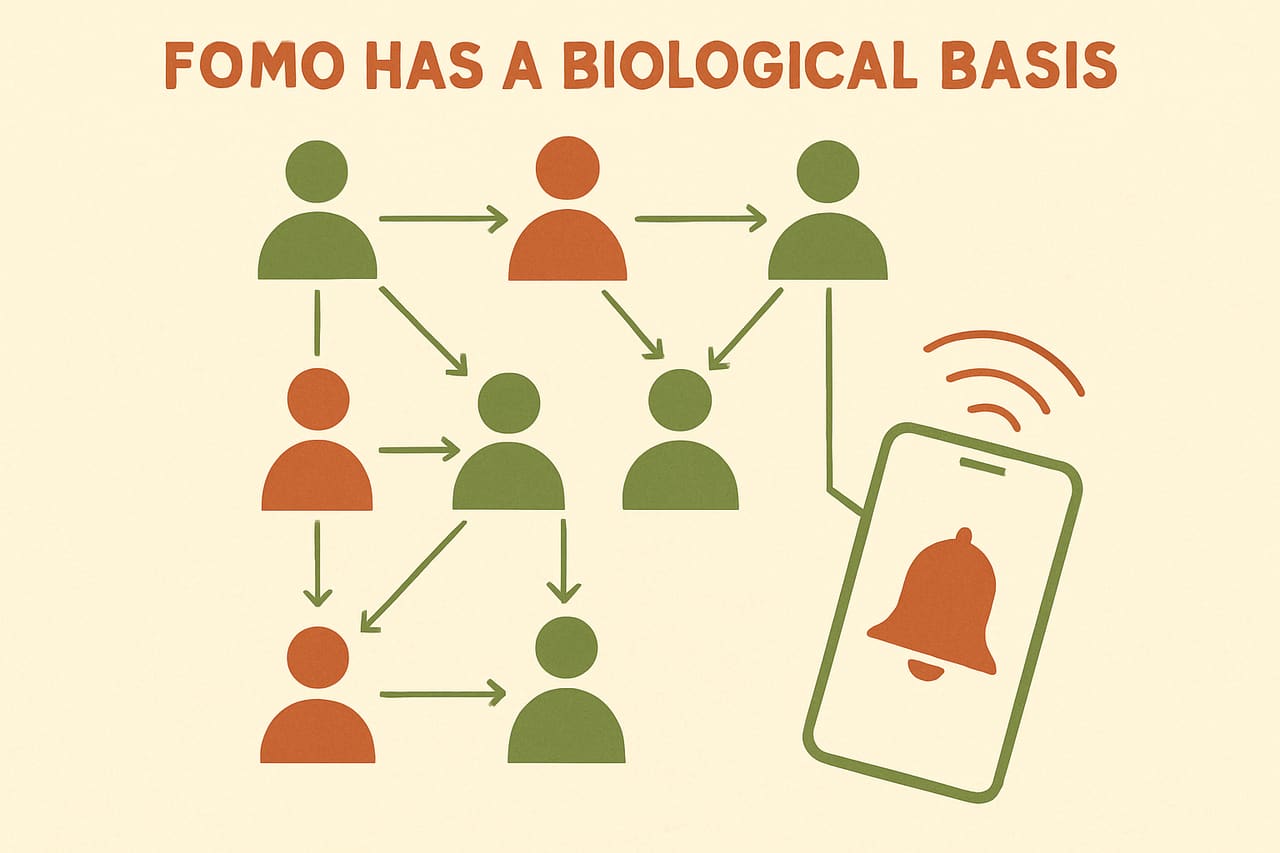
FOMO is the belonging alarm, ringing through a phone.
The short version.
Fear of missing out is the anxiety that others are having rewarding experiences you're absent from. It draws on the deep drive to stay included. Social media makes it constant by broadcasting, in real time, every gathering a teen wasn't part of. Understanding the root helps: it's not vanity, it's the belonging alarm, now wired to a device that never stops broadcasting.
What researchers actually find.
- FOMO is linked to the need to belong and to lower mood and life satisfaction.
- Real-time feeds turn occasional missing-out into an ever-present feed of it.
- It drives compulsive checking, which feeds more FOMO.
- FOMO is linked to lower mood and life satisfaction, and to the compulsive checking that feeds it.
Fear of missing out feels modern, but it's really the ancient belonging alarm wearing a new outfit — the same system that once made being left behind by the group feel dangerous now fires when a teen sees a gathering they weren't part of. The genuinely new ingredient is the broadcast: for most of human history you simply didn't know about the parties and hangouts you missed, but real-time feeds now deliver a live, unfiltered stream of exactly those moments straight to a teen's hand. That turns occasional, fleeting missing-out into a near-constant signal that life is happening elsewhere without them. And because checking the phone briefly soothes the alarm — 'let me just see what's going on' — while also surfacing fresh things to feel left out of, it sets up a loop: the checking quiets the worry for a second and then refuels it. Understanding the root reframes the behavior entirely; the compulsive checking isn't shallow or addictive in some moral sense, it's a deep social drive caught in a device that never stops broadcasting.
You might recognize this.
- Compulsively checking to see what's happening without them.
- Distress over a party or hangout they weren't invited to.
- Difficulty being present because they're monitoring elsewhere.
- Unable to fully enjoy where they are because they're monitoring where they aren't.
How to help.
- Acknowledge the feeling rather than dismissing it as silly.
- Build phone-free zones so the feed can't broadcast every missed moment.
- Cultivate 'JOMO' — the genuine joy of a good night in.
- Create genuine phone-free windows so the broadcast of missed moments simply switches off.
How this changes by age
FOMO usually shows up around group chats and seeing classmates hang out without them, and a single excluded moment can loom large. Keep their access to always-on feeds limited at this age and reassure them that missing one thing doesn't mean being left out of everything.
The social calendar is everything and the phone broadcasts every party, inside joke, and hangout they weren't part of, fueling near-constant checking. Build real phone-free windows so the broadcast simply switches off for a while, and name the feeling out loud rather than dismissing it as silly.
FOMO widens to bigger fears about social standing and even future paths — 'everyone's having a better experience than I am.' Help them notice how monitoring elsewhere steals their actual present, and cultivate the genuine satisfaction of a chosen quiet night rather than a missed loud one.
Create one real phone-free window tonight — dinner, or the last hour before bed — where the device is in another room for everyone, you included. With the broadcast switched off, the belonging alarm finally gets a stretch of quiet, and they get to fully be where they are.
Naming a feeling as FOMO doesn't make it trivial or irrational — the underlying need to stay included is real and worth taking seriously, not waving away. And wanting to be with friends isn't a problem to be cured; the goal is loosening the phone's grip on the alarm, not teaching a teen to stop caring about belonging.
This is a plain-words summary of well-established psychology — a map, not a diagnosis. If your teen is struggling in a way that worries you, a pediatrician or licensed mental-health professional is the right next step. In crisis: call or text 988 (Suicide & Crisis Lifeline, 24/7) · text HOME to 741741 · call 911 for immediate danger.