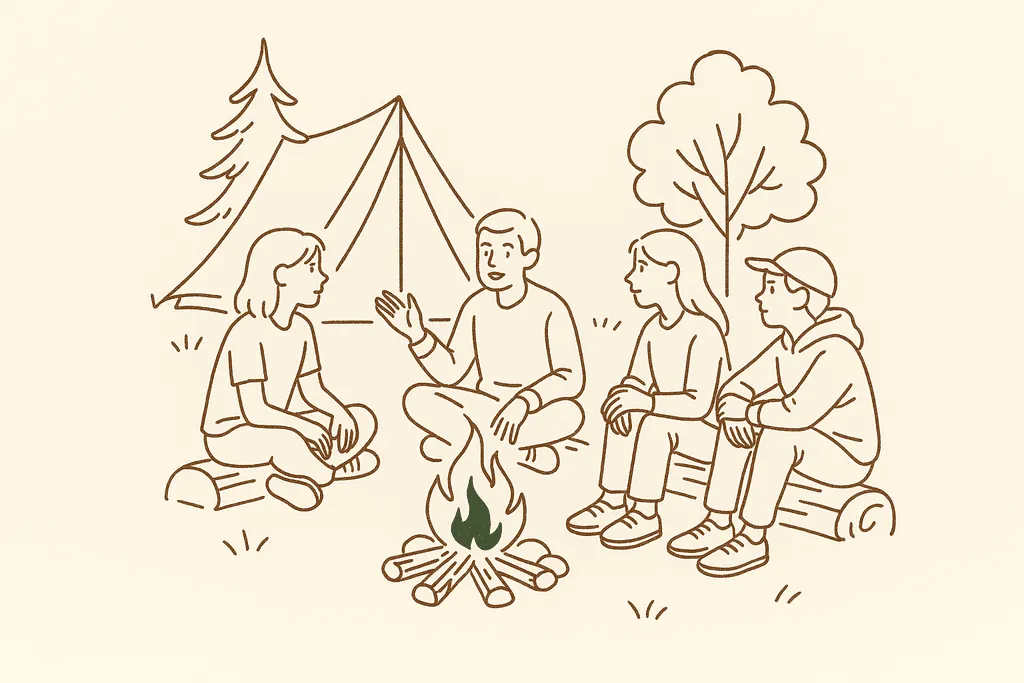
Just five screen-free days measurably improved preteens' ability to read faces and feelings — face-to-face time is the practice ground.
- Reading faces and feelings is a skill that improves with practice, and in-person time is the practice.
- Even a brief, well-bounded break from screens can produce noticeable gains, so unplugging doesn't have to be drastic to count.
- Treat shared face-to-face moments as the workout, not the waiting room between more important things.
- Your own undistracted attention is part of the lesson — teens learn nonverbal cues by reading the people in front of them.
The situation, the move, the outcome.
UCLA researchers sent 51 sixth-graders to a five-day outdoor education camp with no TV, phones or internet, and compared them to classmates who stayed plugged in. After just five days, the camp group got significantly better at reading emotions: their errors interpreting photographed facial expressions dropped from about 14 to roughly 9, and they improved at reading emotions in videotaped scenes too — while the comparison group showed essentially no change. Lead author Yalda Uhls put it plainly: you can't learn nonverbal cues from a screen the way you learn them face-to-face.
The mechanism is straightforward: nonverbal signals — a flicker of the eyes, a shift in tone, a half-smile — are learned by encountering them live and getting feedback in real time. Screens flatten or remove most of those cues, so heavy screen time offers far less of this practice. Remove the screens for a stretch and fill the space with ordinary in-person interaction, and a teen gets concentrated reps at reading other people. The skill responds quickly because it was never lost, only under-exercised.
Why it matters beyond one family.
The study is a clean demonstration that face-to-face time is a skill-builder, not just a nicety — and that even a short break restores ground quickly. It reframes 'unplugging' as practice for the social skills teens will use for life.
This generalizes because the finding isn't really about camp or about any single device — it's about where social skills are built. Any setting that puts a teen in sustained, face-to-face contact with others does the same work, whether it's a family meal, a team, a club or a trip. The practical takeaway for parents is that you don't need a special program to recreate the effect; you need protected pockets of undistracted time. The point isn't to demonize screens but to make sure the in-person practice ground doesn't quietly disappear.
- A short, realistic intervention produced a measurable improvement, which means meaningful change doesn't require a long digital detox.
- The study reframes unplugging as building a lifelong skill rather than just removing something.
- It points to an easy, low-cost move any family can copy: protect a little regular face-to-face time.
- The gains showed up quickly, which is genuinely encouraging for parents worried it might be too late.
How to apply it.
- Protect regular chunks of screen-free, face-to-face time — meals, outings, camps.
- Treat in-person time as practice for emotional skills, not lost productivity.
- Look for device-light camps, trips or activities your teen will genuinely enjoy.
I'd love it if we kept phones off the table at dinner — both of us, me included.
Why? I'm not even on it that much during dinner.
Honestly it's more for me. I notice I miss what you're saying when I'm half-checking it.
I guess that's fair.
It's just dinner — twenty minutes. We can both grab them after.
Okay. Deal. But you can't sneak-check it either.
Agreed. Call me out if I do.
Concrete next steps.
- Build a recurring screen-free ritual (game night, hikes, a weekly family meal).
- Consider an outdoor or device-free camp during breaks.
- Model undistracted attention yourself during shared time.
Read it for yourself.
Call or text 988 (Suicide & Crisis Lifeline, 24/7) · Text HOME to 741741 (Crisis Text Line) · Find a child psychiatrist at aacap.org · For immediate danger, call 911.