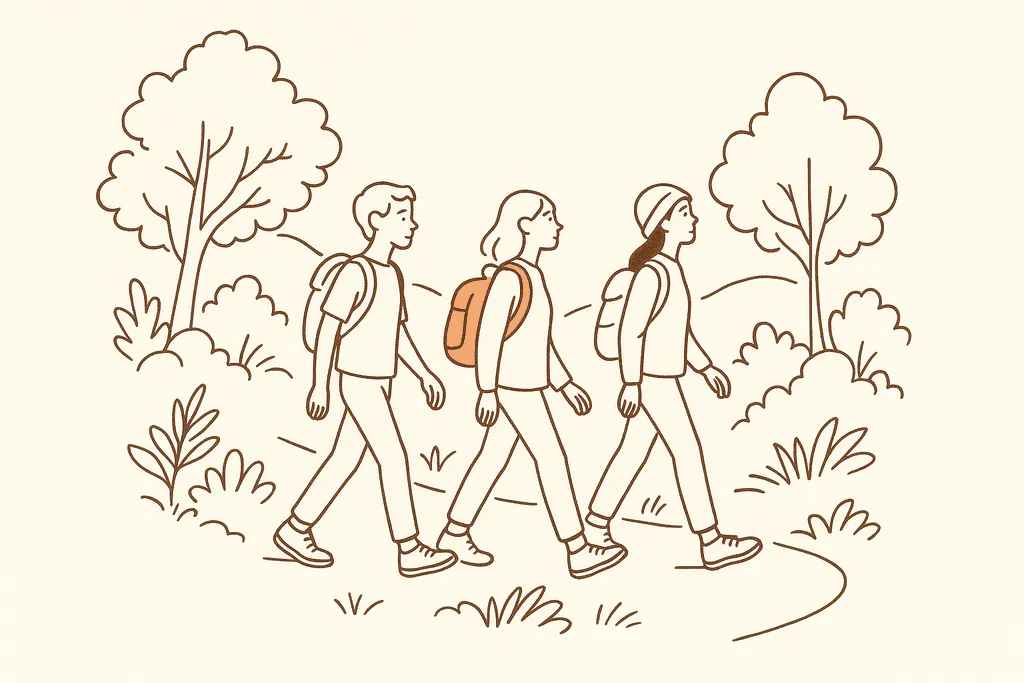
Green time is brain time: about two hours a week in nature is linked to real gains in teen wellbeing and resilience.
- Treat outdoor time as a real input for wellbeing, not just leftover recreation.
- Making green time social or active is what turns it from a chore into something teens choose.
- Small, regular doses outdoors are more sustainable than occasional big outings.
- Even modest local green space counts — you don't need a wilderness to get the benefit.
The situation, the move, the outcome.
A growing body of research finds that time in nature benefits adolescent mental health. A meta-review reported that every review examining under-18s supported nature's benefits, spending at least about 120 minutes a week in green space is associated with good health and wellbeing, and a nationwide study of over 900,000 people found that children who grew up with the least green space had up to 55% higher risk of developing a psychiatric disorder later, independent of other factors.
In practice, the move is less about any single hike and more about working a regular dose of the outdoors into the rhythm of the week. Time outside seems to lower the background level of stress, give attention a chance to recover, and quietly nudge a teen toward movement and being around other people — all things that tend to be in short supply during an indoor, screen-heavy stretch. Because it stacks several benefits at once, even an unremarkable walk in a nearby park is doing more than it looks like. The families who keep it going usually make it pleasant and social rather than framing it as another rule to obey.
Why it matters beyond one family.
Nature appears to moderate stress, support attention and self-discipline, and encourage physical activity and social connection — a low-cost, accessible buffer in an indoor, screen-heavy childhood.
This generalizes because the mechanisms at work — easing stress, restoring focus, encouraging activity and connection — aren't tied to any particular landscape, which is why ordinary local green space appears to help, not only dramatic scenery. For a generation spending so much of childhood indoors and on screens, a regular outdoor habit functions as a broadly available counterweight rather than a niche intervention. It also pairs naturally with other healthy habits, so the same outing can deliver movement and face-to-face time alongside the calm of being outside. The practical reading is that protecting some recurring green time is one of the simpler, more accessible inputs a family has for a teen's mental health.
- It's low-cost and widely accessible, so most families can act on it without special resources.
- The benefit shows up consistently across the research on young people, which makes it dependable.
- It naturally bundles other goods — movement, connection, and a break from screens.
- It gives parents a positive thing to add rather than only a screen habit to subtract.
How to apply it.
- Build in regular outdoor time — aim toward roughly two hours a week.
- Make it social or active (walks, sports, parks) so teens want to go.
- Treat green time as a genuine mental-health input, not just recreation.
I'm walking the loop by the creek before dinner — come keep me company?
It's kind of cold and I'm in the middle of something.
Twenty minutes, no agenda. You can pick the music for the walk.
Fine. But we're not power-walking, I'm tired.
Deal. Slow is the whole point, honestly — I just want out of the house for a bit.
...It is kind of nice out here when the light's like this.
Right? Want to make this our thing a couple nights a week?
Maybe. If I get to pick the route sometimes.
Concrete next steps.
- Schedule recurring outdoor activities the whole family enjoys.
- Swap some indoor screen time for parks, trails or sport.
- Advocate for green space around schools where you can.
Read it for yourself.
Call or text 988 (Suicide & Crisis Lifeline, 24/7) · Text HOME to 741741 (Crisis Text Line) · Find a child psychiatrist at aacap.org · For immediate danger, call 911.