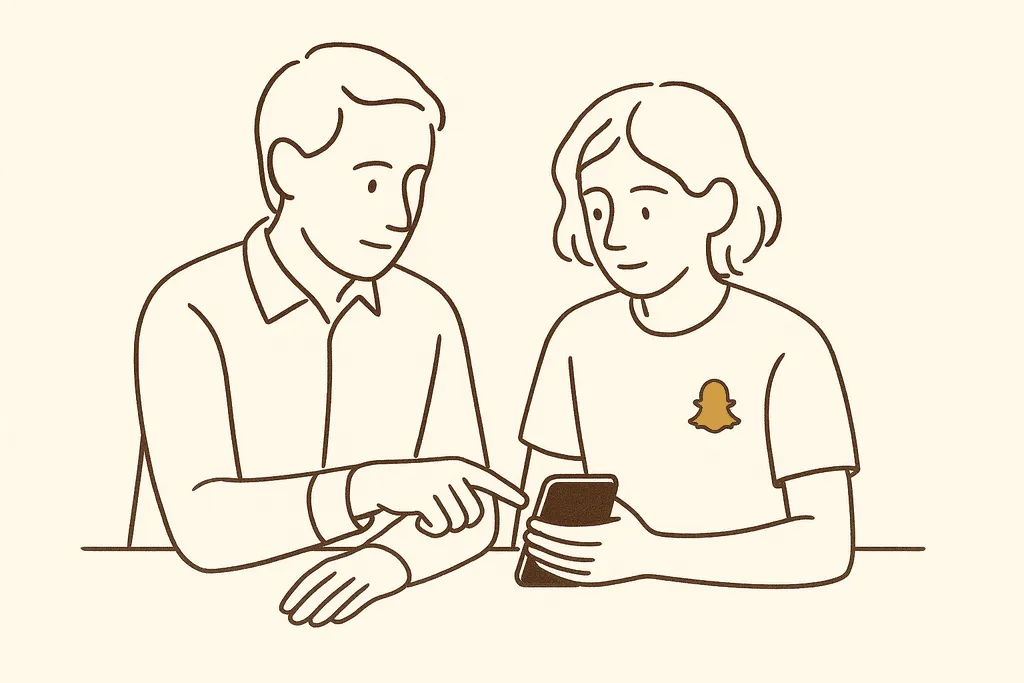
Parental tools that require the teen's buy-in — insight, not secret surveillance — tend to build trust while still improving safety.
- Pick oversight tools your teen has agreed to, because consent is what keeps them working over time.
- Read shared signals like screen time or new contacts as conversation openers, not as evidence to prosecute.
- Sit down and do the built-in safety lessons together rather than assigning them.
- Loosen the settings as your teen demonstrates judgment, so oversight tracks growing autonomy.
The situation, the move, the outcome.
Snapchat launched Family Center in 2022 and has expanded it since. It lets a parent see who their teen is friends with and how much time they spend on the app — broken down by feature — without ever reading their messages, and it embeds a digital-safety course meant to be done together. Crucially, it only works if the teen accepts the invitation to link accounts, which by design makes it a conversation tool rather than a stealth surveillance app.
In practice the tool draws a deliberate line: a parent can see context — connections and time spent, broken down by feature — but never the content of conversations. That boundary is what lets it add oversight without feeling like surveillance, and it's reinforced by the requirement that the teen actively accept the link. Because setup is a shared act, the most useful outcomes come from treating the visible signals as prompts for low-key conversation rather than as a scoreboard. The accompanying safety course extends the same philosophy, turning a settings screen into a moment of joint learning.
Why it matters beyond one family.
The design philosophy is the lesson: transparency builds trust. Tools that require a teen's cooperation tend to strengthen the relationship while still adding real oversight, whereas secret monitoring often backfires.
The principle generalizes well beyond one app: transparency-based oversight tends to preserve trust, while covert monitoring tends to corrode it once discovered. The reason is relational — a teen who knows the terms can buy into them, whereas secret tracking teaches that the relationship runs on suspicion. Framed this way, the specific features matter less than the stance: oversight a teen knows about and can grow out of. Families can apply that test to any tool they consider, asking not only what it sees but whether the teen agreed to it.
- It deliberately keeps messages private, so oversight never tips into reading a teen's conversations.
- Because it only activates with the teen's acceptance, it nudges families toward a conversation instead of a stealth install.
- It bundles a safety course meant to be done together, building shared understanding rather than rules from above.
- Its consent-based design tends to strengthen the relationship while still adding genuine oversight.
How to apply it.
- Choose oversight tools your teen knows about and agrees to.
- Use shared insights (time, new friends) as conversation starters, not verdicts.
- Do the built-in safety lessons together.
I'd like us to set up the Family Center thing on Snapchat. I want to be upfront that I'm asking, not sneaking.
So you'll be able to read all my messages now?
No — that's the part I like. It can't show me your messages at all. Just who you're friends with and roughly how much time you spend.
Then what's the point of it for you?
Mostly peace of mind, and a reason for us to talk if something looks off. It only turns on if you accept the invite.
Okay, that feels more fair than spying.
That's the idea. And there's a short safety lesson built in — want to do it together this weekend?
Sure. As long as we can adjust it later if I show you I'm handling things.
Deal. That's exactly how I want it to work — more freedom as you earn it.
Concrete next steps.
- Set up Snapchat Family Center with your teen's participation.
- Pair platform tools with ongoing, judgment-free conversation.
- Revisit settings as your teen earns more autonomy.
Read it for yourself.
Call or text 988 (Suicide & Crisis Lifeline, 24/7) · Text HOME to 741741 (Crisis Text Line) · Find a child psychiatrist at aacap.org · For immediate danger, call 911.