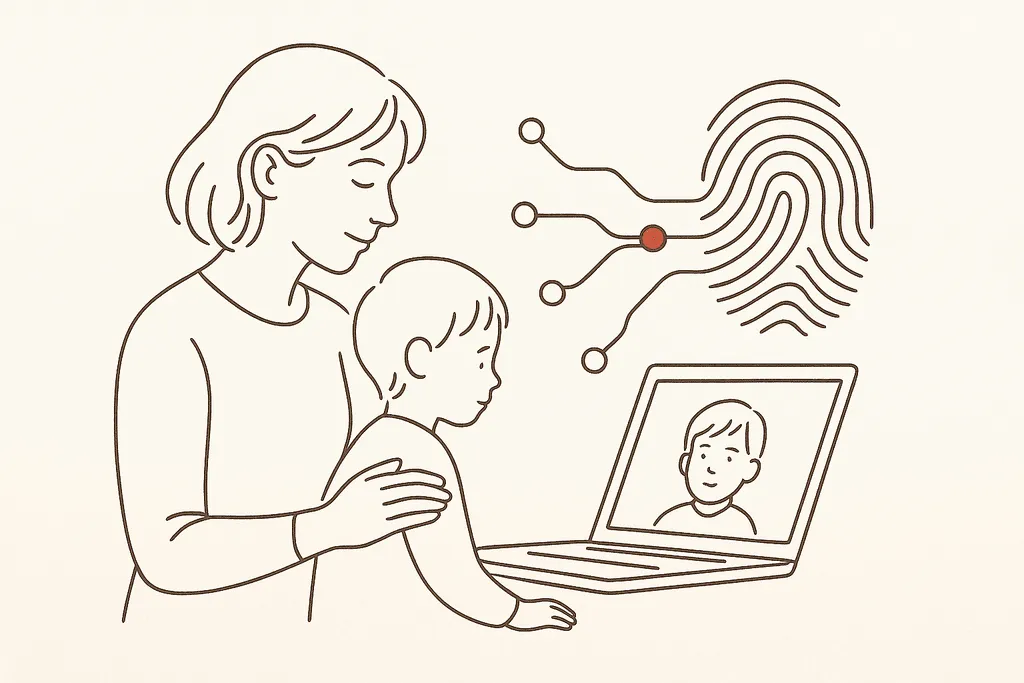
Privacy-preserving image-matching lets platforms automatically catch known abuse material — quietly powering most of the tips that rescue kids.
- Major platforms already scan automatically for known abuse images, so you're not the last line of defense.
- If you ever encounter suspected abuse imagery, report it to NCMEC rather than investigating or saving it yourself.
- Where you have a choice, favor platforms that take part in hashing and safety programs.
- For a young person's own images, dedicated removal tools exist and are the right first call.
The situation, the move, the outcome.
In 2009, Microsoft and Dartmouth built PhotoDNA and donated it to the National Center for Missing & Exploited Children. It converts an image into a numerical fingerprint, or hash, and matches it against a database of known child sexual abuse material — without a human 'looking at' anyone's photos. Used by Google, Facebook, Reddit, Discord and many others, it has helped detect and remove millions of images, convict offenders, and in some cases rescue victims. One investigator estimated about 90% of her cases now originate from PhotoDNA-powered CyberTipline reports.
In practice the technology turns each image into a numerical fingerprint and compares only those fingerprints against a database of known illegal material, so the matching happens without a person viewing ordinary users' photos. That design is what lets it run at enormous scale across many platforms while leaving private images private. For a family, the practical upshot is reassurance and a clear division of labor: the scanning is already happening, and the right move on encountering suspected material is to report through official channels rather than collect evidence personally. The tools meant for a young person's own images live in a separate, purpose-built lane.
Why it matters beyond one family.
PhotoDNA shows that safety and privacy aren't opposites: hashing catches known illegal content automatically while keeping ordinary users' images private. It's invisible infrastructure doing enormous good.
The case generalizes because it overturns a common assumption that protecting children online must come at the cost of everyone's privacy. By matching fingerprints rather than inspecting content, the same principle could inform how other safety problems are approached — automatically flagging the known-harmful while leaving the ordinary untouched. It also models a useful mental boundary for parents: some problems are best handed to specialized infrastructure rather than managed at home. Recognizing that this 'invisible' layer exists helps families act calmly and correctly instead of improvising in a moment of alarm.
- It demonstrates that strong safety and user privacy can coexist rather than trade off.
- It was donated for the public good, which let it spread across many major platforms at no cost.
- It runs quietly in the background, doing large-scale protective work without exposing ordinary photos.
- Investigators credit it as the source of a large share of the tips that lead to real-world rescues.
How to apply it.
- Understand that major platforms already scan for known abuse material.
- Report suspected abuse imagery to NCMEC rather than handling it yourself.
- Favor platforms that participate in hashing and safety programs.
Someone in a group chat posted something that looked like an abuse image. I screenshotted it to show you.
Thank you for coming to me right away. The one thing we shouldn't do is keep or forward that image, even as proof.
Wait, why not? I thought we'd need it.
Saving it can actually be harmful and isn't ours to handle. The right people have tools built for exactly this.
So what do we do instead?
We delete the screenshot and report it to NCMEC's CyberTipline, with the details of where you saw it.
That feels better than just sitting on it.
It is. You handled the hard part by telling me — now we let the system that's built for this take over.
Concrete next steps.
- Report to NCMEC's CyberTipline (CyberTipline.org) or the IWF (UK).
- Use Take It Down / StopNCII for a young person's own images.
- Keep evidence and involve the FBI where there's coercion.
Read it for yourself.
Call or text 988 (Suicide & Crisis Lifeline, 24/7) · Text HOME to 741741 (Crisis Text Line) · Find a child psychiatrist at aacap.org · For immediate danger, call 911.