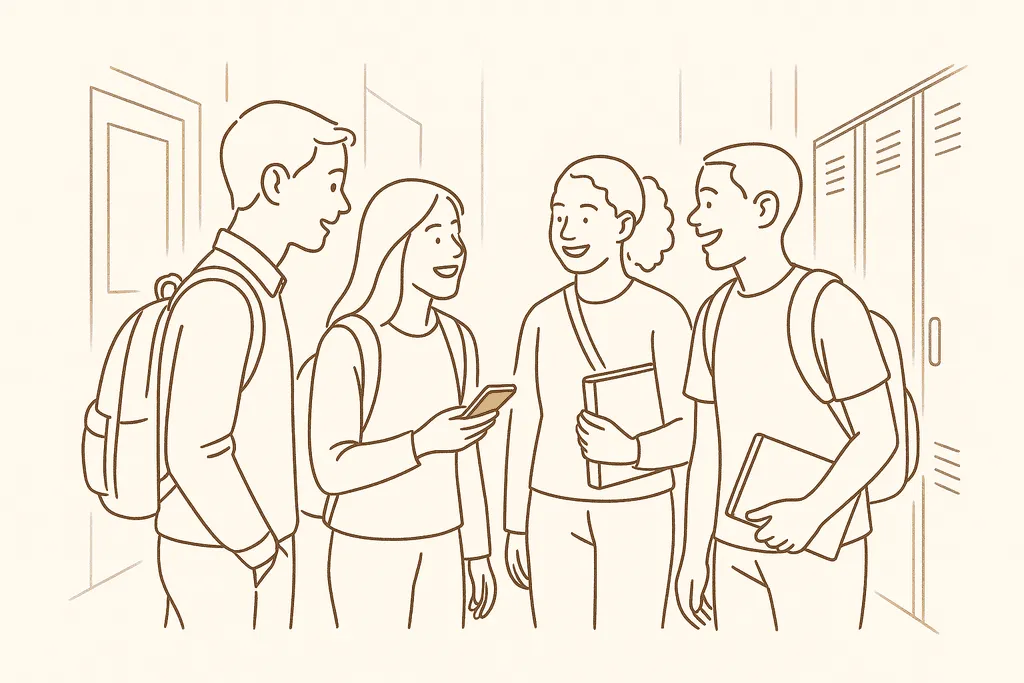
Done consistently and not just punitively, phone-free schools cut in-school bullying and brought back face-to-face connection.
- How a phone policy is rolled out shapes its results as much as the rule itself.
- Clear and consistent beats harsh and punitive when it comes to school device rules.
- Removing the constant pull of notifications gives kids more room to connect in person.
- Family device-free times reinforce at home what a phone-free school is teaching.
The situation, the move, the outcome.
Beyond test scores, the social effects of phone-free schools have surprised educators. In RAND and related surveys, large majorities of principals reported a better school climate after bans, and about 54% said the policy helped reduce cyberbullying that starts during the school day. Districts that went bell-to-bell describe students who are more social, more engaged, and freed from constant notification pressure — with staff spending time teaching instead of policing devices.
On the ground, a phone-free policy changes the texture of the school day more than any single test score would suggest. With devices stored away bell-to-bell, the low hum of notifications and group-chat drama loses its foothold during class hours, so the conflicts that used to spill from a phone into the hallway have fewer openings to start. Teachers stop refereeing screens and get their attention back, and students rediscover the ordinary social friction of lunch tables and passing periods. The schools that report the best results tend to be the ones that made the rule predictable and uniform rather than a source of constant disciplinary standoffs.
Why it matters beyond one family.
The evidence isn't uniform: a minority of studies found bans could backfire when enforced punitively, souring the school climate. The takeaway researchers draw is that how a ban is rolled out — clear, consistent, not purely disciplinary — matters as much as the ban itself.
This generalizes because the lesson isn't really about phones — it's about how change is introduced. A rule that everyone understands and that applies evenly tends to be accepted, while one enforced as a series of punishments breeds resentment that can sour the whole environment. That is why the minority of cases where bans backfired share a common thread of punitive rollout. Families can apply the same principle at home: clear, consistent expectations that everyone follows land far better than surprise crackdowns.
- Most principals reported a calmer climate and more face-to-face connection after going phone-free.
- A majority said the policy helped curb cyberbullying that used to start during the school day.
- Staff got to spend their time teaching instead of policing devices.
- The mixed cases pointed to a fixable cause — punitive enforcement — rather than the idea itself failing.
How to apply it.
- Support clear, consistently applied policies over punitive crackdowns.
- Ask how your school handles enforcement so it doesn't worsen the climate.
- Reinforce face-to-face connection at home — model putting your own phone away.
School's making us lock our phones in pouches all day now. It's so annoying.
I can see why that's a big change. What's the actual day like without it?
Honestly lunch is kind of louder. People talk more.
That tracks with what a lot of schools are seeing. How's it being handled — does it feel fair?
Mostly. Everyone's in the same boat, so no one's getting singled out.
That's the part that matters most to me. If it ever starts feeling like a 'gotcha,' tell me and I'll raise it with the school.
It's fine, I guess. I just miss checking it.
Fair enough. How about we try our own phone-free dinner so it's not just a school thing?
Concrete next steps.
- Share the principal-survey data with your PTA or board.
- Advocate for storage solutions (pouches/lockers) plus a fair discipline plan.
- Pair school policy with family device-free times so the message is consistent.
Read it for yourself.
Call or text 988 (Suicide & Crisis Lifeline, 24/7) · Text HOME to 741741 (Crisis Text Line) · Find a child psychiatrist at aacap.org · For immediate danger, call 911.