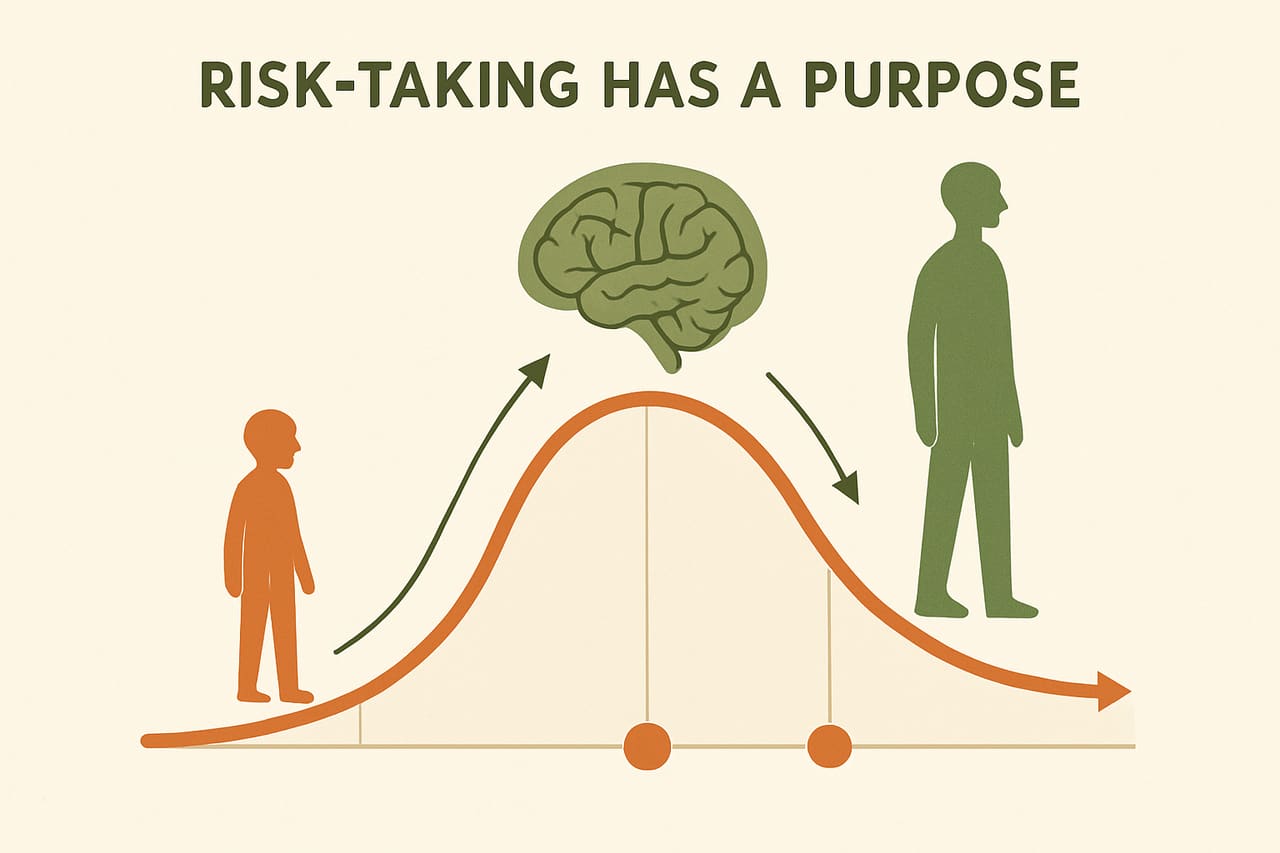
Healthy risk is how teens grow; the aim is to aim it.
The short version.
Adolescent risk-taking evolved for a reason: leaving the familiar, trying new things, and braving social and physical challenges are how a young person builds an independent life. Risk isn't only danger — it's also auditions, tryouts, asking someone out, and speaking up. The aim was never to eliminate the drive — that would mean a teen who never tries, auditions, or steps up.
What researchers actually find.
- Risk appetite supports learning, exploration, and independence.
- The drive can be channeled into positive challenges, not just dangerous ones.
- Teens offered bold, healthy challenges seek fewer harmful thrills.
- Teens offered bold, healthy challenges tend to seek out fewer dangerous thrills.
Underneath the boldness is a timing mismatch in how the teen brain matures: the reward and sensation-seeking systems come online early and run hot, while the slower-developing control circuits are still catching up. That gap isn't a defect — it's what makes a teen willing to leave the familiar, audition, speak up, and try things an adult would talk themselves out of. The drive intensifies especially around peers, because social reward feels enormous at this age. The key insight is that the appetite for risk is fairly fixed, but its target is not. When you stock a teen's life with bold, meaningful challenges, that same energy has somewhere worthwhile to go — which is why exciting healthy outlets tend to crowd out the harmful ones rather than simply suppressing the urge.
You might recognize this.
- Drawn to intensity and challenge.
- Bored by the safe and predictable.
- Energized by adventure, performance, and competition.
- Coming alive in the face of a real challenge, performance, or competition.
How to help.
- Offer positive risks — sports, performance, travel, public speaking.
- Aim the drive rather than trying to switch it off.
- Let them stretch and sometimes fail in safe arenas.
- Stock their life with positive risks so the drive always has somewhere worthwhile to go.
How this changes by age
The drive shows up as restlessness and a hunger for 'big kid' freedoms more than truly dangerous acts. Give small, real stretches — a harder team, a solo errand, a stage — so risk gets paired early with effort and pride rather than secrecy.
Sensation-seeking peaks and the audience of peers makes everything feel higher-stakes, so dares and impulsive choices spike. Offer intense, supervised arenas — competition, performance, adventure — and stay calm about small failures so the thrill stays in safe territory.
Risk gets more deliberate and identity-driven: new relationships, driving, leaving home, taking a real shot at something. Shift from gatekeeping to coaching the judgment — talk through trade-offs and exits rather than just forbidding, since they'll soon be making these calls alone.
Name one bold, healthy challenge your teen could actually pursue this month — a tryout, an open mic, a hard class, a trip — and say, 'That sounds like your kind of thing. Want to go for it?' You're aiming the drive, not arguing with it.
This doesn't mean all risk is good or that danger should be waved through — serious, irreversible risks still need firm limits. Channeling the drive lowers the pull toward harmful thrills; it doesn't erase it, and it isn't a substitute for supervision where stakes are high.
This is a plain-words summary of well-established psychology — a map, not a diagnosis. If your teen is struggling in a way that worries you, a pediatrician or licensed mental-health professional is the right next step. In crisis: call or text 988 (Suicide & Crisis Lifeline, 24/7) · text HOME to 741741 · call 911 for immediate danger.