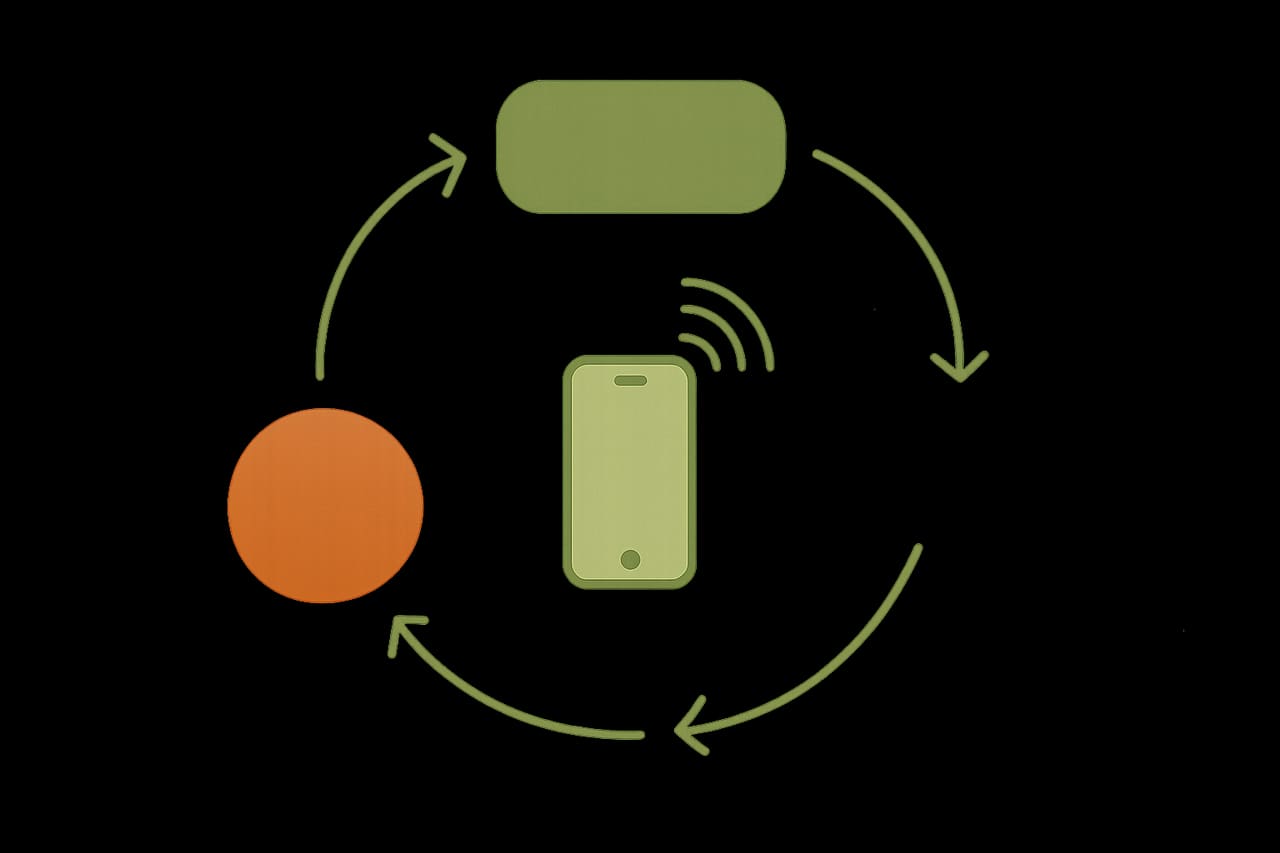
A silent phone on the desk still steals attention.
The short version.
Adrian Ward and colleagues at UT Austin ran a series of experiments in 2017 (published in the Journal of the Association for Consumer Research) showing that people who put their phone face-down on the desk performed worse on cognitive tests than those who put it in a bag, and those people performed worse than those who put it in another room. Crucially, this was true even when the phone was silenced and turned off. The brain spends ongoing inhibitory effort not attending to a phone in eyesight — and that effort comes out of the pool available for the actual task.
What researchers actually find.
- In Ward et al. (2017), participants completed working-memory and fluid-intelligence tasks with their phone either in another room, in a bag, or face-down on the desk. Performance dropped with proximity.
- Phone owners reported they weren't thinking about their phone — but the cognitive cost showed up anyway. Self-report and performance diverge.
- Effect size was largest in people who described themselves as most phone-dependent — the people who claim they 'aren't affected' showed the biggest drop.
- Related research from Stanford (Ophir, Nass, Wagner) shows heavy media multitaskers perform worse on tests of attention and task-switching, not better as they often believe.
You might recognize this.
- A two-hour 'study session' producing 20 minutes of actual work — phone face-up on the desk the whole time.
- Homework taking twice as long as it should and the teen genuinely not knowing why.
- Grades not matching effort hours — because the effort hours are mostly switching cost.
- Conversations that don't land because everyone at the table has a phone in their peripheral vision.
How to help.
- Phone in another room during the study block. Not face-down, not silent — gone. This single move outperforms any app blocker, parent monitoring system, or willpower-based plan.
- Build a 'study room' that doesn't have a phone in it — kitchen table, library, friend's dining room. Bedrooms are the hardest place to enforce this.
- Phones-in-a-basket at meals. Not a punishment — a focus tool. The presence-effect is real for adults too.
- Try 50/10: 50 minutes phone-free, 10 minutes full access. Most teens prefer it once they try.
This is a plain-words summary of well-established psychology — a map, not a diagnosis. If your teen is struggling in a way that worries you, a pediatrician or licensed mental-health professional is the right next step. In crisis: call or text 988 (Suicide & Crisis Lifeline, 24/7) · text HOME to 741741 · call 911 for immediate danger.