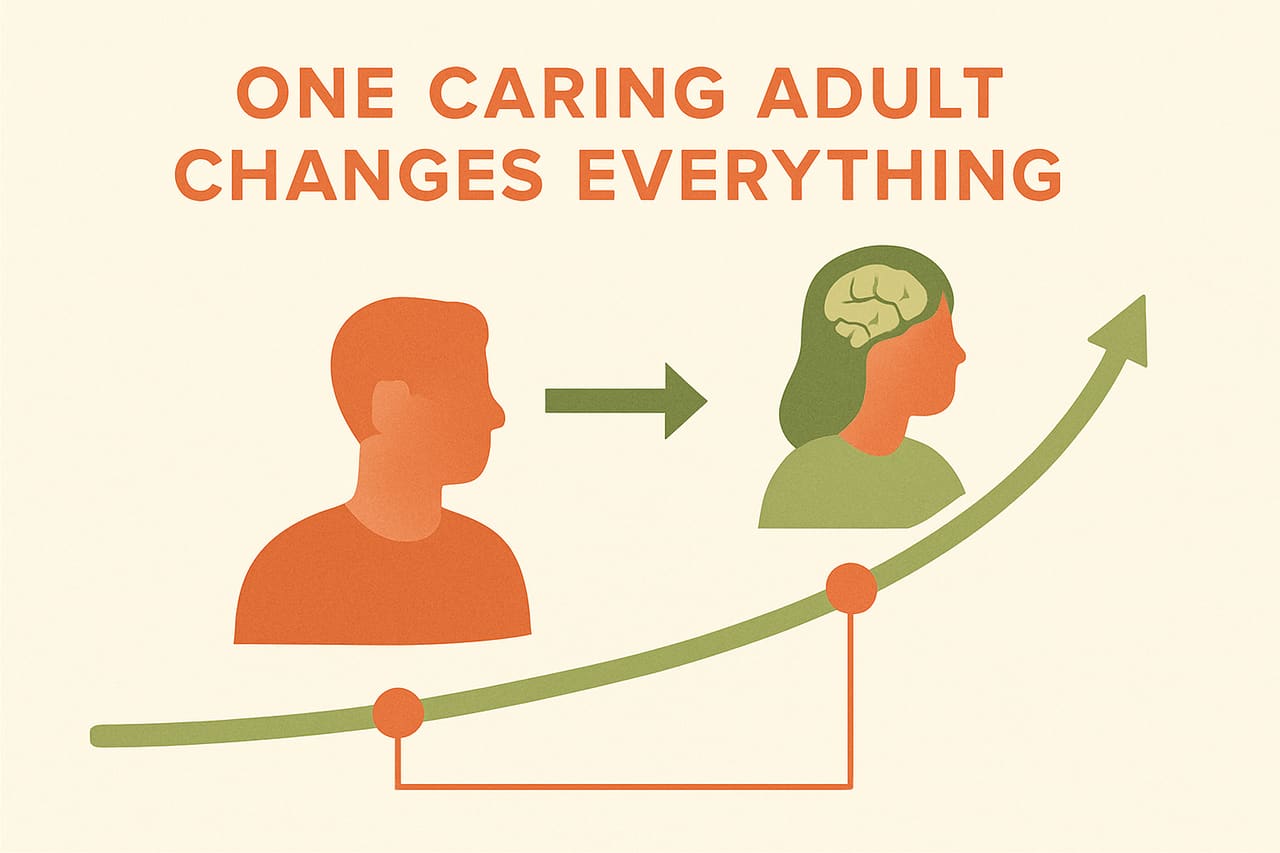
One reliable adult is the strongest protection a teen can have.
The short version.
Resilience research keeps landing on the same finding: the presence of at least one stable, caring adult relationship is the strongest predictor that a teen will come through hardship okay. It doesn't have to be perfect parenting — it has to be reliable, warm, and present. It doesn't require perfect parenting — just one relationship that is reliably warm and present.
What researchers actually find.
- A stable caring adult is the most consistent protective factor in resilience research.
- The relationship buffers stress at a biological level.
- It can be a parent, relative, coach, or mentor — presence matters more than role.
- The protective effect of a caring adult shows up at a biological level, buffering the stress response.
The mechanism behind this finding is partly biological and partly about meaning. A reliable, warm relationship acts like a buffer on the stress system — when a teen knows someone steady has their back, the same hardship registers as more survivable, and the body's stress response settles faster. It also gives them a working model of being worth showing up for, which shapes how they handle later relationships and risk. What matters most is reliability over intensity: predictable, ordinary presence — being there at pickup, noticing, following through — does more than rare grand gestures. And the role is flexible; the protective effect comes from the relationship itself, so a coach, grandparent, teacher, or mentor can carry it when a parent can't. It also doesn't require perfection, which takes real pressure off parents.
You might recognize this.
- Doing better through hard times when they feel genuinely backed by someone.
- Seeking out trusted adults — sometimes you, sometimes another.
- Steadier when at least one relationship feels rock-solid.
- Steadier through hard times whenever at least one relationship feels rock-solid.
How to help.
- Prioritize the relationship over being right; connection is the protection.
- Be reliably present — small, consistent moments beat grand gestures.
- Welcome other caring adults (coaches, relatives, mentors) into their life.
- If you can't be that adult right now, help connect them to one — a coach, relative, or mentor counts.
How this changes by age
Presence is concrete at this age — showing up, shared routines, and being interested in their world build the felt sense of 'someone reliable has me.' Protect small recurring moments (the drive to practice, bedtime check-ins) over big outings.
They may push you away while needing the anchor more than ever, and other adults start to matter intensely. Stay steadily available without forcing closeness, and welcome trusted coaches, relatives, or mentors instead of treating them as competition.
As they pull toward independence, the relationship shifts from supervision to a secure base they launch from and return to. Keep the door open and the judgment low so that when something big goes wrong, you're still the one they call.
Pick one small, repeatable moment you can reliably show up for this week — a ride, a shared show, ten minutes at bedtime — and just be there for it, no agenda. Reliability is the whole point.
'One caring adult' is the strongest single protective factor, but it's not a guarantee or a substitute for real help — a steady relationship lowers risk, it doesn't immunize a teen against serious mental-health, safety, or family problems that may also need professional support. It also doesn't have to be the parent; if you can't be that person right now, connecting them to someone who can still counts.
This is a plain-words summary of well-established psychology — a map, not a diagnosis. If your teen is struggling in a way that worries you, a pediatrician or licensed mental-health professional is the right next step. In crisis: call or text 988 (Suicide & Crisis Lifeline, 24/7) · text HOME to 741741 · call 911 for immediate danger.