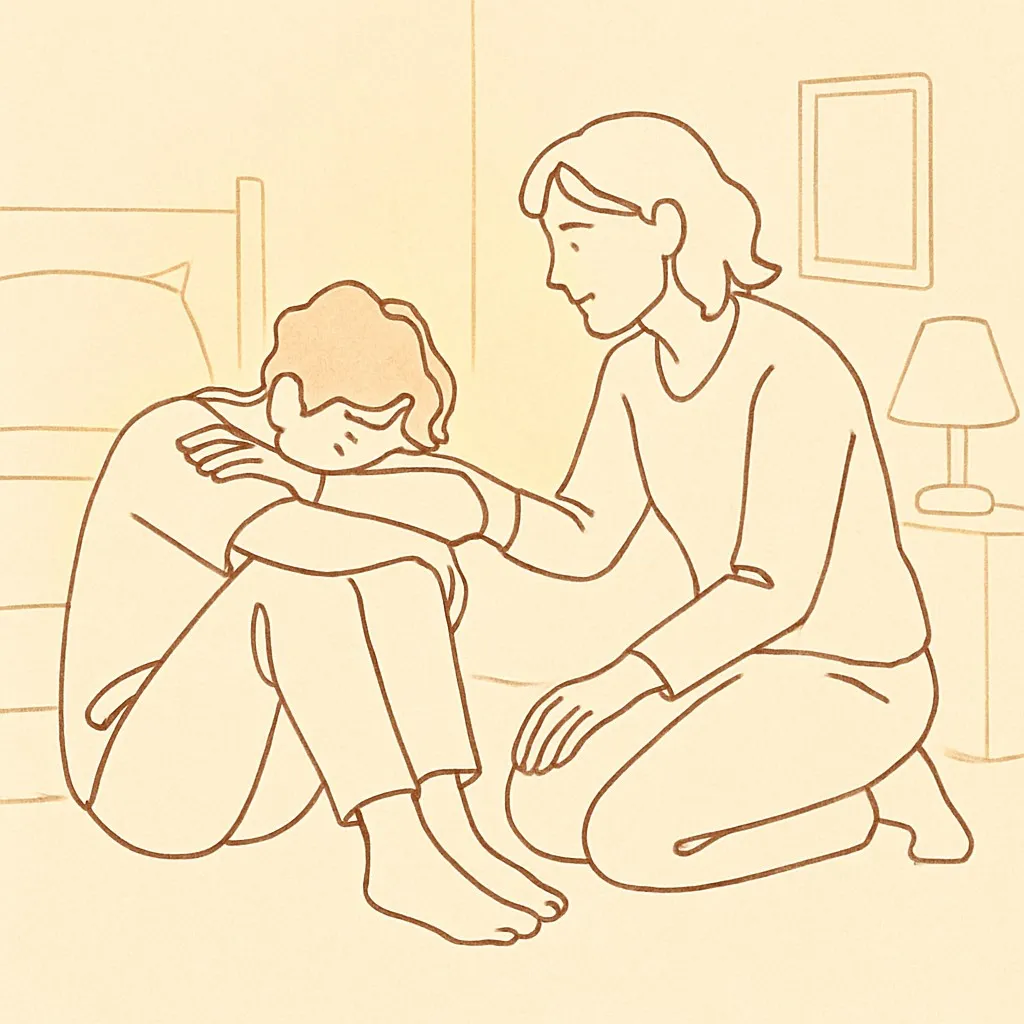
What's happening.
Your 15-year-old, voice flat: “I think I'm having panic attacks. Like, three times this week.” You hold both the urge to comfort and the urge to schedule.
What we usually say — and why it backfires.
Oh honey, everyone gets anxious. You'll be fine, it's just teenager stuff.
It's not just anxious. I literally can't breathe. I think I'm dying.
You're not dying, you're just stressed about school.
(decides they're alone with this and stops telling you)
- “Everyone gets anxious” is the dismissal that closes the door on the bigger conversation. Panic attacks are a specific physiological event, not generic stress.
- “You're not dying” skips the part where the teen FEELS like they are during one — which is the actual hard part of a panic attack.
- “Just stressed about school” presumes a cause without asking. Often the cause isn't school at all.
What works — and why.
Three times this week is real. Walk me through what it feels like when it happens — physically.
Heart racing, can't catch my breath, hands tingle, feel like the room is closing in. Lasts like ten minutes.
That sounds exactly like a panic attack. Two things — one: they're medically not dangerous even though they feel that way. That's information your brain doesn't have in the moment, so I want to say it now. Two: this deserves actual help. Let me find you someone to see this week, not next month. Sound okay?
Yeah. Thanks for not telling me to just breathe through it.
- Asking for the physical experience separates panic attacks (specific, treatable) from generalized anxiety (also real, different treatment).
- “Medically not dangerous even though they feel that way” is the single most reassuring fact a teen with panic attacks can hold onto. Say it explicitly.
- “This week, not next month” signals urgency without panic — and most pediatric mental-health practices have same-week slots if you call by mid-week.
Key phrases to reach for in the moment.
- Three times this week is real.
- Walk me through what it feels like — physically.
- Panic attacks are medically not dangerous even though they feel that way. Your brain doesn't have that information in the moment.
- Let me find you someone to see this week, not next month.
Panic attacks are treatable — CBT and (when appropriate) SSRIs are well-established. Pediatrician or child psychiatrist within the week. If your teen is also expressing suicidal thoughts: 988 Suicide & Crisis Lifeline · Text HOME to 741741 · ER for active risk.