
What's happening.
You ask, “How was school?” every day after school. You get, “Fine,” “Nothing,” or a shrug every day after school. You wonder if your teen is hiding something or if you've just lost the connection. Probably neither.
What we usually say — and why it backfires.
How was school?
Fine.
What did you do?
Nothing.
You did SOMETHING. You were there for seven hours.
I don't remember.
- “How was school?” is too broad to answer. It's the equivalent of asking an adult “how was your day at work?” — the honest answer is always “fine.”
- The escalating “you did SOMETHING” turns a polite blow-off into a confrontation about effort.
- Daily repetition trains the teen to give you the shortest possible answer just to end the loop.
What works — and why.
Who did you eat lunch with today?
Sam and Lily.
What's going on with Lily? You said something last week about her and Maddie.
Oh my god, so — Maddie is being SO dramatic about the trip…
- Specific questions about specific people get specific answers. The brain has somewhere to land.
- Following up on a thread from a previous conversation signals you actually listen — which makes future answers richer.
- You learn more about school in this 2-minute exchange than from a month of “How was school?”
Why this script works on a teen brain.
"How was school?" is a closed-loop question disguised as an open one. The brain processes it as a bid for status maintenance, not a real query — the script-level equivalent of "how are you?" at the grocery store. Nobody answers "how are you?" with their actual state. Teens answer "how was school?" the same way, for the same reason.
The second problem is timing. The 15 minutes after pickup or after walking in the door is exactly when the teen's brain is depleted from a full day of social vigilance. Asking your most important questions in that window guarantees the worst answers. The best questions land 45 to 90 minutes later — over food, in a car, during a low-stakes shared activity. That's when the prefrontal cortex is back online and the teen has something to say.
The specific-question rule isn't just better intel-gathering; it's a relationship signal. When you ask about Maddie and the field trip, the teen learns you're tracking the cast of their life. The next time something matters, they'll bring it to the person who already knows the cast.
Same dynamic, different surface.
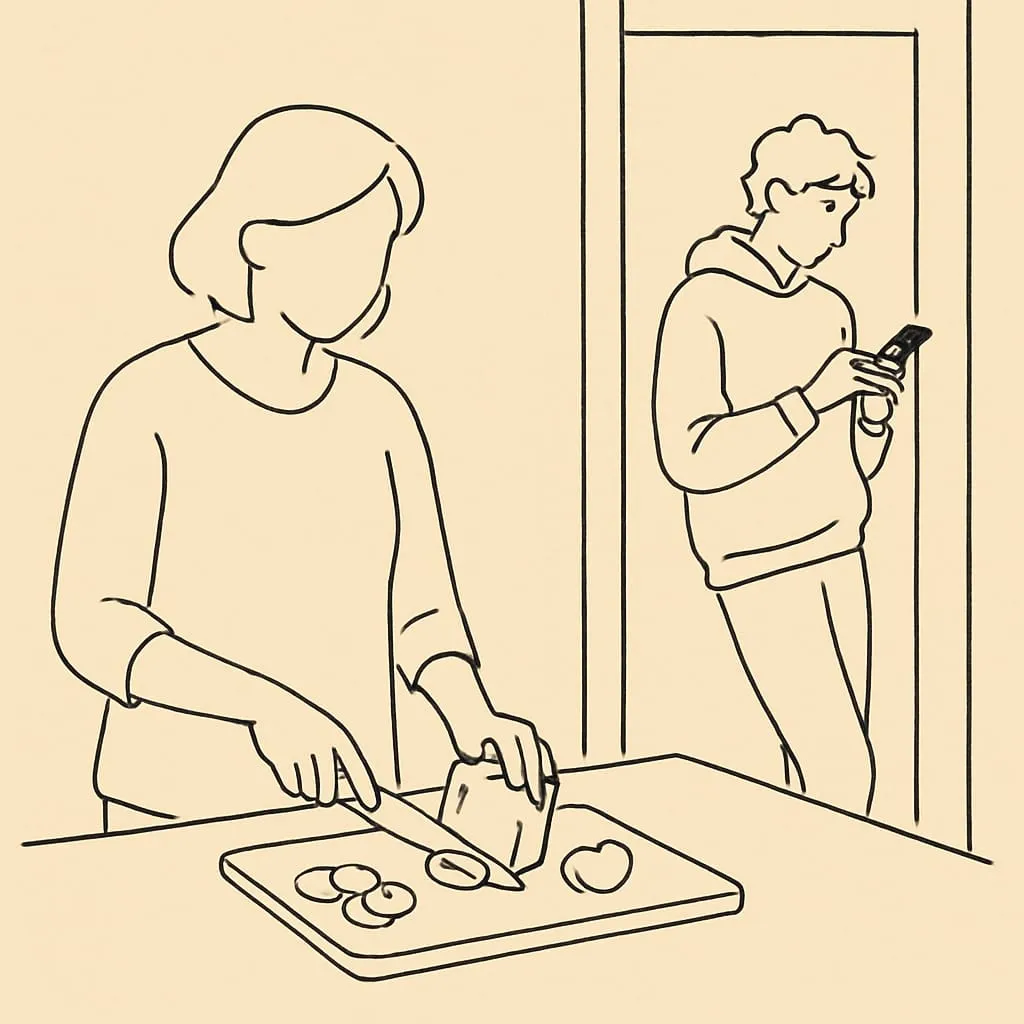
It's been three weeks of "fine" and "nothing." You're starting to worry it's something — depression, bullying, a secret. You sit your teen down for a Big Talk. They flatten.
What usually happens.
Sit down. I want to actually talk to you, not just get "fine" again. What is going on at school?
...nothing.
Don't shut me out. Are you being bullied? Are you sad? Just tell me.
I just want to go to my room.
- Scheduling a "Big Talk" frontloads pressure that no teen brain can metabolize. They will flatten 100% of the time.
- Listing possible diagnoses ("bullied? sad?") makes the teen feel pathologized. They'll deny everything to escape the label.
- The teen leaving the room is the most predictable possible outcome — and it cements that talking to you is a procedure, not a relationship.
What works better.
(Saturday morning. Driving the teen to a haircut.)
Random question. Who's the funniest person in your grade right now?
Probably Jordan. He keeps doing this teacher impression thing.
What teacher?
Mr. Singh. It's like, freakishly accurate. He does the voice and everything.
I love that. What's Mr. Singh like normally?
- "Random question" gives the teen permission to answer lightly — no pressure, no clinical undertone.
- Asking about a third party ("the funniest person") gets you all the information about your teen's social world without putting them on the spot.
- Following the thread ("what's Mr. Singh like normally?") shows real interest, which is what makes the next answer richer than the last.
Key phrases to reach for in the moment.
- Who did you eat lunch with today?
- What's going on with [specific person they mentioned]?
- What was the best thing that happened today? And the worst?
- Did anything weird happen?
When to use each one.
-
Who did you eat lunch with today?
Use as the daily anchor question. Specific enough to answer, low-stakes enough to bother.
-
What's going on with [specific person]?
Use when you remember a name from a prior conversation. Demonstrates you've been listening; almost always gets a longer answer than expected.
-
Who's the funniest person in your grade right now?
Use to open a closed teen. Asking about a third party bypasses self-reporting defenses.
-
Did anything weird happen?
Use as the catch-all. "Weird" is one of the few adjectives teens find honest — covers everything from a fight to a crush.