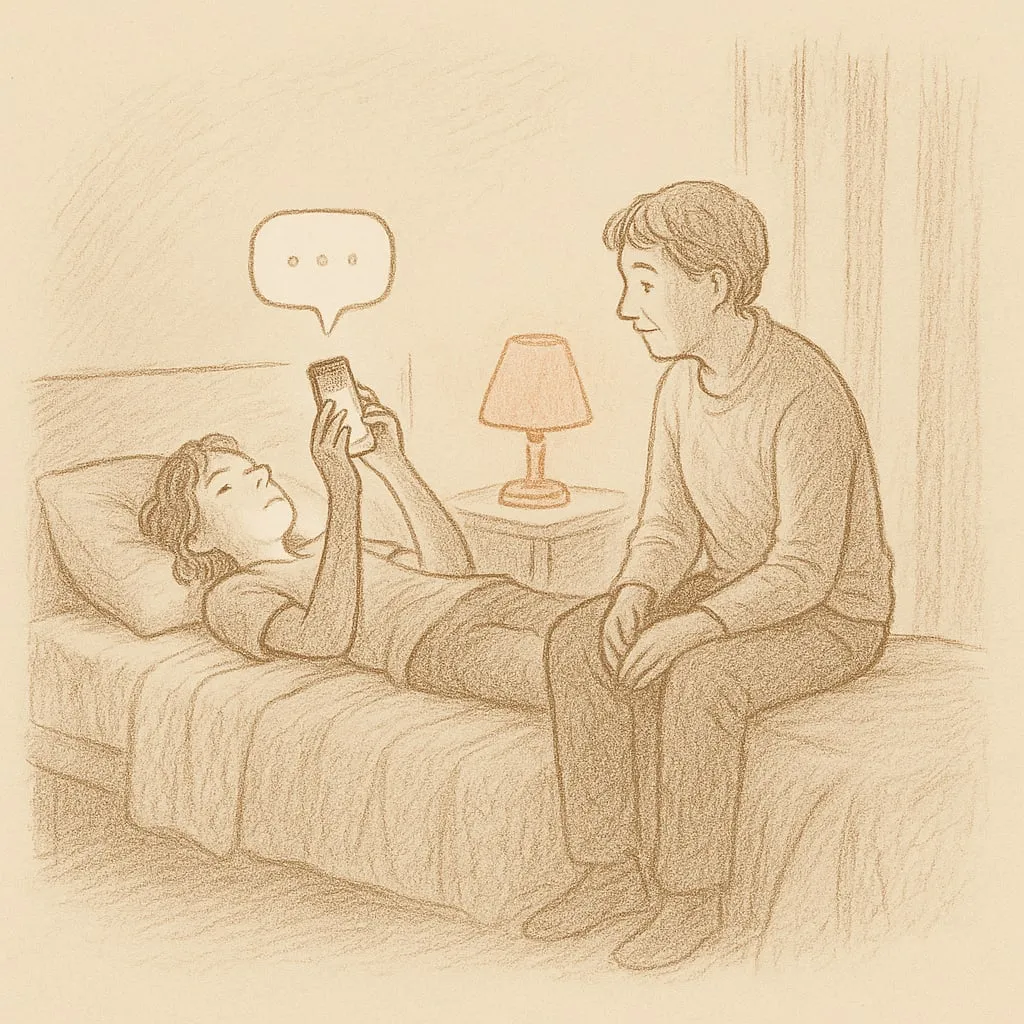
What's happening.
Your autistic teen has an online friend they talk to constantly — someone they met through a game or a fandom server. Lately the friend has been asking for things: a gift card, a “just for you” photo, your teen's password, money for an emergency. To you it has every mark of grooming. To your teen, this is one of the only people who gets them.
What we usually say — and why it backfires.
That person is not your friend. They're using you. You're done talking to them.
You don't even know him! He's my best friend.
He's a stranger on the internet. I'm taking your phone.
(shuts down — and finds a way to keep talking to him in secret)
- Calling the friend fake attacks the one relationship where your teen feels understood. They'll defend it harder — and stop telling you anything about it, which is the opposite of what safety requires.
- Confiscating the phone removes your visibility without removing the predator. Grooming moves to a platform you can't see, and now your teen is hiding it.
- It skips the actual lesson. Your teen isn't naïve for valuing the friendship — they need the specific skill of spotting when a friend's requests cross a line, which a blanket ban never teaches.
What works — and why.
It sounds like he really matters to you, and I believe the friendship feels real. I want to ask about one thing, not the whole friendship — okay?
...fine. One thing.
A real friend never needs your password, money, or a private photo to stay your friend. When did he start asking for those?
A couple weeks ago. He said he'd stop talking to me if I didn't send it.
That part — “I'll leave if you don't” — that's the part that isn't friendship. Let's keep the friend and shut down the asking. I'll help you write exactly what to send back.
- Separating the relationship from the requests lets the teen keep their dignity and their friend while you target the actual danger. You're not the enemy of their social world — you're an ally against one behavior in it.
- A flat, memorizable rule — “a real friend never needs your password, money, or a private photo” — gives a literal, rule-loving brain a bright line that's easier to apply than “use your judgment about who to trust.”
- Naming the exact manipulation (“I'll leave if you don't”) teaches the red flag itself, so they can catch it next time with the next person — the skill outlasts this one conversation.
- Offering to help script the reply meets a documented need: autistic teens often want to shut down unwanted contact but aren't confident doing it alone.
Why this script works on a teen brain.
Autistic teens are, on average, at higher risk of online grooming and exploitation — and the reasons are specific, not vague. Difficulty reading social cues can mean missing the signals that something is off. A literal, trusting style means taking “you're my best friend” at face value. And the loneliness that often comes from struggling to connect offline makes an online friend who finally “gets it” enormously valuable — which is exactly the leverage a predator exploits.
That last point is why the instinctive crackdown backfires so badly. The online friendship may be one of the few places your teen feels socially successful. Attacking it doesn't just fail to remove the danger — it teaches your teen that telling you about their online life gets it taken away, so they stop telling you. You lose the visibility that is your actual safety tool.
The affirming move keeps two things true at once: the friendship can be real AND specific requests can be dangerous. By targeting the behavior (asking for money, photos, passwords; threatening to leave) rather than the person, you teach a portable red-flag skill, preserve your teen's trust, and stay the person they bring the next weird message to.
Key phrases to reach for in the moment.
- I believe the friendship is real — I want to ask about one thing, not the whole friendship.
- A real friend never needs your password, money, or a private photo.
- “I'll leave if you don't” is pressure, not friendship.
- Let's keep the friend and shut down the asking — I'll help you write the reply.
- You're not in trouble. You did the right thing telling me.
If photos were already requested or sent, or money was sent: report to the NCMEC CyberTipline (report.cybertip.org / 1-800-843-5678). Take Down requests for explicit images of a minor: NCMEC's Take It Down (takeitdown.ncmec.org). Block and screenshot before deleting. Do NOT punish the teen for disclosing — it's the single biggest predictor of whether they'll tell you next time.