What's happening.
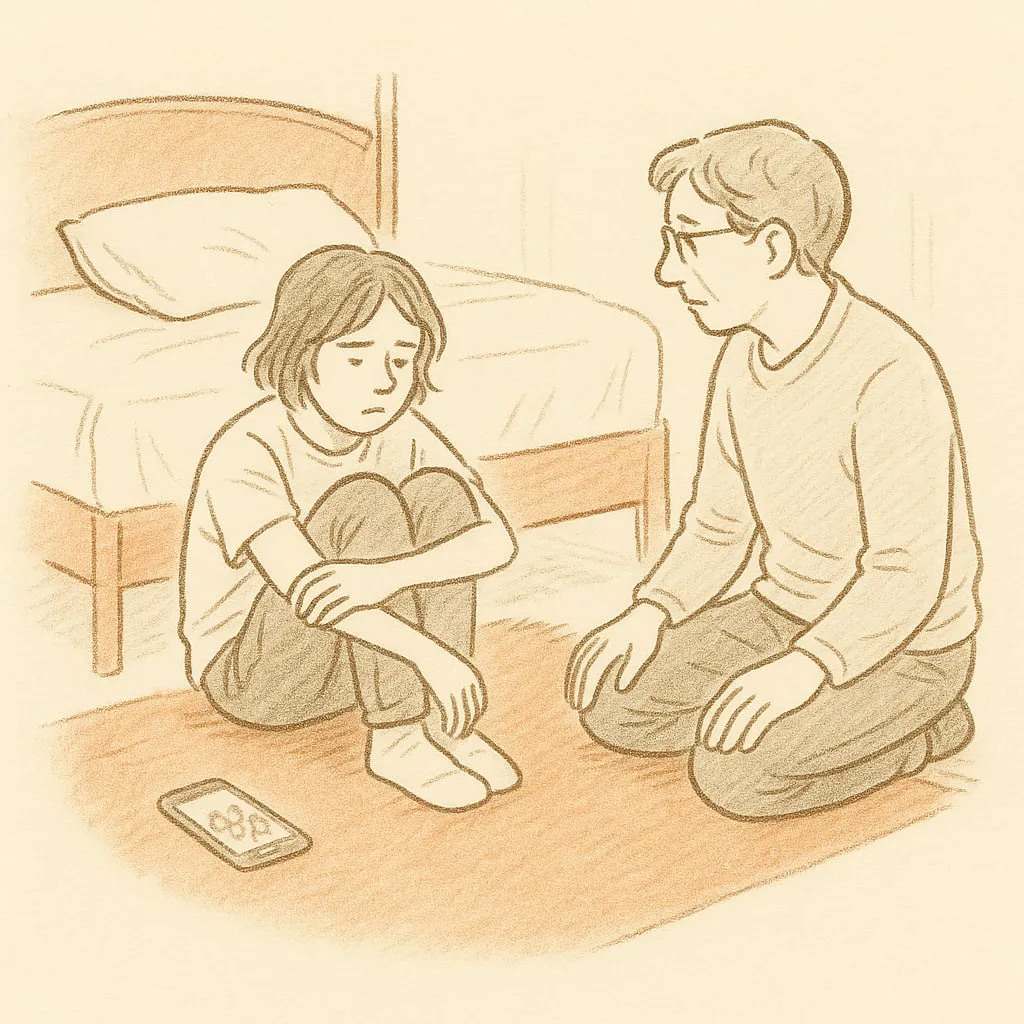
Your autistic teen comes out of their room flat and quiet, or sharp and angry. Eventually it comes out: they saw photos on Instagram or a group chat of classmates hanging out — a hangout they weren't invited to. The same feeds that let them follow their interests just showed them, in detail, that they were left out.
What we usually say — and why it backfires.
That's why you shouldn't be on that app so much. Just get off social media and you won't see it.
So I should have NO friends instead of seeing them?
You have us. And honestly, if you'd just put yourself out there more—
Forget it. You don't get it.
- “Get off the app” reads as “the solution is to disconnect from your whole social world.” For a teen whose easiest connections are online, that's not relief — it's a threat.
- “You have us” is true but it's not what they're missing. It quietly tells them their longing for peers is wrong, so they stop sharing it.
- “Put yourself out there more” lands as: this is your fault for not masking harder. After exclusion, blame is the last thing a nervous system can absorb.
What works — and why.
Ugh. Seeing that hurts. Being left out is one of the worst feelings there is — you're not wrong to feel it.
They didn't even think of me.
Yeah. That part really stings. I'm not going to tell you it's nothing.
Maybe I'm just bad at being a person.
No — you're great at being you, and you haven't found your people yet. Those can both be true. Want to figure out where your people might actually be?
- Naming the feeling first (“being left out is one of the worst feelings”) validates before fixing. An autistic teen who's told their pain makes sense can come down from it; one who's told to log off cannot.
- Refusing to minimize (“I'm not going to tell you it's nothing”) builds the trust that makes you the person they show the next painful screenshot — instead of hiding it.
- Reframing “bad at being a person” into “haven't found your people yet” attacks the shame without arguing them out of their feeling. It points at a solvable problem (finding the right group) rather than a permanent flaw.
- Offering to help find genuine community — an interest-based club, a moderated server, a meetup around their special interest — treats online connection as a real need to meet better, not a habit to cut.
Why this script works on a teen brain.
Online spaces are genuinely double-edged for autistic teens. The same platforms that let them find friends around a shared interest — where text lowers the eye-contact and sensory demands that make face-to-face exhausting — are also the ones that broadcast every gathering they weren't part of. So “just get off social media” isn't neutral advice; it asks them to give up their best route to connection to avoid the pain of exclusion. Most will choose the pain.
Exclusion also lands harder when a teen already suspects they're different. “They all hung out without me” slots straight into an existing story — I'm bad at people — and the instinct to fix it fast (get off the app, try harder, you have us) accidentally confirms that story. The teen hears that their longing is the problem.
The better script does two jobs. It validates the feeling fully, because a validated feeling settles and a dismissed one festers. Then it redirects the energy toward the actual unmet need — belonging with peers who share their world — which, for autistic teens, is very often easier to find in an interest-based community (online or off) than in the random social pool of a given classroom.
Key phrases to reach for in the moment.
- Being left out is one of the worst feelings — you're not wrong to feel it.
- I'm not going to tell you it's nothing.
- You haven't found your people yet — that's different from being bad at this.
- Want to figure out where your people actually are?