The short version.
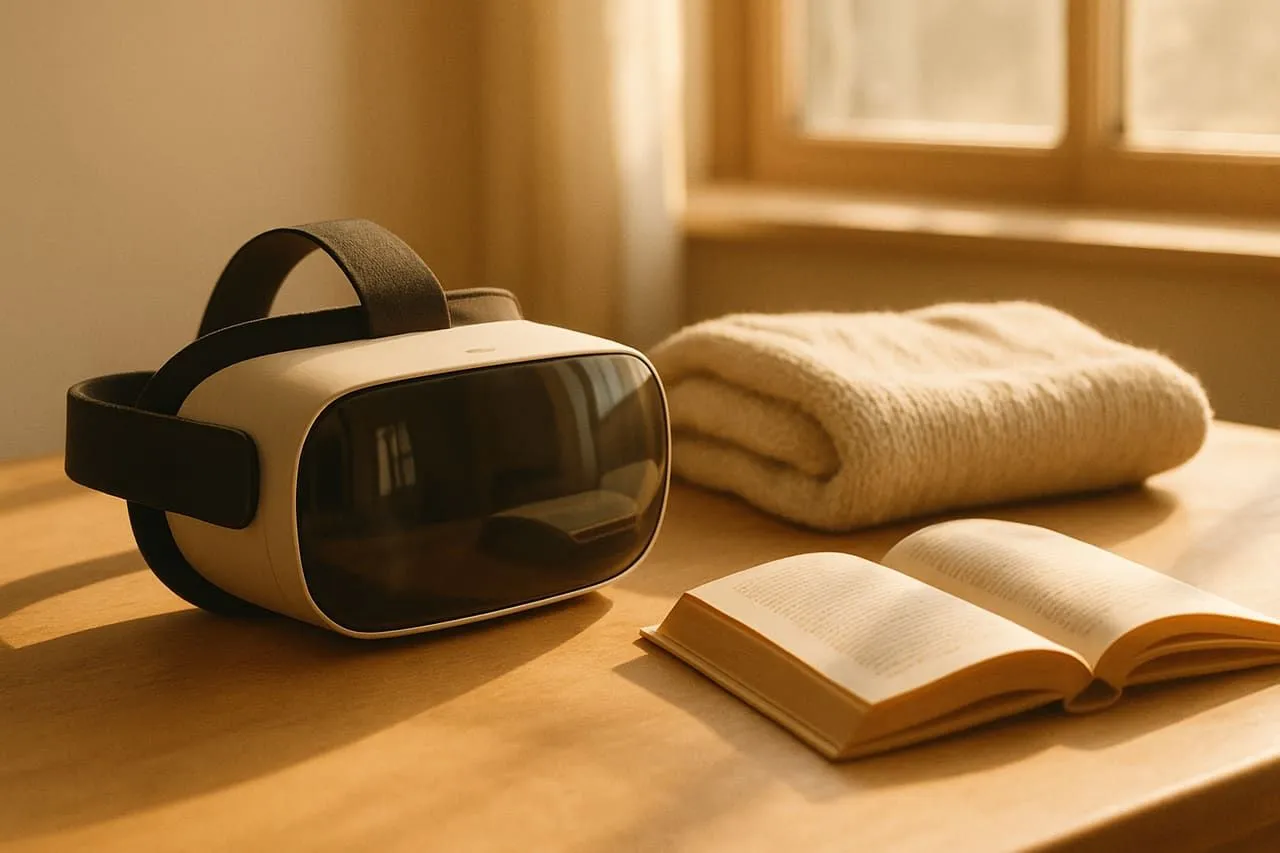
Roblox added official VR support for Meta Quest 2/3/Pro in late 2024. The same games kids play on phone now run as fully embodied VR — your kid's avatar mirrors their actual head + hand motion, voice chat is automatic, and the experience is private inside the headset. For VRChat (a separate platform with similar mechanics and an older average user), the integration with Roblox-style worlds is even tighter.
The platforms and contexts.
Meta Quest headsets (the dominant consumer VR), PlayStation VR2, and increasingly mixed-reality glasses. Apple Vision Pro support announced for 2026.
The timeline.
Roblox VR pilot since 2014; consumer-grade VR adoption took off 2020+; mainstream kid use post-Quest 2 mass adoption 2021. Roblox-on-Quest mass rollout 2024–2025.
The core facts a parent needs.
- VR shifts the body. Roleplay groping, dance-floor grinding, and 'personal-space' violations that exist as text in regular Roblox become embodied gestures in VR. The kid's body learns the response.
- Voice chat is on by default in VR for verified 13+. Headset privacy means a parent has no idea what conversations are happening unless they're actively watching the headset stream on the phone app.
- VRChat-style 'private worlds' attached to Roblox accounts can host anything — including adult-themed spaces. Moderation in VR contexts is significantly thinner than in flat Roblox.
What's actually at stake.
- Embodied predator contact — adult users making physical-feeling advances on minor avatars. Multiple documented federal cases in VR contexts already.
- Sleep displacement — VR is more immersive and harder to set down. Kids report losing 2–4 hours in a session without noticing.
- Headset-as-private-world — a parent can't tell from outside what the kid is seeing or who they're with. The 'shoulder surf' parenting strategy stops working entirely.
The talk that lands — try it now.
Imagine you just learned your teen brushed up against this. You have 60 seconds before the conversation begins. What you say first decides whether the next 20 minutes opens the door — or slams it.
"What were you thinking? Give me your phone — now."
Panic + punishment in the same breath. The teen reads it as "every honest detail will be used against me." The phone comes; the truth doesn't.
What would you open with instead? Picture it for a beat — then…
"I want to ask about something — no trouble, I just want to understand it. Can we sit for five minutes?"
Curiosity, not court. Promise of safety in the first sentence. Time-bounded so it doesn't feel like a trap. Almost every teen says yes to five minutes.
Then, in those 5 minutes:
- If you're giving VR: set up the Quest with Family Mode and link the parent's phone to the kid's headset. Meta's Family Center lets you see app activity and time, and require approval for new app installs.
- Disable voice chat for kids under 14 in headset settings. Trade-off: they'll complain. Worth it for the safety margin.
- Keep the headset in shared space — same rule as 'no Roblox in the bedroom.' VR amplifies the existing rule.
Try saying it out loud once before you close this tab. Cool parents rehearse — yelled parents wing it.
Practice 200 more parent–teen scripts →Concrete next steps.
- If you're giving VR: set up the Quest with Family Mode and link the parent's phone to the kid's headset. Meta's Family Center lets you see app activity and time, and require approval for new app installs.
- Disable voice chat for kids under 14 in headset settings. Trade-off: they'll complain. Worth it for the safety margin.
- Keep the headset in shared space — same rule as 'no Roblox in the bedroom.' VR amplifies the existing rule.
NCMEC CyberTipline 1-800-843-5678 for VR-context predator contact · Meta abuse reporting (meta.com/help/quest) · Local police for in-person meeting attempts.