The short version.
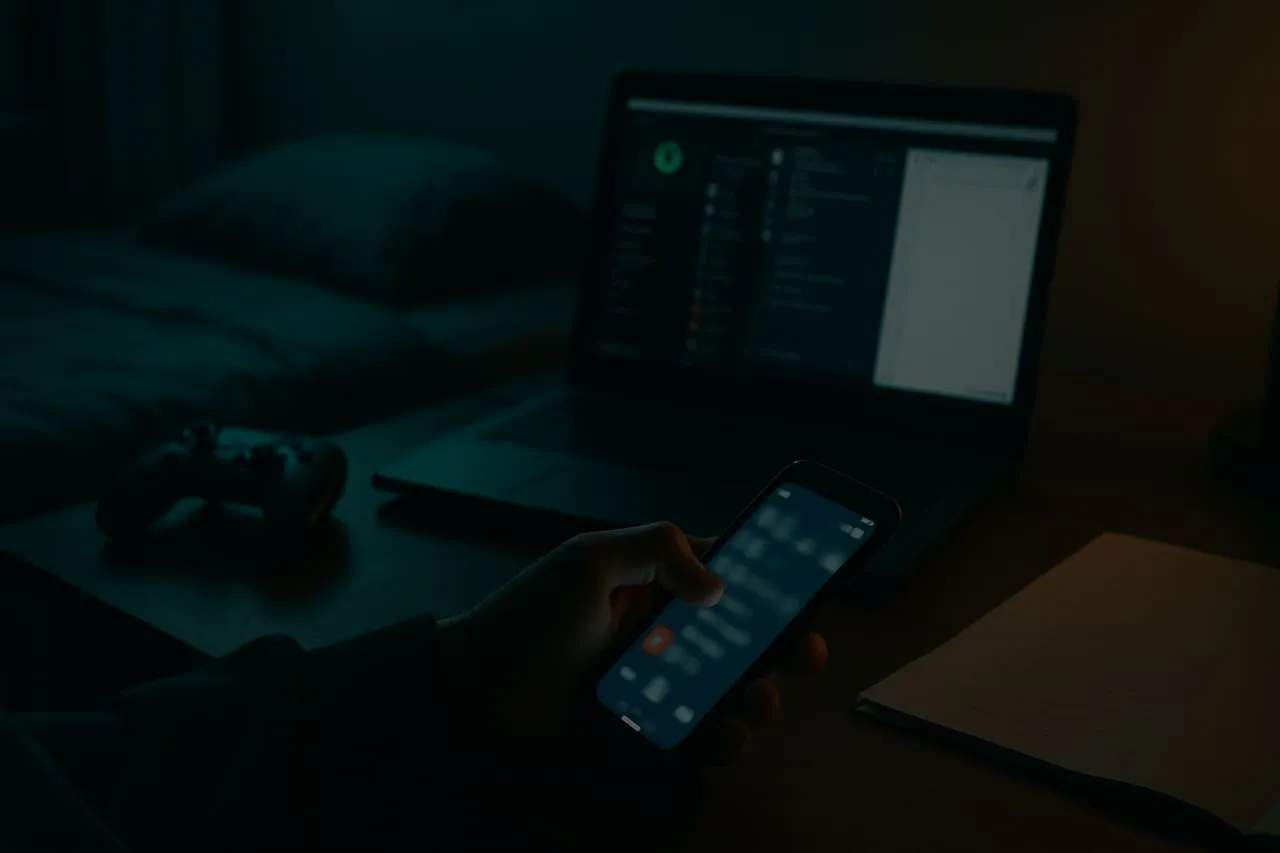
'Homework mode' is the parent-facing label for what is often a 90/10 split: 10% of the time on the actual assignment, 90% on a rotating stack of Discord, Snapchat, Spotify, TikTok, gaming notifications, and AI chatbots. The cognitive-science research on this is unambiguous — heavy media multitasking measurably degrades focus, working memory, and learning. The teen genuinely believes they're studying; the grades and the homework completion gradually say otherwise.
The platforms and contexts.
Anywhere a teen has a phone, a laptop, and the door closed: bedrooms, dorm desks, kitchen tables, library carrels. The pattern crosses every demographic — straight-A kids and struggling kids both do it.
The timeline.
The pattern grew with the laptop-required school era (post-2010) and intensified after Discord and TikTok became part of teen baseline use (2018+). Stanford's Eyal Ophir / Clifford Nass research on media multitasking dates from 2009 and has been replicated repeatedly.
The core facts a parent needs.
- Switching tasks costs measurable seconds of re-focus every time. A two-hour 'study session' with 40 switches loses ~15-20 minutes to switch costs alone — and the work that does happen is shallower.
- Teens who self-report 'I study better with music and Discord' generally score worse on tests of what they just studied. The feeling of efficiency is not the same as the efficiency.
- AI chatbots have made this worse, not better: a teen who uses ChatGPT to answer questions inside the homework session often retains less than one who struggled through it.
What's actually at stake.
- Grades that don't match the apparent hours of work, which most parents read as laziness or capability — when it's actually attention fragmentation.
- A learned style of work that doesn't transfer to college finals, professional jobs, or any setting where deep focus is required.
- Sleep loss: the homework session bleeds into 11pm because real work didn't happen, then bleeds into midnight because they're still 'finishing.'
The talk that lands — try it now.
Imagine you just learned your teen brushed up against this. You have 60 seconds before the conversation begins. What you say first decides whether the next 20 minutes opens the door — or slams it.
"What were you thinking? Give me your phone — now."
Panic + punishment in the same breath. The teen reads it as "every honest detail will be used against me." The phone comes; the truth doesn't.
What would you open with instead? Picture it for a beat — then…
"I want to ask about something — no trouble, I just want to understand it. Can we sit for five minutes?"
Curiosity, not court. Promise of safety in the first sentence. Time-bounded so it doesn't feel like a trap. Almost every teen says yes to five minutes.
Then, in those 5 minutes:
- Move the work outside the bedroom. Kitchen table, dining room, library. Bedrooms are biologically wired for sleep and downtime; they're poor study rooms for almost everyone.
- Phone in another room during the actual study block. Even sitting face-down on the desk meaningfully degrades performance (Adrian Ward / UT Austin 'brain drain' study).
- Try 50/10 — 50 minutes phone-free focus, 10 minutes full access. Most teens prefer this once they try it: the focus block actually ends, and the break is real.
Try saying it out loud once before you close this tab. Cool parents rehearse — yelled parents wing it.
Practice 200 more parent–teen scripts →Concrete next steps.
- Move the work outside the bedroom. Kitchen table, dining room, library. Bedrooms are biologically wired for sleep and downtime; they're poor study rooms for almost everyone.
- Phone in another room during the actual study block. Even sitting face-down on the desk meaningfully degrades performance (Adrian Ward / UT Austin 'brain drain' study).
- Try 50/10 — 50 minutes phone-free focus, 10 minutes full access. Most teens prefer this once they try it: the focus block actually ends, and the break is real.
Call or text 988 (Suicide & Crisis Lifeline, 24/7) · Text HOME to 741741 (Crisis Text Line) · Find a child psychiatrist at aacap.org · For immediate danger, call 911.