The short version.
Astrology has shifted from a fringe interest to a mainstream teen identity scaffold. Co-Star, The Pattern, Sanctuary, and similar apps push daily horoscopes and detailed natal-chart interpretations. Friend groups discuss 'Big Three' (sun, moon, rising) signs the way previous generations exchanged music tastes. Light use is harmless; heavy dependence — making major decisions by horoscope, evaluating friends by birth chart, blaming personality issues on Mercury retrograde — substitutes external frameworks for the self-knowledge work adolescence is supposed to develop.
The platforms and contexts.
Astrology apps (Co-Star is the dominant teen-girl app), TikTok creator content, Instagram horoscope memes, and increasingly inside friend-group decision-making (compatibility checks, hiring decisions, dating filters).
The timeline.
Astrology mainstreamed sharply around 2017–2018 as Co-Star and adjacent apps scaled. The pattern has continued.
The core facts a parent needs.
- Astrology has no predictive validity in controlled studies. The 'it worked for me' experience is selection bias plus the Barnum effect (general descriptions that feel personal).
- Heavy users substitute external attribution ('It's because I'm a Scorpio') for internal work ('What about my behavior could I change?').
- Identity foreclosure: locking into a personality framework during the years personality is still forming.
What's actually at stake.
- Decision-paralysis when horoscope contradicts judgment.
- Friendship and relationship constraints based on incompatibility frameworks that have no basis.
- Substituted self-knowledge that delays the actual self-discovery work of adolescence.
The talk that lands — try it now.
Imagine you just learned your teen brushed up against this. You have 60 seconds before the conversation begins. What you say first decides whether the next 20 minutes opens the door — or slams it.
"What were you thinking? Give me your phone — now."
Panic + punishment in the same breath. The teen reads it as "every honest detail will be used against me." The phone comes; the truth doesn't.
What would you open with instead? Picture it for a beat — then…
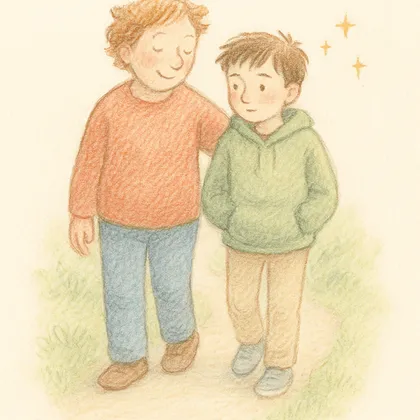
"I want to ask about something — no trouble, I just want to understand it. Can we sit for five minutes?"
Curiosity, not court. Promise of safety in the first sentence. Time-bounded so it doesn't feel like a trap. Almost every teen says yes to five minutes.
Then, in those 5 minutes:
- Don't mock the interest — it ends the conversation. Engage seriously: 'What's your sign say about your friendships? Does it match?'
- Encourage the curiosity behind it. Teens drawn to astrology are usually looking for self-understanding; route them to other frameworks (Big Five personality, journaling, therapy) that have more substance.
- If decisions are being made by horoscope, gently push back. 'What would you decide if you didn't know what the horoscope said?'
Try saying it out loud once before you close this tab. Cool parents rehearse — yelled parents wing it.
Practice 200 more parent–teen scripts →Concrete next steps.
- Don't mock the interest — it ends the conversation. Engage seriously: 'What's your sign say about your friendships? Does it match?'
- Encourage the curiosity behind it. Teens drawn to astrology are usually looking for self-understanding; route them to other frameworks (Big Five personality, journaling, therapy) that have more substance.
- If decisions are being made by horoscope, gently push back. 'What would you decide if you didn't know what the horoscope said?'
Call or text 988 (Suicide & Crisis Lifeline, 24/7) · Text HOME to 741741 (Crisis Text Line) · Find a child psychiatrist at aacap.org · For immediate danger, call 911.