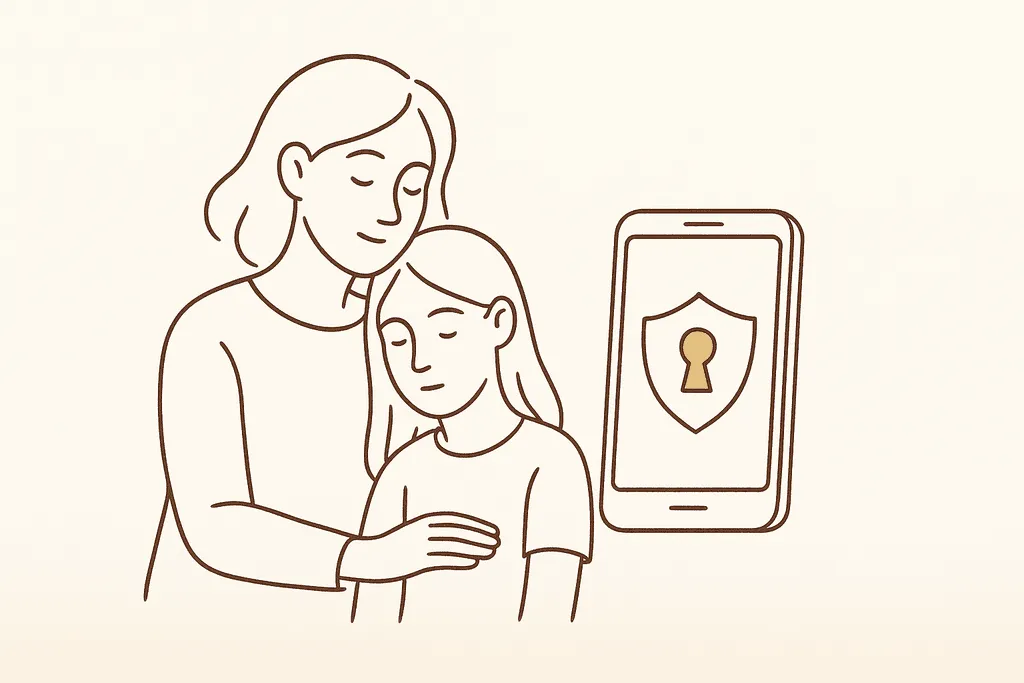
A free, anonymous tool can fingerprint an image so major platforms block it — a real first step that doesn't require going public.
- An image being out there is not the end of the story — containment is still possible and worth pursuing.
- Because the picture never leaves the device, a teen can take action without handing the image to anyone new.
- Letting your teen choose between doing it together or privately keeps them in control of an already overwhelming moment.
- Pair the tool with a CyberTipline report whenever an adult or coercion is involved, not just a removal request.
The situation, the move, the outcome.
A teen who fears an explicit image of themselves is circulating can feel powerless. NCMEC's Take It Down tool, launched at the end of 2022 with initial funding from Meta, changes that. The teen (or a parent) selects the image on their own device; the tool converts it into a unique digital fingerprint, or 'hash,' and never uploads the picture itself. Participating platforms — including Facebook, Instagram, OnlyFans and Pornhub — use that hash to detect and remove or block the image. It can be used anonymously, and since launch it has helped resolve hundreds of cases.
In day-to-day use the tool works by converting the selected image into a unique fingerprint, or hash, so participating platforms can recognize and block that exact image without ever needing to see it. Because the picture stays on the teen's device, the step feels far less exposing than handing a file to a stranger, which is exactly why teens are willing to try it. The anonymity means a teen can act on their own timeline, with or without telling a parent first, and still reach across several major platforms at once. It is best understood as a real, concrete first move rather than a complete fix — useful precisely because it asks so little of an already frightened teen.
Why it matters beyond one family.
Many teens won't go to the police or even their parents out of shame — so a private, low-barrier first step matters enormously. Take It Down meets teens where they are while still tackling the spread of the image at the platform level.
The reason this matters for ordinary families is that shame, not ignorance, is usually what keeps a teen silent, and a private low-barrier option meets that head-on. A parent who simply knows the tool exists can offer a way forward instead of a lecture, which keeps the conversation open rather than shutting it down. Because it works at the platform level, it tackles the spread of the image without requiring the teen to confront anyone directly. For most households the practical lesson is to mention that this option exists before it's ever needed, so a teen remembers there is somewhere to turn.
- A free, anonymous first step lowers the barrier for the many teens who would never go to police or even a parent.
- Major platforms participate, so a single submission can work across several of the places an image is most likely to spread.
- The design keeps the actual image on the teen's own device, which respects their privacy at the worst possible moment.
- Knowing a concrete tool exists replaces helplessness with something a teen can actually do tonight.
How to apply it.
- Reassure your teen that an image already out there can still be contained — it's not hopeless.
- Walk through Take It Down together, or let them use it privately if they prefer.
- Pair it with a report to NCMEC's CyberTipline for anything involving coercion or an adult.
I heard there's a picture of me going around. I don't even want to think about it.
That's a horrible feeling, and I'm really glad you told me. This isn't hopeless — there's an actual tool for exactly this.
I don't want to send the picture to some website. That's even worse.
You won't have to. Take It Down turns it into a kind of fingerprint right on your phone — the picture itself never gets uploaded anywhere.
So the platforms can block it without anyone seeing it?
Right. And you can do it anonymously. Do you want to walk through it together, or would you rather do it on your own and tell me when it's done?
Maybe... together. I don't really know how it works.
Then we'll do it together. And if there's an adult or any threats involved, we'll also make a report so it's not just on you to fix.
Concrete next steps.
- Start at takeitdown.ncmec.org — the image stays on the device; only the hash is shared.
- For images that may not be online yet, the similar StopNCII.org serves adults 18+.
- Keep evidence and report to the FBI if there's extortion involved.
Read it for yourself.
If your teen is being sextorted: do not pay, do not delete anything, and stop all contact with the offender. Save the messages and usernames. Report to the FBI at tips.fbi.gov or 1-800-CALL-FBI and to NCMEC's CyberTipline at CyberTipline.org. Use NCMEC's free Take It Down tool (takeitdown.ncmec.org) to stop images from spreading. For emotional crisis, call or text 988 (Suicide & Crisis Lifeline, 24/7).