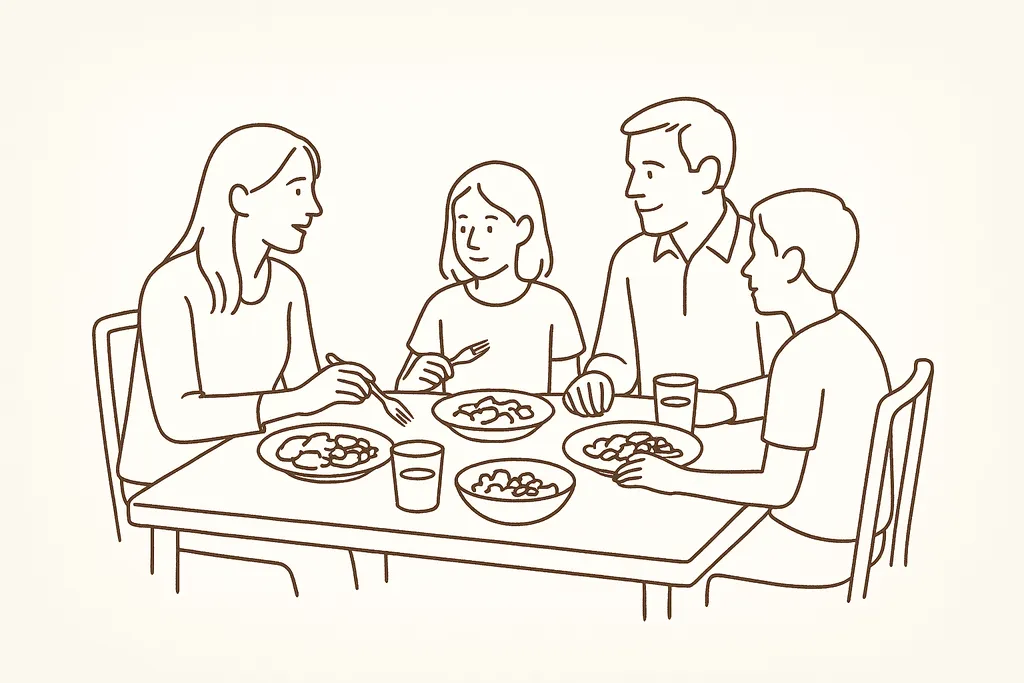
Putting parents in charge of refeeding — early, and without blame — has the deepest evidence base for adolescent anorexia recovery.
- Acting on early signs beats waiting it out, because earlier intervention has the better track record.
- Ask specifically for an FBT-trained clinician — the approach is well-defined, not just a general style of therapy.
- Expect to be hands-on at every meal; heavy parental involvement is the mechanism, not a sign something's wrong.
- Treating parents as part of the solution, never the cause, is central to how this approach actually works.
The situation, the move, the outcome.
For decades, families were sidelined — or blamed — in eating-disorder treatment. Family-Based Treatment (FBT), also called the Maudsley approach, flipped that: parents are coached to take temporary charge of their teen's eating and weight restoration at home, then gradually hand control back as the teen recovers. It is now the gold-standard, evidence-based treatment for adolescent anorexia. In studies, around 90% of patients under 19 with under three years of illness restored a healthy weight, with many maintaining recovery at five-year follow-up. Researchers note full psychological remission depends on how recovery is defined — but weight-restoration outcomes are strong and durable.
In practice the approach works by having parents take temporary charge of meals and weight restoration at home, then gradually hand control back as the teen recovers, so the family's daily presence becomes the engine of treatment. Because the parents are coached rather than blamed, they can step into that intensive role without carrying guilt, which frees them to act decisively. The early, hands-on involvement is the point — it puts support exactly where the illness lives, at every meal — rather than something to apologize for. As recovery takes hold, the structure loosens on purpose, returning normal autonomy to the teen in step with their progress.
Why it matters beyond one family.
Early, family-centered intervention beats waiting. FBT works partly because it treats parents as the solution, not the cause — mobilizing the people who are with the teen every day at every meal.
What makes this generalize is its core reframe: the people who are with a teen every day are treated as the solution rather than the cause, which mobilizes a resource most other approaches left on the bench. For ordinary families, the practical lesson is to act on early signs and to ask specifically for a clinician trained in this method rather than hoping any therapy will do. The strong, durable weight-restoration record gives families a reason for grounded hope, even as clinicians are honest that full psychological recovery depends on how it's defined. And because the approach is well-defined and trainable, families can seek it out deliberately instead of stumbling into it.
- FBT is the gold-standard, evidence-based treatment for adolescent anorexia, so families aren't experimenting on their own.
- Weight-restoration outcomes are strong and durable, including at longer follow-up, which gives real grounds for hope.
- By mobilizing the people who are with the teen every day, the approach uses the family's presence as an asset.
- Reframing parents as the solution rather than the blame lifts a weight that used to keep families on the sidelines.
How to apply it.
- Act on early signs — food restriction, rapid weight loss, over-exercise — rather than waiting it out.
- Ask specifically for an FBT-trained clinician; the approach is well-defined and trainable.
- Expect to be actively involved; in FBT, that's the point, not a burden.
I've noticed you've been skipping meals and exercising a lot more. I'm not angry — I'm worried, and I want us to get help early.
I'm fine. You're making it a bigger deal than it is.
Maybe, and I hope so. But the thing I keep reading is that acting early works much better than waiting, so I'd rather check than guess.
So you're going to be watching everything I eat now? That sounds awful.
For a while, yes — I'd be helping with meals. There's a specific approach where parents take that on temporarily and then hand it back as you get better.
It feels like you think this is my fault.
Just the opposite. This whole approach treats us as the people who can help you through it — not the cause of it. We're on the same side here.
I don't really know what that looks like.
We'll find a clinician trained in it and learn together. You won't be doing this alone, and neither will I.
Concrete next steps.
- Find FBT providers via eating-disorder clinics or your pediatrician's referral.
- Get oriented at NEDA (nationaleatingdisorders.org) for screening and treatment options.
- For crisis or co-occurring suicidality, call or text 988.
Read it for yourself.
Call or text 988 (Suicide & Crisis Lifeline, 24/7) · Text HOME to 741741 (Crisis Text Line) · Find a child psychiatrist at aacap.org · For immediate danger, call 911.