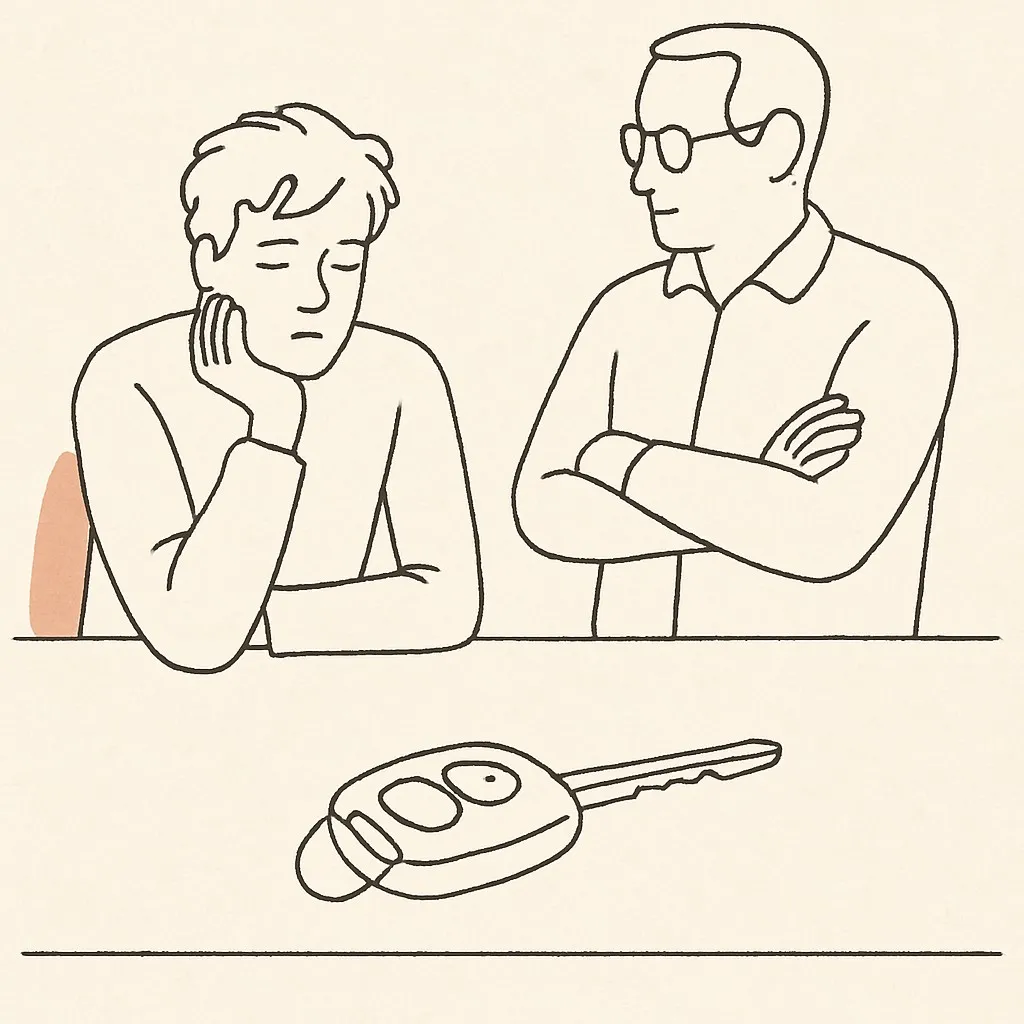
What's happening.
Your 16-year-old has the permit. They want to drive to the store. You say not tonight. They snap: “You're never going to let me. What's the point?”
What we usually say — and why it backfires.
I just don't think you're ready.
I have a PERMIT. I've passed every test. What do I have to do?
I'll know when you're ready.
That's not a real answer.
- “I don't think you're ready” without specifying what would change your mind is a goalpost with no location. The teen can't aim for it.
- “I'll know when you're ready” is the parent claiming sovereign judgment over a thing the teen has already passed every objective test for. It rankles.
- The teen's last line is correct. You owe them a real answer.
What works — and why.
You're right that wasn't a real answer. Here's what's actually going on for me — I'm scared because the data on 16-year-old drivers is rough and I don't trust the road, not you specifically. Let me give you a real ramp.
Okay.
Daytime, dry weather, drives I'm in the car for, for the next month. Then daytime alone for short routes — store, school. Then we open it up. Highway driving and night driving wait until both of us are confident, not just you.
That's actually fair. Can we start tomorrow?
Tomorrow.
- Owning your fear specifically (“the road, not you specifically”) takes 90% of the personal sting out — and is also probably true.
- A real ramp with concrete graduation criteria turns an open-ended “maybe” into a roadmap. Teens will follow a roadmap they can see.
- Distinguishing the data risks (night, highway, weather) from arbitrary restrictions gives the teen credit for being a rational adult — which they're trying to be.
Key phrases to reach for in the moment.
- You're right, that wasn't a real answer.
- Here's what's actually going on for me.
- I'm scared of the road, not you specifically.
- Let me give you a real ramp.