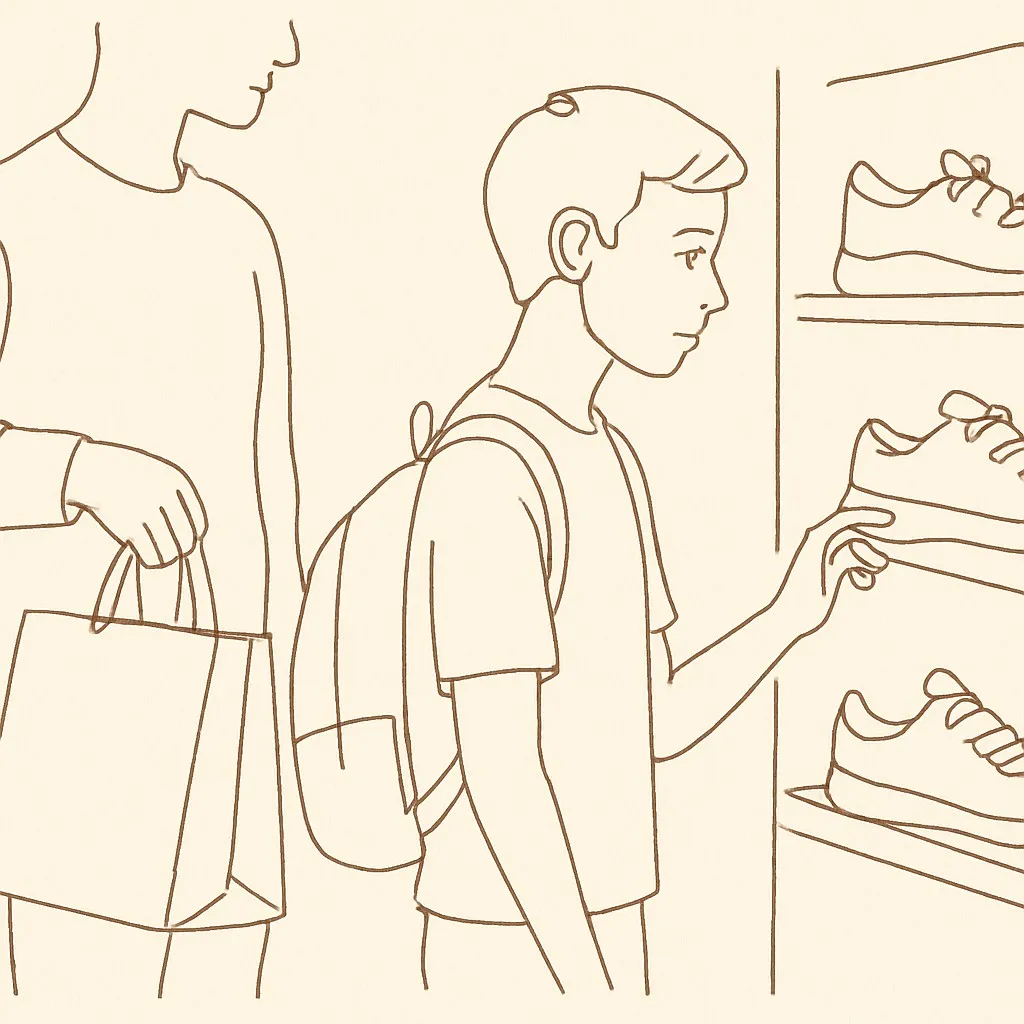
What's happening.
Your 14-year-old wants the $280 sneakers “everyone is wearing.” Your budget doesn't have an extra $280. Their face is set; this isn't a casual ask.
What we usually say — and why it backfires.
$280 for sneakers is insane. Absolutely not.
Everyone else's parents bought them.
Well, everyone else's parents are spending money they don't have.
I never get anything.
- “Insane” attacks the choice, not the budget. Teens defend choices that get attacked.
- “Everyone else's parents” dismissal moralizes other families' spending instead of staying in your own lane.
- “I never get anything” is the teen's stock comeback when the conversation is about money but the actual ask is about belonging. You haven't surfaced that yet.
What works — and why.
Okay. Real talk — that's outside what I can do this month. What's the deeper want? Is it the shoes, or is it being in the group that has them?
...both. But I guess mostly the second one.
Thank you for being honest. So — couple of options. We can put $80 toward them and you save up the rest from babysitting. Or we find a similar pair that's $120ish and you have the look without me having to skip groceries. Which one fits better?
Can I think about it?
Always.
- Splitting “the shoes” from “being in the group that has them” lets the teen see their own want clearly. Often they pick a cheaper proxy once the underlying need is named.
- Giving real options (split the cost vs find similar) treats them like a financial partner, which they actually are — they'll be one their whole life.
- “Always” at the end is a small word with a long shadow — it says “you're not on a clock with me.”
Why this script works on a teen brain.
The peer-belonging research is dense and unambiguous: from roughly age 12 onward, social belonging registers in the brain similarly to physical safety. The $280 sneakers are not the want; they're the cheapest available proof that the teen is in the group that has them. Refusing the object without addressing the belonging is a parental no that closes the wrong loop — and ensures the next ask shows up the same way, just bigger.
This is also why "everyone has them" lands so hard. The teen isn't lying or even exaggerating much; their lunch-table cohort really may have a high concentration of the item, and the teen has correctly assessed that lacking it produces a daily small social cost. The skill is to take that cost seriously as real (it is) while not letting it be the only thing on the table (it isn't).
The trade-or-substitute frame is the durable move. It teaches the teen three things at once: (a) the household has a budget that's real and shareable, (b) status anxiety can be addressed by a less-expensive proxy without losing what they actually need, and (c) you'll let them participate in the financial reasoning instead of just delivering a verdict. The teens who learn this in middle and high school become adults who think before they buy. The teens who get only "no, that's insane" become adults who don't tell their partner about the credit card.
Same dynamic, different surface.

Your 13-year-old wants an iPhone 16 because their current iPhone 13 "looks broke." The 13 works perfectly. Their friend group all upgraded at the same time. You can see them brace for the conversation before they've started.
What usually happens.
Your phone works. We're not buying a new one for fashion.
It's not fashion. It's that mine doesn't even take normal photos anymore.
Your phone takes fine photos. Don't try to manipulate me.
Fine. I just won't take pictures with anyone anymore.
- "Don't try to manipulate me" attacks the teen's framing instead of engaging with the underlying ask. They will refine the manipulation, not abandon it.
- "Your phone takes fine photos" pre-litigates a technical point that's beside the point — the phone in the friend group's group photos is the symbol, not the camera.
- "I just won't take pictures" is the teen self-excluding socially, which is the exact harm a parent is trying to prevent. The blunt no produced the outcome it feared.
What works better.
Help me understand. Is it the camera that's bugging you, or is it being the one with the older phone in the group?
Both. But the group thing is harder, honestly.
Thank you for saying that. Couple of options on the table: we wait for the holiday upgrade cycle and you contribute half from babysitting. Or — a sleeker case that makes the 13 look way newer, plus we revisit at the next milestone. Neither is no, neither is yes today. Which one do you want to chew on?
Probably the case for now. And we revisit.
- Asking is-it-the-thing-or-is-it-the-group is the diagnostic that splits camera-need from status-need. Teens almost always tell you the truth when offered the binary cleanly.
- Offering two real options instead of a yes/no is the move that keeps you out of the manipulation trap — you've already conceded a path forward, so they don't need to push.
- "Which one do you want to chew on" gives them the time to land somewhere honest. The decision they make alone, overnight, sticks better than the one they win at the kitchen counter.
Key phrases to reach for in the moment.
- Real talk — that's outside what I can do this month.
- Is it the [thing], or is it being in the group that has the [thing]?
- Thank you for being honest.
- Couple of options — which one fits better?
When to use each one.
-
Real talk — that's outside what I can do this month.
Use to name the budget without moralizing other families' spending. Stays in your own lane and is harder to argue with.
-
Is it the [thing], or is it being in the group that has the [thing]?
Use as the diagnostic for any status purchase. Surfaces the belonging-need underneath the object-want.
-
Couple of options — which one fits better?
Use instead of yes/no. The two-option frame transfers the decision burden in a way that produces better outcomes.
-
Thank you for being honest.
Use the moment they admit it's the social part. Frontload the reward; you want this honesty next time too.