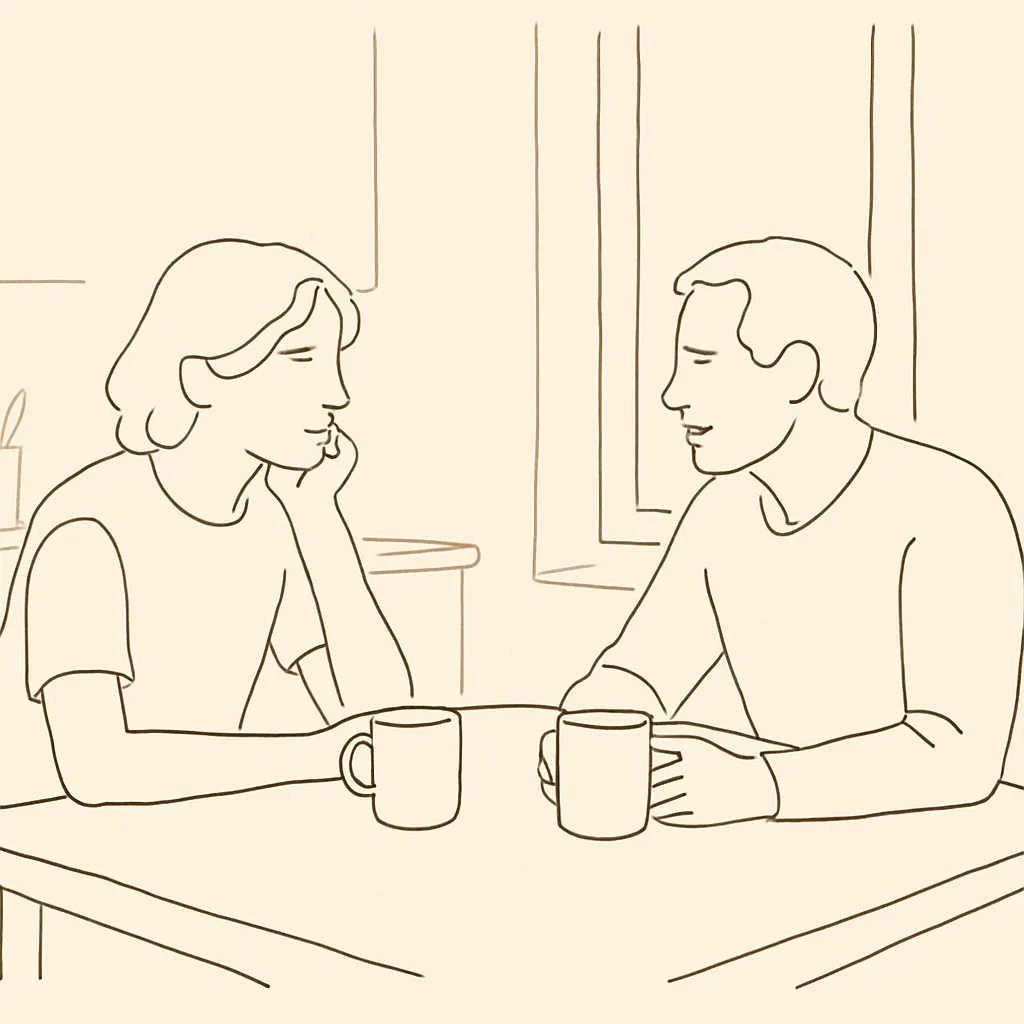
What's happening.
Your 17-year-old, white-faced, sits down across from you Sunday morning: “Mom. I'm pregnant.” Or: “Maya's pregnant.” You inhale.
What we usually say — and why it backfires.
WHAT? How did this happen? How could you let this happen?
I'm sorry —
We need to handle this immediately. Are you keeping it? You can't keep it. You're 17.
(makes the decision alone, in fear, with whoever is more comfortable to be around than you)
- “How could you let this happen” puts shame at the front of a conversation that needs to be a planning conversation.
- Forcing a decision in the first five minutes (“you can't keep it”) takes the agency out of the only person whose agency matters.
- “Makes the decision alone” is the worst outcome — you wanted to be in the room; you talked your way out of it.
What works — and why.
(deep breath) Okay. Thank you for telling me. I love you. Whatever we do next, we figure it out together. First — are you safe right now, physically and emotionally?
I'm okay. Just scared.
Okay. We have time. This isn't a decision for tonight. The first steps are: confirm with a real test or doctor, figure out how far along, and learn what options actually look like — keeping, adoption, or termination — without ranking them before we know the facts. Whoever you'd want with you for each step, we make sure they're there. I am unconditionally on your side.
...thank you.
- “Thank you for telling me. I love you. We figure it out together” are the three sentences that keep you in the room.
- “We have time” is medically accurate — most decisions don't need to be made in the first 48 hours — and de-escalates the emergency framing.
- Naming all three options neutrally (“keeping, adoption, or termination”) shows you're not pre-deciding, which is the only stance that lets the teen think clearly.
Key phrases to reach for in the moment.
- (Deep breath.) Thank you for telling me. I love you.
- Whatever we do next, we figure it out together.
- We have time. This isn't a decision for tonight.
- Whoever you'd want with you for each step, we make sure they're there.
This is medical, legal, and emotional all at once. First: pregnancy test confirmation + OB/GYN or Planned Parenthood within the week for accurate gestational dating. Counseling: a non-directive pregnancy counselor (Planned Parenthood, school counselor, or independent therapist) can walk through all options without agenda. Avoid 'crisis pregnancy centers' that present as medical but are religious advocacy. The teen's autonomy is legally protected to varying degrees by state; know your state law before promising anything specific.