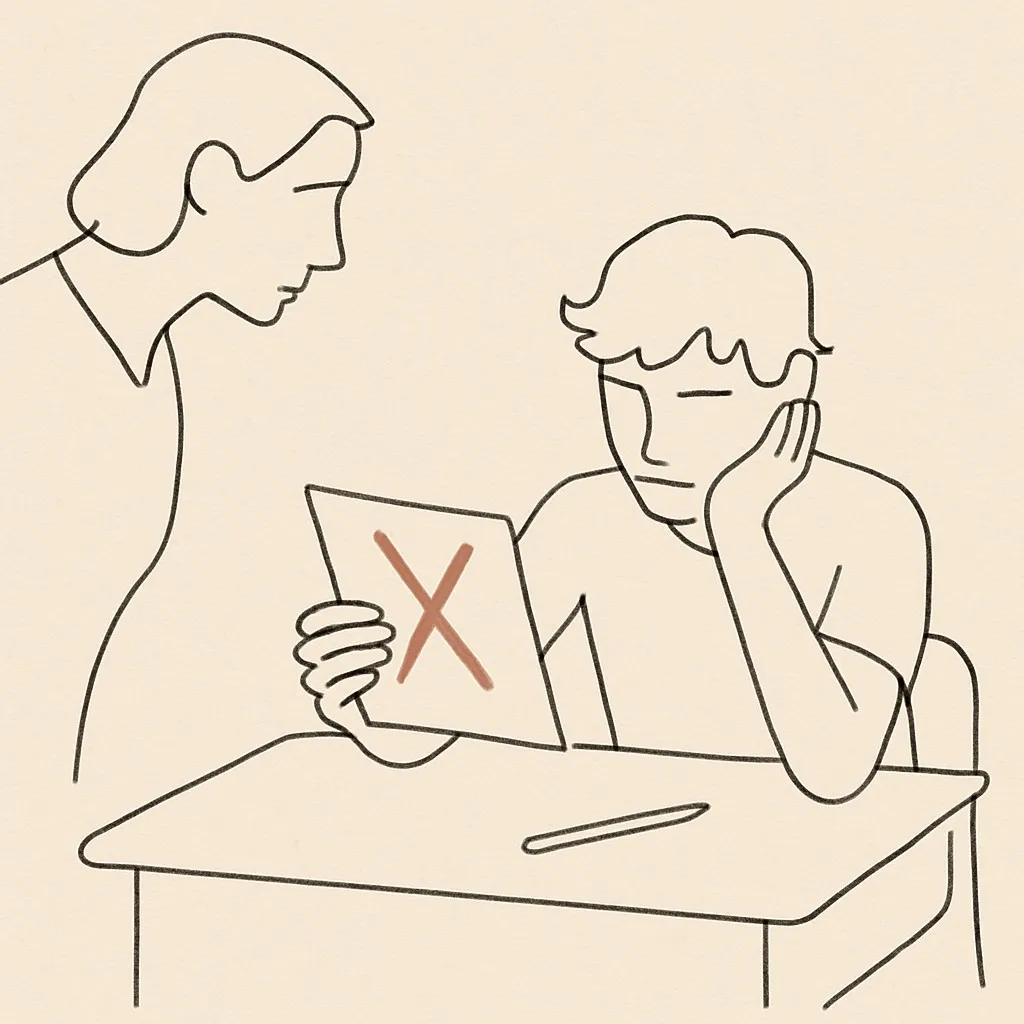
What's happening.
Your 15-year-old, pale: “Mrs. M says I cheated on the essay. I didn't. She wants a meeting.” You feel the parental adrenaline.
What we usually say — and why it backfires.
Tell me you didn't actually cheat.
I DIDN'T. I swear.
Because if you're lying to me I'll find out and it'll be ten times worse.
Are you on my side or hers??
- Leading with “tell me you didn't” puts them on trial in their own kitchen — they have to defend before they're allowed to explain.
- Threatening downstream consequences for lying makes lying MORE likely, not less. The teen has now logged: telling you the truth comes with extra punishment.
- “Are you on my side or hers” is the question you've now forced them to ask. The answer should never be in doubt.
What works — and why.
Okay. First — I'm on your side. Whatever happened, we deal with it together. Tell me what's going on, the whole picture.
I wrote it myself. I used ChatGPT to brainstorm a few ideas but I wrote every sentence. The detector flagged it as 67% AI and she's saying that's proof.
Okay. Detectors flag false positives all the time, that's documented. Show me your draft history — Google Docs has a revision log. If we can show progressive writing, that's strong evidence.
Yeah, the doc is on my drive.
Good. I'll go into the meeting with you. I'll be calm and ask for the specific evidence she's using. If she's right we accept the consequence; if she's wrong we push back hard. Sound okay?
- “I'm on your side” first is the sentence that earns you the actual truth in sentence two. Reverse the order and you get a defense.
- Asking for the whole picture before judging surfaces the specific evidence — revision history, AI detector reading — that actually decides the case.
- “If she's right we accept; if she's wrong we push back hard” gives the teen both safety (you'll defend them when they're right) and accountability (you'll let them face consequences when they're wrong). Both matter.
Key phrases to reach for in the moment.
- First — I'm on your side.
- Tell me the whole picture.
- (Then ask for evidence — revision history, the detector reading, the actual sentences flagged.)
- If she's right we accept the consequence; if she's wrong we push back hard.
Call or text 988 (Suicide & Crisis Lifeline, 24/7) · Text HOME to 741741 (Crisis Text Line) · Find a child psychiatrist at aacap.org · For immediate danger, call 911.