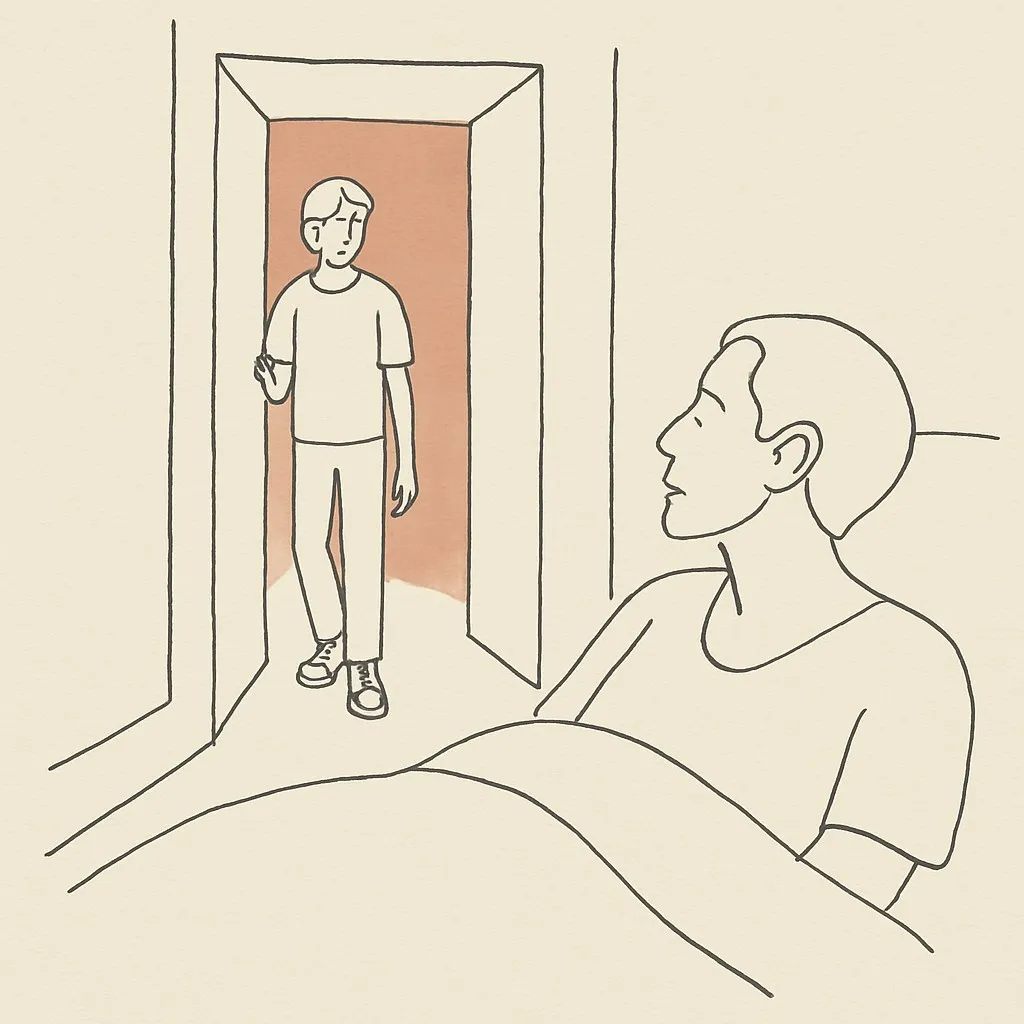
What's happening.
It's 11:47pm. Your bedroom door opens. Your 12-year-old, in pajamas: “I can't sleep.” You squint at the clock.
What we usually say — and why it backfires.
It's almost midnight. Get back to bed. Count sheep.
I've been trying for an hour.
Try harder. School tomorrow.
(goes back to bed, doesn't sleep until 2am, doesn't tell you next time)
- “Count sheep” is dismissive of the actual physiological state — they can't sleep, you've now added shame to the insomnia.
- Sending them back without asking why means the real cause (anxiety, caffeine, screen too late, something at school) goes unidentified for nights or weeks.
- Teens stop coming to your door when their nighttime trips are met with sleep-shaming. The information you most need shows up at 11pm or not at all.
What works — and why.
Okay. Come sit on the bed for a sec. What's keeping you up — is it your body or is it your brain?
My brain. I keep thinking about the science test tomorrow.
Got it. Two things. One: you're going to be fine; the test will go how it goes and you're as ready as you can be. Two: let's get you off the bed-thinking loop. Want a glass of milk, or do you want to lie on the floor of your room with the lights off — sometimes the change of position resets it.
Milk.
- “Body or brain?” is the diagnostic question that surfaces 90% of teen insomnia in one sentence.
- “You're as ready as you can be” gives the brain a softer story than “you must perform tomorrow.”
- Offering two physical resets (milk, floor) treats insomnia as a body-state problem with body-state interventions, which it usually is.
Why this script works on a teen brain.
Teen insomnia is dramatically under-recognized and over-shamed. The CDC reports that ~73% of high schoolers don't get the recommended 8-10 hours of sleep — and the largest controllable contributors are blue light exposure, late caffeine, anxiety, and parental sleep-shaming, in roughly that order. The parent who sends a teen back to bed with "count sheep" is solving the immediate question (the teen in the doorway) while reinforcing the underlying problem (insomnia treated as a behavior to suppress rather than a state to investigate).
The "body or brain" question is the most useful single tool a parent has for adolescent sleep. "Body" answers (too hot, caffeine, stomach hurts) suggest physical interventions. "Brain" answers (test tomorrow, fight with friend, looping thoughts) suggest co-regulation and reframing. Asking it once normalizes the diagnostic vocabulary for the teen — they'll start asking themselves the same question, which is a metacognitive skill that pays for itself for life.
The physical reset move (milk, floor, change of position) works because it interrupts the conditioned association between bed and not-sleeping. Sleep research is consistent: getting OUT of bed and back in 15-20 minutes later often resets the cycle. Teens almost never figure this out alone; the parent who teaches it gives them a tool they'll use through college and adulthood.
Same dynamic, different surface.
Your 16-year-old has been sleeping until 2pm on weekends and reports she "can't sleep" weeknights until 3am. School performance is sliding. You suspect circadian rhythm collapse but you don't have the words.
What usually happens.
You need to go to bed earlier. This isn't sustainable.
I can't fall asleep before 3. My body just won't.
Yes it will. Phone off at 9, lights out at 10. Done.
I'll lie there for five hours, great.
- "You need to go to bed earlier" treats the wake-up time as the problem when the underlying problem is the delayed sleep phase. The teen is correct that mandating bedtime alone won't work.
- Forcing phone-off + lights-out without addressing the circadian shift creates a five-hour lying-awake experience that intensifies the insomnia association.
- The teen's sarcastic prediction is accurate. You'll back off in a week, and they'll know rules are negotiable when they're tired enough.
What works better.
Yeah, that's a real thing — it's called delayed sleep phase, super common in teens. Your circadian clock has actually shifted later, it's not just willpower. Want to try a reset together over a few weeks?
...what's the reset?
Bright light in your face within 10 minutes of waking, no caffeine after noon, screens fade to grayscale at 9, and we shift bedtime earlier by 15 minutes every three days. Slow but it works. Want to start Monday?
Yeah, okay. That's not what I thought you'd say.
- Naming "delayed sleep phase" gives the teen a real explanation that respects the biology — they're not lazy, they're shifted. That alone changes the conversation.
- Offering a multi-week reset rather than an overnight rule treats the problem as the long-term medical thing it is, not a discipline issue.
- Asking "want to start Monday" hands them agency over the start date, which dramatically increases compliance. Imposed sleep schedules fail; chosen ones often work.
Key phrases to reach for in the moment.
- Come sit on the bed for a sec.
- What's keeping you up — is it your body or is it your brain?
- You're as ready as you can be.
- Want [warm drink], or [change of position] — sometimes a reset works.
When to use each one.
-
Come sit on the bed for a sec.
Use the moment they appear in your doorway. Welcome the visit; investigate the cause.
-
What's keeping you up — is it your body or is it your brain?
Use as the universal first question for any sleep complaint. Sorts the intervention.
-
That's a real thing — it's called [delayed sleep phase / rumination / etc.].
Use when you have language for it. Names give teens permission to be patient with themselves.
-
Want to start [the fix] [specific day]?
Use to hand them the start date. Compliance goes up when the start time is chosen, not imposed.